Mr. Nice Guy: Henry Rollins, Band
Still Superior
Interview by Will K. Shilling
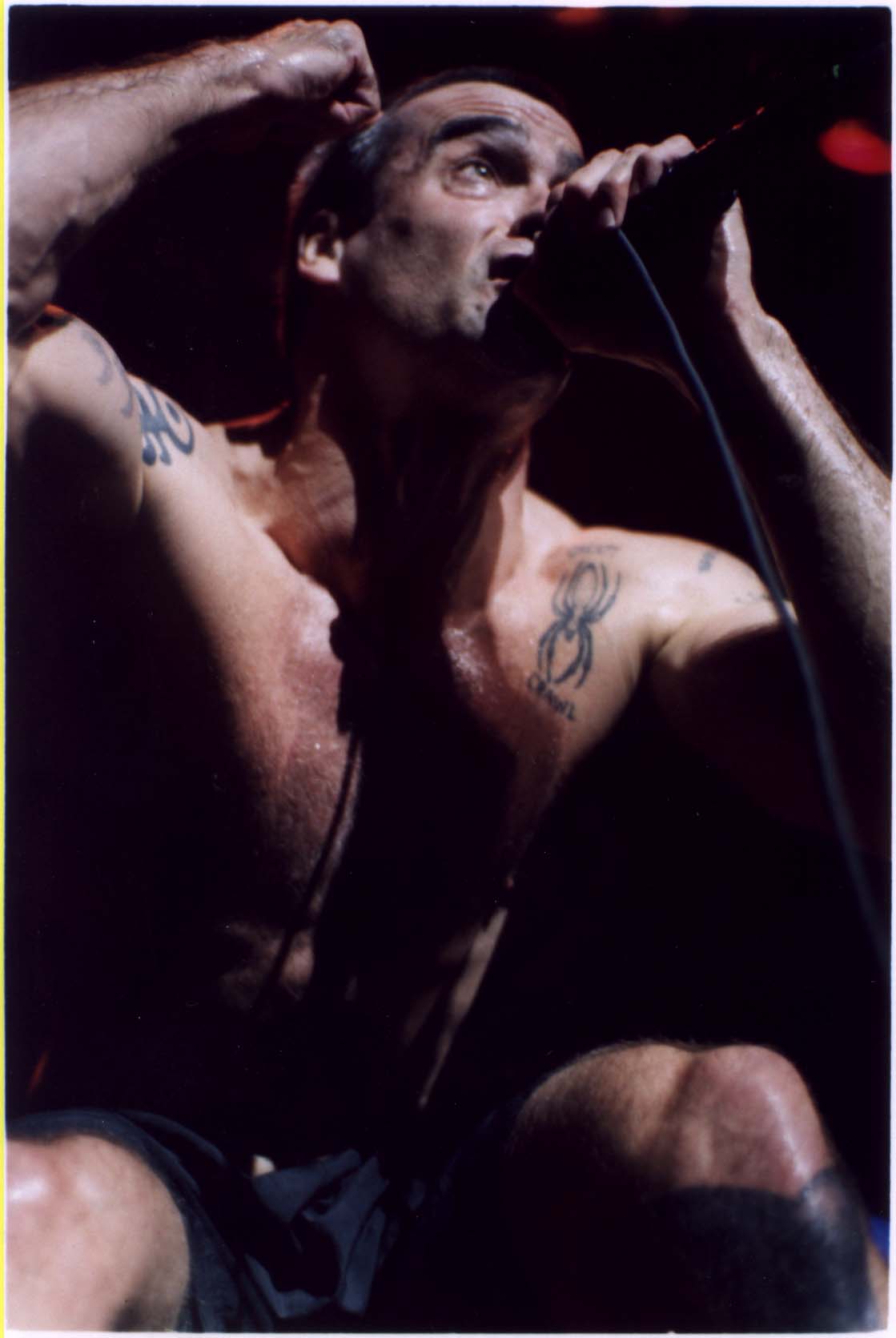 "Stop
me. You know, say anything you want, but let's see you stop me."
"Stop
me. You know, say anything you want, but let's see you stop me."
No one is taking Henry Rollins up on this challenge
just yet. The 40-year-old, self-described "Low Budget Renaissance Man,
Jackass of All Tirades" is still plugging away after 21 years, three backing
bands, about a dozen solo and spoken-word albums, several movie roles,
and hundreds of live performances.
Since the 1986 breakup of seminal punk legends,
Black Flag, Henry Rollins' solo career has probably enjoyed more permutations
-- and underground cred -- than any other artist in the post-punk universe.
His latest offering, Nice, is his second effort with Mother Superior,
the heavy-rocking L.A. trio who took over backing band duties when Rollins
dissolved the original Rollins Band before 1999's Get Some Go Again.
Loaded with his trademark introspection and brutal soundscapes, Nice
is anything but.
Will K. Shilling: Let's talk about the new album. How does
this batch of songs differ from Get Some Go Again?
Henry Rollins: We utilized more of what we've got on this record.
The guys in the band are singing on the choruses. We're stretching musically.
I think the record is more of a band effort, where Get Some Go Again,
an album I like a lot, was basically three plus one -- it was the Mother
Superior guys plus me. And that was a record where I was trying to figure
out what that meant -- as far as, what's the equation mean. This time around,
it's what you basically get after 164 shows, many hours spent in just sheer
hang out, you know, just being friends -- it has a lot to do with how you
play together. And the record definitely shows that.
So you've bonded with this group of guys?
Well, yeah. As you would with anybody you spend such an amount of time
with. That's the thing when you do music: a lot of bands are friends and
also at each other's throats at times. Like if you read that interview
with Metallica in Playboy -- um, I only buy it for the press --
I actually did read that interview, 'cause I heard so many people talk
about it. Now that's a total love-hate relationship. We have nothing that
emotionally intense with our band -- except that we're also four guys who
are buddies and who love to play music together. But there is an inter-band
[sic] language you develop when you spend a lot of nights on the road.
You earn it. It's a thing that you earn. And we've definitely earned ours.
You talk about that a lot in your writing, the time spent on the
road with the band…
Well, it's how I've spent 21 years of my life.
And if people ever slag you off, you talk about how you'd like to
see them do it for just one day…
Stop me. You know, say anything you want, but let's see you stop me.
You once wrote that you wanted your book Black Coffee Blues
to do for readers what Henry Miller's books had done for you. What do you
want your albums to do for listeners?
Perhaps it's a record that people will enjoy. And, I don't know, it's
another arrow in the quiver. It's just more ammunition against the "eh"
of life.
What's "Gone Inside The Zero" mean?
It's when you go into a sort of extinction from people and the world
at large. I don't know how easy it is to pick out the words from the tune.
I say, 'one species, me/ no expectations/ unknown, unknown but to me.'
Numbers inform your lyrics and writing a lot. Ok, well, one and zero
-- that's about it, right?
Well, those are the two that I vacillate between. To me, two is cluttered.
It's got one too many. As in, all good things are from the One. To be yourself,
to be one with yourself is good. When the band plays well, everyone goes,
'wow, they sound so good together. ' When a band plays well, to
me, it's a One experience. And that's why you must diminish your self and
your ego when you go into the band thing, so you're are a part of. You
are a fraction. You are part of one. You listen to a good Duke Ellington
record or a great rock band, that's a One thing happening. There's a lot
stuff going on inside it, but the overall is this big, beautiful One. And
so that's what I'm going for with that. And so those two numbers, zero
and one, are the two that I'm constantly entertaining in my mind.
It's obviously personal when you write, but do you ever try to craft
your personal expression, your lyrics, into a more universal thing?
Well, sure. I make every song so it communicates. I thought that was
the job of the lyric: to take something maybe very personal or somewhat
obscure and put it in a way that doesn't lessen the intensity or the clarity
or power of that idea, that also gives it to someone else so they get ownership
of the song, too. Lyrics that are so thoroughly inside, to me, are kinda
selfish in a way. I've always been more interested in folk music, where
it's music for folks. Where Bob Dylan or Nick Cave or a great lyricist
can take a very either fragile or very internal thing and turn it into
something that 3,000 people sitting in a room can all get -- and not have
it be lowest common denominator or dumbed down, but so beautifully and
wittily rendered that it becomes inescapable. Like the song 'The
Tracks Of My Tears.' Not a complex sentiment at all. But what a lyric!
I mean, who can't get to that? Um, any song on Al Green's Let's Stay
Together -- except 'Gimme That Old Time Religion,' you know, I'm not
a religious guy -- pretty much anything else he's saying on that, um, it's
not a complex message that he's putting across. But the lyrics or the way
he's rendering the lyric, even with the tone of his voice, makes it so
welcoming, where you feel you know the person, you are somehow his friend
and he somehow knows you. And that's what I go for with a lyric. And it's
not always easy, but to me that is the job. Absolutely.
You've said before that you're not a very spiritual guy, that you're
not very religious, either. Do you still feel that way? I mean, you were
just talking about "the One" and "ego diminishing."
Well, the 'ego diminishing' is just so you don't get in the way of
that which you and your band mates are trying to create. When you put your
ego in the way of someone else's idea or someone else's contribution to
the music, you're basically throwing mud into the pure cup of water. And
the music will show it, 'cause music is pure. The only thing that ruins
music is musicians. Yeah, the only thing that gets in the way of music
is musicians and their ego trips. So I've always been interested in the
John Coltrane approach, to realize that the music is the master, and that
you're just a peon who has this servile job of serving it up, that you
must be the pure vessel through which it travels. And that's how Coltrane
approached his music and that why, I think, one of the reasons it sounds
so beautiful. That and he's wildly talented, which doesn't hurt. Um, I
could play the saxophone with the best of intentions, but I swear you wouldn't
want to listen to it for more than twelve seconds -- I know not of
what I'm doing. But I guess, in a way, that could be kind of spiritual.
But, to me, it's really seeing and focusing in on what the job is. You
know, what do you want to do with music? And that was why Black Flag always
worked, I think, successfully. We could do it even when none of the band
members ever really liked each other. And that was really strange, to be
in a band where no one really like each other. That was the facts. I have
no real like of any of those people except for a couple. Otherwise, I don't
hate them. I just don't, uh, whatever -- ech. Do I respect
them? Definitely. Did we make good music? Absolutely. Because the music
was first, all our personal bullshit… well, it finally became personal.
But, before it did, it was really an amazing group.
It must be weird to look back on that. It reminds me of looking back
on my parents. Like, how the hell did they get along long enough to have
me?
Oh, I always wondered the same thing with mine. You know, one a total
Republican, the other a total Democrat. My mom: total civil rights woman.
My dad: 'Why is your mom such a nigger lover?' Yo, dad, I'm eight. I don't
really know what the fuck you're talking about, but I'll get back to you,
dad, when I'm sixteen so I can say that I truly hate your guts. Ok, so
how they ever got in the sack and had me, or how they ever exchanged vows
still blows me away.
Yeah, how'd that work?
Maybe it was love. You know, maybe love is so powerful that, you know:
Here's my bigot husband. [laughs] Tell us, how do you work that?
And your mom was a big civil rights supporter?
Well, I remember, I was the one who told her the news that Martin Luther
King [Jr.] was assassinated. I was watching early morning cartoons, and
I went in and starting jumping up and down on her bed and said, 'Mom, a
man named Martin Luther King was assassinated.' I was just proud of myself
that I could say the word 'assassinated.' I didn't even know what it meant.
And she got up and freaked out. And I thought I'd said something wrong.
She's like crying and screaming, and I'm like, 'oops.'
You were living in L.A.'s South Bay when you made music with Black
Flag. Coming from Torrance, I understood when you wrote in Get In The
Van about kids growing up there and looking at that beautiful sunset
through smokestacks by the ocean and realizing just how fucked up things
are. Did living there, creating music in that environment, inform the work
you did with Black Flag?
It was always very interesting to me to consider all the beach bands,
all the South Bay area bands -- all the SST, New Alliance bands, the Redd
Kross people. Because, you know, these are guys who had surfboards, some
of them, and could go down to the beach and say 'hey dude' -- and then
turn around and make either very angry or very arty, will-never-sell kinds
of music, like Saccharine Trust -- utterly brilliant, but you're gonna
starve to death making music like that. You know, it's some the best music
I've ever heard, but still, no one's gonna buy it. And so, moving out here
from Washington D.C., I was like, well, this is kinda nice: Chicks with
bikinis and all this aggro. I think environments like that tend to breed
explosive answers to what would be a cultural vacuum. See, a lot of times
you see inner city music coming out very pop, very escapist. Whereas, in
the Midwest, you find Slipknot, out of Indiana. And they're not a subtle
group of young men. And the music isn't ragtime. So, you know, I've been
to Indiana, and there's nothing happening on the outside that would lead
you to such aggression. But, maybe if you hang out in Indiana for fifteen
years, that's enough. To where, me hanging out in L.A. doesn't necessarily
make me want to write 'I'm bored and furious.' It might make me more edgy,
want to write a song like, 'Please don't shoot me, motherfucker.'
Is "Renaissance Man" a term you are comfortable with?
Low Budget Renaissance Man is the one I've assigned myself. Low Budget
Renaissance Man, Jack Ass of All Tirades.
Those are good qualifiers.
Yeah.
You've also become something of a Punk Rock archivist, collecting
live and rare recordings. Why are those important to you?
'Cause it's an alternate history. It's the Britney Spears-free history
of music. At my office, which I'm sitting in right now, I have hundreds
of hours of very rare, one-of-a-kind recordings. Everything from early
Ian MacKaye musical attempts to early Bad Brains or Nick Cave musical pursuits.
Stuff that's never gonna get written up, you know, somebody's gotta preserve
it. Just stuff that I think is really important. Even when the band members,
the perpetrators of this stuff aren't all that interested, I am. And years
later, they come back and, 'hey, can I get a copy of that CD-R you made
of our stuff?' Well, yeah, of course, it's your music. At the time, when
I said I need all of your cassettes, they're like, 'what do you want this
stuff for?' Well, your basement demos are very important to my world of
music. Because these guys were, and are, amazing. And it needs to be backed
up, stored and documented somewhere that, you know, April 15, the Minor
Threat band practice was recorded, these songs were recorded. Because at
a certain point, it is the Dead Sea Scrolls. And if no one looks out for
this history, then no one looks out for it, but someone should. And if
I had more time, if I had thirty hours a day, I would take the extra six
and work on the library of stuff I have all the more.
You wrote that books and music saved you as a kid. How so?
The Beatles and early records I bought when I was kid let me know I
wasn't alone. They were voices who raised me. I mean, the Beatles will
always be my distant uncles who raised me. I will always feel I somehow
know Paul McCartney -- in that kind of way that one always thinks they
know someone whose records they adore. And I have a lot of people like
that in my little world, who I like very much, who I'll never meet, who
I don't know, but what they've done artistically means a lot to me.
You know, it's really weird: I was reading your interview with John
Lee Hooker the day he died.
I got a lot of mail after he died. And it was all, 'oh, our lives are
all diminished, and it's so sad.' I really don’t feel sad about it at all
-- in that, I mean, I'm a huge fan, but -- eh, at least seventy eight years
on the planet, well loved. And you know, he knew he was the man. And everyone
else did too. Um, I was not sad about it. It definitely made me pause.
But I was like, shit man, six of my friends have died this year and none
of them got to get that old. So I'm happy for anybody who gets such a long
life.
Is integrity still a valid concept to you?
Sure. It's a premium value that anyone should try and maintain and
keep pristine.
Are you still a Road Hog? Is that an accurate description?
Well, I love being on the road. It's where my life is. When I'm off
the road I'm just waiting to get back on it.
How long can you keep it up?
I don't know. I don't really think about how long. I just think about
the next tour.
Home
©2001 Will K. Shilling