You're
With The Band
Michael Azerrad, author of Our Band
Could Be Your Life, waxes nostalgic about the eighties indie underground
by Will
K. Shilling
 Michael
Azerrad may not have begun his writing career until the time of D. Boon’s
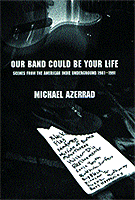
death in 1985, but in his new tome, Our Band Could Be Your Life: Scenes
from the American indie underground 1981-1991, the official Nirvana
biographer has more than made up for any belated coverage of the bands
that made Nevermind possible. Azerrad profiles thirteen bands in
his new book, all of which share much of the responsibility for blazing
a trail to the indie rock explosion of the early nineties. From his apartment
in Greenwich Village, he elaborates on the stories that made up that influential
era, and praises one band in particular, The Minutemen, whom he says are
“perhaps the most important chapter in the book.”
Michael
Azerrad may not have begun his writing career until the time of D. Boon’s
death in 1985, but in his new tome, Our Band Could Be Your Life: Scenes
from the American indie underground 1981-1991, the official Nirvana
biographer has more than made up for any belated coverage of the bands
that made Nevermind possible. Azerrad profiles thirteen bands in
his new book, all of which share much of the responsibility for blazing
a trail to the indie rock explosion of the early nineties. From his apartment
in Greenwich Village, he elaborates on the stories that made up that influential
era, and praises one band in particular, The Minutemen, whom he says are
“perhaps the most important chapter in the book.”
WILL K. SHILLING: What inspired you
to write about the bands in Our Band Could Be Your Life?
MICHAEL AZERRAD: What inspired me to write
about them was actually a ten part documentary on the history of rock that
I saw on TV awhile back…
Was this the public television documentary
series?
No, it was produced, I think, by Time/Life.
It's actually in the bibliography of the book.
The one they eventually showed on VH1?
Right. It took about nine sections to
get up to punk rock. It got up as far as Talking Heads, and then it jumps
to Bruce Springsteen talking about the perils of fame -- which is a natural
lead-in to Nirvana. And so it had skipped over the Eighties. I was sitting
there thinking perhaps I had blacked out for ten minutes. I just thought
that's ridiculous, that's outrageous. What about Husker Du, what about
The Replacements, what about Sonic Youth? What about all these great bands
who were so influential on music, that we're still hearing today? I thought
this is an outrage, someone ought to do something about it. And then the
three magic words of punk rock popped into my head: do it yourself. So
I started writing up a book proposal.
I remember that documentary, too. It
jumps from early punk to The Boss talking about fame, and then Pete Townsend
talking about his friends being casualties of fame or the lifestyle or
whatever, while they showed visuals of Kurt and moshpits in the Nineties.
It completely skips an era.
Not a peep. Although Sonic Youth get talked
about later, but not in the eighties incarnation. They get a light dusting,
you know. That's about it. This music that meant so much to so many key
musicians now, if only for that reason… This music has been almost photoshopped
out of rock history. It's like the book 1984 or something. Someone's
gotta say no, wait a minute, this really happened.
So why are these bands important?
Besides the fact that they are such a
huge influence on the biggest bands of the nineties and beyond, they really
demonstrated some things that we shouldn't ever forget. One is that sometimes
the best art is not the stuff that's being crammed down your throat by
the corporate mainstream media. Another big idea is that is doesn't matter
where you are, or who you are, you can make great art. You don't have to
be a creation of one of the big media outlets on the coasts to make something
meaningful. It can come from anywhere. I think people tend to discount
things that come from what is sometimes known as "fly-over country."
In the introduction of the book, you
say that Bob Dylan and The Beatles were precursors to DIY. How so?
Bob Dylan and The Beatles did something
that was fairly heretical early on, which was they wrote the songs that
they sang. Before that, Elvis Presley and people like that didn't write
their own songs. So that was a real power grab on the part of the artists.
They weren't beholden to the record companies who told them what songs
to sing. That kind of autonomy was pretty radical and revolutionary at
the time. Very quickly it became the prerequisite to credibility -- for
an artist to write his or her own songs.
Now, that existed to some extent in
what they used to call "race music" or black music in the early part of
the century, right? Didn't those musicians get to record their music pretty
much undiluted and without interference?
That’s also true. And folk singers from
the Forties and Fifties like Woody Guthrie, also, wrote and sang their
own songs. But those weren't as mass-appeal artists as Elvis Presley or
the Beatles. So, yeah, of course, people have been writing and singing
their own songs for centuries; but, in terms of the mainstream, pop star
system, people like Dylan and The Beatles were pretty revolutionary. And
later on, Stevie Wonder got a lot of grief from the record company for
demanding to produce himself. All that is about the artist retaining his
vision and personal autonomy. This music is not some light, piffly thing
that they happen to do. With really good artists, this music comes from
their soul, it's an expression of who they are. So, to take back control
of their own music is a very meaningful gesture.
But you also note in the epilogue how
Bob Dylan's heretical plugging in at Newport in the Sixties is analogous
to the breaking of Nirvana's Nevermind in the Nineties.
Those two moments were definitely times
when things took off in very different directions, as far as eras go.
Our Band concentrates on the
stories, rather than the music, of these bands. Why?
A very large part of that comes from bumping
into Legs McNeil at a record fair. Legs McNeil wrote a great book called
Please
Kill Me…
An oral history of punk rock, right?
Exactly. I bumped into him and he asked
me what I was working on and I told him I was working on this Eighties
indie rock book. And he just looked at me, aghast, and said, 'You're not
gonna write about the music, are you?' And, at first, I thought he meant
that the music was terrible. So, I asked him what he meant and he said,
'Just write about the people and the music will come out of it.' So I took
that to heart. Partially because it's such a quixotic pursuit to try and
describe music; and two, because I figured, you know, just get the records
[laughs] if you wanna know what the music is like. In the introduction,
I say if you really wanna read about the music, pick up The Trouser
Press Guide.
Which I already had, by the way.
[laughs] Oh, good. See?
But it did seem like such a validation
to have you mention it. You know, the entire book felt like a validation
of not just musical taste, but interest in that era, those ideas.
I think that was really the point
of the book: that just because something didn't sell millions of records,
that doesn't mean it's not valid. That's a big point: that validity is
not measured in units.
Demystifying the process of music was
a big theme in the book, right?
Yeah, demystifying and decentralizing
the process of music and art are two pretty important ideas -- that egalitarian
impulse of punk was really put into action by these bands. That's a very,
very empowering thing. If you take it to heart, you can apply it to many
aspects of your existence -- and that's why I called the book "Our Band
Could Be Your Life." There's no more perfect illustration of that idea
than The Minutemen.
What made a band like the Minutemen
so emblematic of that era?
One big thing that made them really emblematic
of the whole ethos of that movement was their incredible dedication and
incredibly articulate expression of this idea of pragmatism and frugality.
As Watt says, you don't have to play the princeling, the pampered rock
star, to make good music. That whole idea just flew in the face of that
Eighties, material excess mindset that really ruled the entire decade.
It was a radical thing to 'jam econo' in the age of Lifestyles Of The
Rich And Famous. They were very iconoclastic that way, and very inspiring
to people who were incredibly disgusted with that whole era.
How enthusiastic was Mike Watt in talking
about it? Was he excited or did he see it as just so much nostalgia?
Watt was very proud to tell his story.
He is very proud of what he's done. And he is extremely proud of D. Boon.
There's not a trace of nostalgia. He's completely at ease with the fact
that, you know, he did something great. And he's still doing great things
now. So I think maybe that's where his comfort in discussing it comes from…
Um, I really want to say that they made a connection -- and it sounds a
little far-fetched, but the Minutemen and their pragmatism and frugality
really hail way back into American culture to Thoreau. It's a very old
idea. Make do with what you got, and your true essence will shine through.
I really do believe that. And Mike Watt still does that. It's wasn't some
sort of pose, that's the way he really is. He's a very inspiring character,
and I think the Minutemen chapter is perhaps the most important in the
book. I'm so pleased that he cooperated with it, 'cause it really did make
all the difference.
Do you see any corollaries to these
bands and this philosophy today?
I'm sure there are about two hundred bands
riding around in vans right now who have picked up on some aspect of The
Minutemen's philosophy, whether directly or indirectly. Watt's famous dictum,
"If You're Not Playin, You're Payin" -- I'm sure is something that a lot
of bands follow. Play every night, otherwise you're losing money. Learn
how to fix your own van. Advance your own gigs. Don't bring a roadie if
you don't absolutely need it. All that stuff -- serious nuts and bolts
stuff -- maybe the Minutemen didn't quite pioneer it, but they really articulated
why it’s a good idea.
I see the same thing here in San Diego
every week, when a band comes through one of our best indie clubs, The
Casbah -- so much so, that when a band like Mudhoney comes through and
they have two vans, it's a big deal.
Well, to be fair to Mudhoney, those guys
have definitely paid their dues. And if they wanna get two vans, by god,
let's let 'em get two vans.
Besides, it didn't actually look like
much of a luxury. I mean two vans are still vans, not busses.
Exactly, they're not riding around in
a bus, so let's put it in perspective.
How has indie and underground rock changed
since the Eighties?
Immediately after the Nirvana explosion
it really changed because people who never thought they'd get a major label
deal, or become rich and famous, suddenly had that possibility open to
them. That really changed the whole scene, top to bottom, left to right.
Later on, when things didn't really pan out as much as people thought in
the post-Nevermind euphoria, things kinda got back to normal. But
what's left is this infrastructure that all these eighties bands and early-nineties
bands created, which is even more radio stations, even more stores, more
places to play, and most importantly, even more labels and bands than there
were in the eighties. There's just tons and tons of indie music and there
are venues for it everywhere. It's arguably a lot easier for indie bands
now that it was then. Even though you have a lot more competition, there's
still more avenues for a band to reach an audience.
Have you noticed what I like to call
the "You Stole My Band!" phenomenon among the fans in the post-Nirvana
scene -- this idea that it's not cool to like a band after they've become
popular? Wasn't that common even back in the eighties underground?
Well, that goes back even to Dylan. I
think obscurity is often tied to authenticity. And authenticity is the
coin of the realm in the indie world. Basically, you are supposed to be
doing this as an unfettered, uncompromised mode of expression, and
corporate-ness is inextricably tied up with selling out, with compromising.
Some people assume that if you do go to a major label that you've compromised
your art. But, that's ironic that people from that scene think that, because
the whole idea is to remain open-minded and not think in this kind of knee-jerk
way. So that's kind of a tragedy. But then, there are other people
who have a philosophical objection to filling the coffers of multinational
corporations.
Like the guys in Fugazi, who -- no matter
what -- wouldn't go to a major.
Exactly. But if you're going to talk strictly
about the music, the music doesn't necessarily get compromised just because
you go to a major label. You might compromise your political beliefs, but
it's not necessarily true that the music automatically gets compromised.
You mentioned earlier the ideas of frugality
and pragmatism. Do you think that, once again, those are incredibly out
of fashion ideals in today's music industry?
Well, there is this blockbuster mentality
in the major label world. These record companies are owned by progressively
larger and larger multinational corporations and they just want to maximize
profits. They're less and less interested in actually making interesting
music. But, I wouldn't discount the aftermath of recent events. People
are really rolling back, big time. You hear a lot about people who are
just trying not to be so ostentatious anymore, they just think it's tacky
now. And since music tends to be at the cutting edge of social trends,
I wouldn't surprised if you see some bands scaling back on their over-the-top-ness.
The book takes place during Reagan's
eighties, his conservative "Morning In America" decade. Do you think that
politically conservative times lead to creative explosions in the underground?
Is there a connection there?
That's a very popular notion, but it should
be pointed that punk exploded during the Carter administration. So, I'm
not so sure of whether that's true. It may come down to economics, where
it's actually cheap for artists to live and make their art. For instance,
when punk started in New York City, it started because many artists could
live cheaply and work on their art. Same thing with jazz and bebop in the
forties. An artist like Charlie Parker could work some dumb job and pay
his thirty or forty dollar rent, then the rest of the day play scales for
twelve hours. So whenever that kind of thing happens -- that's when, I
think, art really blossoms, it doesn't necessarily matter who's in the
White House.
When the mainstream is ignoring a certain
portion of the populace -- like say, when mainstream disco was ignoring
the kids starting a hip hop underground -- do you think maybe there's a
connection there?
Yes. When the glare of the media spotlight
is off a certain region or genre, um…
Then it's free.
Then it's more free to work in peace and
it can really flourish. It can get build up a following and get quite good
without A&R scouts checking out all the shows. That's when good things
happen.
----------------------------------------------------------------------------
Home
©2001 Will K. Shilling