Questions About
America's Anti-terrorism Crusade
by Martin A. Lee
Mainstream journalists in the United States
often function more like a fourth branch of
government than a feisty fourth estate. If
anything, the patterns of media bias that
characterize sycophantic reporting in
"peacetime" are amplified during a war
or a national security crisis.
Since the tragic events of September 11, the
separation between press and state has dwindled
nearly to the vanishing point. If we had an
aggressive, independent press corps, our national
conversation about the terrorist attacks that
demolished the World Trade Center towers in New
York and damaged the Pentagon would be far more
probing and informative. Here are some examples
of questions that reporters ought to be asking
President Bush:
1. Before the attacks in New York and
Washington, your administration quietly tolerated
Saudi Arabian and Pakistani military and
financial aid for the Taliban regime, even though
it harbored terrorist mastermind Osama bin Laden.
But now you say fighting terrorism will be the
main focus of your administration.
By making counter-terrorism the top priority
in bilateral relations, aren't you signaling to
abusive governments in Sudan, Indonesia, Turkey,
and elsewhere that they need not worry much about
their human rights performance as long as they
join America's anti-terrorist crusade? Will you
barter human rights violations like corporations'
trade pollution credits? Will you condone, for
example, the brutalization of Chechnya in
exchange for Russian participation in the
"war against terrorism?" Or will you
send a message loud and clear to America's allies
that they must not use the fight against
terrorism as a cover for waging repressive
campaigns that smother democratic aspirations in
their own countries?
2. Terrorists finance their operations by
laundering money through offshore banks and other
hot money outlets. Yet your administration has
undermined international efforts to crack down on
tax havens. Last May, you withdrew support for a
comprehensive initiative launched by the
Organization for Economic Cooperation and
Development (OECD), which sought greater
transparency in tax and banking practices.
In the wake of the September 11 massacre, will
you reassess this decision and support the OECD
proposal, even if it means displeasing wealthy
Americans and campaign contributors who avoid
paying taxes by hiding money in offshore
accounts?
3. Four months ago, U.S. officials announced
that Washington was giving $43 million to the
Taliban for its role in reducing the cultivation
of opium poppies, despite the Taliban's heinous
human rights record and its sheltering of Islamic
terrorists of many nationalities. Doesn't this
make the U.S. government guilty of supporting a
country that harbors terrorists? Do you think
your obsession with the "war on drugs"
has distorted U.S. foreign policy in Southwest
Asia and other regions?
4. According to U.S., German, and Russian
intelligence sources, Osama bin Laden's
operatives have been trying to acquire enriched
uranium and other weapons-grade radioactive
materials for a nuclear bomb. There are reports
that in 1993 bin Laden's well-financed
organization tried to buy enriched uranium from
poorly maintained Russian facilities that lacked
sufficient controls. Why has your administration
proposed cutting funds for a program to help
safeguard nuclear materials in the former Soviet
Union?
5. On September 23rd, you announced plans to
make public a detailed analysis of the evidence
gathered by U.S. intelligence and police
agencies, which proves that Osama bin Laden and
his cohorts are guilty of the terrorist attacks
in New York and on the Pentagon. But the next day
your administration backpedaled. "As we look
through [the evidence]," explained Secretary
of State Colin Powell, "we can find areas
that are unclassified and it will allow us to
share this information with the public... But
most of it is classified."
Please explain this sudden flip-flop. How can
we believe what you say about fighting terrorism
if your administration can't make its case
publicly with sufficient evidence? How do you
expect to win the support of governments and
people who otherwise might suspect Washington's
motives, particularly some Muslim and Arab
nations?
6. Exactly who is a terrorist, and who is not?
When the CIA was busy doling out an estimated
$2 billion to support the Afghan mujahideen in
the 1980s, Osama bin Laden and his colleagues
were hailed as anti-communist freedom fighters.
During the Cold War, U.S. national security
strategists, many of whom are riding top saddle
once again in your administration, didn't view
bin Laden's fanatical religious beliefs as
diametrically opposed to Western civilization.
But now bin Laden and his ilk are unabashed
terrorists.
Definitions of what constitutes terror and
terrorism seem to change with the times. Before
he became vice president, Dick Cheney and the
U.S. State Department denounced Nelson Mandela,
leader of the African National Congress, as a
terrorist. Today Mandela, South Africa's
president emeritus, is considered a great and
dignified statesman. And what about Israeli prime
minister Ariel Sharon, who bears significant
responsibility for the 1982 massacre of 1,800
innocents at the Sabra and Shatila refugee camps
in Lebanon? What role will Sharon play in your
crusade against international terrorism?
7. There's been a lot of talk lately about
unshackling the CIA and lifting the alleged ban
on CIA assassinations. Many U.S. officials
attribute the CIA's inability to thwart the
terrorist attacks in New York and Washington to
rules that supposedly have prohibited the CIA
from utilizing gangsters, death squad leaders,
and other "unsavory" characters as
sources and assets. Why don't you set the record
straight, Mr. President, and acknowledge there
were always gaping loopholes in these rules,
which allowed such activity to continue unabated?
It's precisely this sort of dubious
activity-enlisting unsavory characters to advance
U.S. foreign policy objectives-that set the stage
for tragic events on September 11th. It's hardly
a secret that the CIA trained and financed
Islamic extremists to topple the Soviet-backed
regime in Afghanistan. Some of the same
extremists supported by the CIA, most notably bin
Laden, have since turned their psychotic wrath
against the United States.
Instead of rewarding the CIA with billions of
additional dollars to fight terrorism, shouldn't
you hold accountable those shortsighted and
perilously naive U.S. intelligence officials who
ran the covert operation in Afghanistan that got
us into this mess?
8. John Negroponte, the new U.S. ambassador to
the United Nations, says he intends to build an
international anti-terrorist coalition. During
the mid-1980s, Negroponte was involved in
covering up right-wing death squad activity and
other human rights abuses in Honduras when he
served as ambassador to that country. Doesn't
Negroponte's role in aiding and abetting state
terrorism in Central America undermine the moral
authority of the United States as it embarks upon
a crusade against international terrorism?
9. The attacks on the World Trade Center and
the Pentagon brought home the frightening extent
to which U.S. citizens and installations are
vulnerable to terrorist attacks. If terrorists
hit a nuclear power plant, it could result in an
enormous public health disaster. In the interest
of protecting national security, why haven't you
ordered the immediate phaseout of the 103 nuclear
power plants that are currently operating in the
United States? Why doesn't your administration
emphasize safe, renewable energy alternatives,
such as solar and wind power, which would not
invite terrorism?
10. After years of successful lobbying against
rigorous safety procedures, the heads of the
airline industry will receive a
multibillion-dollar taxpayer bailout for their
ailing companies. Given your support for the
airline rescue package, do you now agree that
letting the free market run its course won't
resolve all our economic and social problems?
(That's what antiglobalization activists have
been saying all along.) And if airlines deserve a
bail-out, how about a multibillion-dollar rescue
package for human needs like health and
education? Why aren't we bailing out our
under-funded public schools, our insolvent
hospitals, our national railroads, and other
elements of our dilapidated social
infrastructure?
11. September 11th will be remembered as a day
of infamy in the United States because of the
terrorist attacks in New York and Washington. In
Chile, September 11th is also remembered as the
day when a U.S.-backed coup toppled the
democratically elected government of Salvador
Allende in 1973, initiating a reign of terror by
General Augusto Pinochet. Given your
administration's avowed stance against terrorism,
will you cooperate with the various international
legal cases that are honing in on ex-secretary of
State Henry Kissinger for colluding with
Pinochet's murderous regime?
12. If the killing of innocent people in New
York and Washington is indefensible, and surely
it is, then why do U.S. officials defend American
air strikes that kill innocent civilians in Iraq,
Sudan, Serbia, and Afghanistan? More than 500,000
Iraqi children under age 5 have died as a result
of the 1990 Gulf War, subsequent economic
sanctions and ongoing U.S. bombing raids against
Iraq. Will your planned actions lead to a similar
fate for the children of Afghanistan?
13. What will you accomplish if you bomb
Afghanistan? Wouldn't this galvanize Islamic
fundamentalist movements that are already
powerful in Algeria, Egypt, Pakistan, Sudan, the
oil-rich Arab monarchies and the Balkans?
Wouldn't a U.S.-led military onslaught against
Afghanistan be the fastest way to create a new
generation of terrorists?
Adept at manipulating real grievances,
terrorist networks breed on poverty, despair and
social injustice. Do you think you can wipe out
or even reduce this scourge, Mr. President,
without seriously and systematically addressing
the root causes of terrorism?
Martin A. Lee is the author of Acid Dreams and
The Beast Reawakens. This essay was first
published in Outlook India.Com Magazine on Oct
29, 2001.
http://www.commondreams.org/views01/0928-11.htm
============================================
IN A
PERFECT WORLD THIS
FOLLOWING BIT OF FICTION
WOULD BE REALITY.
(Oh, if
only President Bush was this real.)
Bush Resignation Hailed by World Leaders
by Greg Palast
September 11, 2003
[Washington] The surprise resignation of
the forty-third President of the United States,
George W. Bush, on the second anniversary of the
terrorist attack on America, was hailed by chiefs
of state throughout the world. Mr. Bush
announced that after, "two years of
bloodshed, economic devastation, and spreading
fear in America and abroad," he saw no
choice but to accept that, "I have held a
title which I did not win, and for which I have
proven unqualified."
The text of the former President's September 11
address to the nation follows:
"My fellow Americans:
I come to you tonight with a heavy heart.
Two years ago today,
thousands of innocent Americans were murdered by
terrorist maniacs.
In the script I've been handed, I'm now supposed
to tell you that
America is safer today, and that the world is
kinder and nicer and
happier, because of I'm such a brilliant general
in the War on Terror.
But who are we kidding? Yesterday, Osama released
his new hit video. The terrorists are having a
picnic ever since I turned over our foreign
policy to Saudi Arabia and Exxon-Mobil.
And here's the point in my speech where my
handlers would have me tell you about how I've
been praying hard, making it sound like I just
got off the phone with the Lord. I don't
know about you, but I find it pretty darn
offensive, downright blasphemous, to drag the
Lord's name into every cheap campaign speech and
chest-pounding war threat. Osama says he
talks to God too. Let's leave Him out of
the politics from now on, OK?
Look, in my speech this past Sunday, I used the
word "democracy" about 11 times when
talking about Iraq. It's democracy
Florida-style, I suppose. Except we're not
fixing the vote this time . we aren't letting
these people vote at all. "Iraqis
aren't prepared for democracy." That's
what Dick Cheney and Saddam Hussein told me.
So we're blowing 100 billion bucks we don't have
to colonize a country we don't want. Rummy
tries to explain it to me each morning -- oil
this and oil that -- but I just don't see it. And
one of our kids dying there every day - where are
their parents, anyway? My dad didn't let
that happen - he got me out of the service.
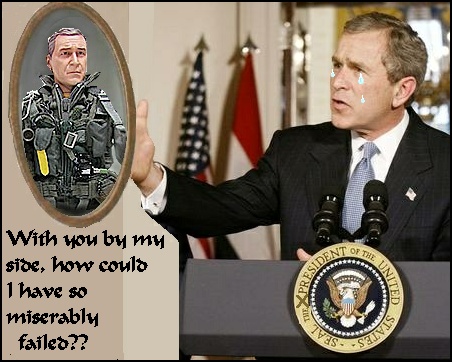
Didn't I look neat in that fly-boy suit?
And, let me tell you, I just looked at our
nation's piggy bank. Uh-oh.
When I arrived, the last guy left me $4 trillion
and said, "Be
careful with all that cash in this
neighborhood." Well, I have to level
with you, America: it's all gone. The
cupboard's bare and this year alone we blew half
a trillion more dollars than we have in our bank
account. Man, I can't believe I went
through all that dough stone sober.
And what did we get for it? A Fatherland
Security Department that's trying to read the
labels on everyone's underpants. Think
about it, all this Total Information Awareness
KGB stuff: two years ago Americans were the
victims - but my government has made Americans
the suspects. I don't know about you, but
this guy Ashcroft scares the bejeezus out of me.
And today I'm told that over nine million
Americans are out of work.
That's not so bad: I haven't done
much work in my lifetime either.
But my mama explained to me that not everyone's
daddy can lend them an oil well to tide them
over.
It's like I can't get anything right. The lights
are going out in Ohio
and the North Pole is melting. I don't get
it. I appointed all those
regulators that Ken Lay told me to, and I got rid
of all the rules that
got in the way of patriotic Polluter-Americans ..
and what's the
upshot? America the Beautiful is looking like
she's had a pretty rough night. Won't be
long before the whole country smells like
Houston.
And now the stock market's floating face down in
the swimming pool -- despite everything I've done
for those guys on Wall Street. Even my plan to
give every millionaire an extra million seems to
have
backfired. Greenspam says I've created
"business risk." Says I spook
investors. But when I asked Greenspam for a
solution, all he did was hand me a bag of
pretzels.
Hey, I can take a hint. OK, I'm over my
head on this one. I look back over these
last years, and what have I got to show you for
it: two years of bloodshed, economic devastation,
and spreading fear in America and abroad.
When I ran for this office, I said the issue was,
"character." And
just look at the characters around me. I've
gotten all their
resignations today. And while I've got some
character left, here's my own good-bye note too.
Let's face it: I have held a title which I
did not win, and for which I have proven
unqualified. You know it. And I know
it.
It's at this point in the speech where I'm
supposed to say, "And may
God bless America." God better,
because Dick Cheney won't. Don't
panic: I'm not turning over this sacred
office to Mr. Contracts-R-Us.
Instead, I've petitioned the United States
Supreme Court to pick a
President for us. Those guys picked the
last one, why not the next
one?
And so, my fellow Americans, you can take this
job and .."
Here, Mr. Bush's words became
unintelligible. As usual.
Greg Palast is author of the New York Times
bestseller, The Best
Democracy Money Can Buy. Subscribe to his
writings for Britain's
Observer and Guardian newspapers, and view his
investigative reports
for BBC Television's Newsnight, at http://www.gregpalast.com//contact.cfm
============================================
|