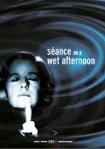
Now, on to the film.
When I was growing up, the movies that really frightened me the most were the ones that had to do with the supernatural. Films like The Omen, The Exorcist, and The Shining always stuck with me because the unexplained always seemed more terrifying than somebody who just went nuts. Séance had a similar quality.
Kim Stanley’s performance was mesmerizing. She had a "far-off" look about her that made me wonder whether or not there was actually more to her than a crazed lunatic seeking self-worth. Her distant stares as she recalled her past were so eerie she had me believing she could communicate with the dead. Her performance was so hair-raising it reminded me of the unforgettable roles that Louise Fletcher mastered in One Flew Over the Cockoo’s Nest (Nurse Ratchet) and Flowers in the Attic (Grandmother). Anthony Hopkins’ Hannibal Lechter is probably the scariest character in film history because his character could somehow jump into your mind. Stanley’s Myra had similar moments.
Another thing that really stood out for me was John Barry’s haunting score. His lonely piano gave the film its dying soul. Barry is one of my favorite film composers. His work in the James Bond films is known the world over. I own a few of Barry’s scores and I could hear glimpses of pre-Bond moments shining through in Séance.
It was Richard Attenborough’s wimpy, subservient Bill, however, whom I thought gave the movie its balance. Once I got passed the bridge of his nose (did that bother you or what?), I found his quiet desperation intriguing, and very humorous at times. And once he started to think for himself, he was very likable. The way he reluctantly carried out Myra’s crazed plan reminded me of Dustin Hoffman’s portrayal of the oppressed young professor in Straw Dogs. I could tell early on that at some point in the film he was going to be pushed to the brink. You couldn’t help but see his guilt grow with each illegal act he committed. I knew it was only going to be a matter of time when he exploded.
One of my favorite lines in the film was when he tried to explain to Myra how things like this can go horribly wrong. That line reminded me of the kidnapping-gone-wrong in Fargo. With that in mind, I had a horrible feeling throughout most of the film that somehow the girl was going to die. The girl was so likable that this thought had my stomach in knots for the final hour.
I also liked the relationship Bill and the girl had from the start. He showed real compassion for her. The funniest moment of the film came when he first kidnaps her. As he tries to get her out of the car, she locks the doors so he can’t get to her.
Although Bill never really betrays Myra, I think there’s a point in the film when he understands that her selfish plan will eventually backfire on its own. As a pacifist, he pretty much sits back and watches it happen. In fact, what surprised me was near the end of the film, after he safely places the girl under the tree and returns home, I thought for a moment that he’d finally cracked and called the police. There’s a scene when the police walk into the room that Bill is standing on their side, and they are all looking at Myra. It almost looks like he called them to come and take her away.
By the end of the film, I found myself with more sympathy for Myra than I expected. As dangerous as she was, she is truly a tragic character trapped in her own grief. The only way she could live through the grief of losing a child was by believing she could communicate with him. In fact, their loss explains the separate realities they are living in, and with that, you come to realize that they really do need each other to survive.
On a scale of 1-5, I give Séance a 3 Stars for its rich, and very memorable performances.