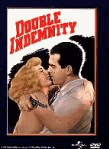
Let me start by saying, the first thing that comes to my mind when I think of Billy Wilder is comedy – as in Some Like It Hot, Sabrina, The Seven Year Itch, and my personal favorite, The Fortune Cookie.
The first thing that comes to my mind when I think of Fred MacMurray is comedy – as in My Three Sons and Disney’s Absent-Minded Professor movies.
With that said, Double Indemnity surprised me with a double whammy. Although I guess I should have seen it coming. After all, some of Wilder’s most important work includes the cynical and dark Sunset Boulevard, and much darker The Lost Weekend. Although I think MacMurray found his niche with Disney, there are a number of films (including Wilder’s The Apartment, where he plays a pushy, dishonest boss) that established him as a more serious, multidimensional actor.
Okay, onto the film.
I don’t know if I was ever sold on the narrative. It kept breaking the tension of the film. I initially thought as the story evolved, I would have preferred not knowing the outcome before the events took place (Wilder used the same narrative-style in Sunset Boulevard, in which William Holden narrates the movie although he’s dead at the beginning of the film… I’ve never actually figured that one out. How could he be recounting the story when he’s dead?). But as DI developed, it slowly pulled me. Halfway through, I was completely hooked. I wanted to know what little mistake the lead character would make that would get them caught. By then, I was okay with knowing they would be caught, and enjoyed listening to Edward G. Robinson’s hunches as he began to slowly put the pieces together.
I thought MacMurray’s acting was a stiff, baby! The way he delivered his dialog was too pulpy for me. He wasn’t a very likeable character, either. I thought Barbara Stanwyck and Robinson clearly stole the show. As ruthless as she was, I thought Stanwyck had passion (and looks, as compared to her more popular Big Valley days). Robinson, on the other hand, was the most likeable character in the film. His character may have taken his job a little too serious, but I liked the fact that he poked fun at himself, as well. Some of my favorite moments of the film were watching him pick the situation apart, drawing conclusions that would ultimately lead to the truth.
But the true star of the show was clearly Wilder. His ability to catch the characters off-guard, and watch them wiggle their way out of a sticky situation, was what kept me glued to the set. The following are the key scenes of the film:
A few other things I enjoyed about DI were the supporting performances of the cruel husband and victimized daughter (who was actually pretty hot!). I liked the twist that Stanwyck was also suspected of killing the girl’s mother, too, making her even more of a black widow. Once I found that out, I knew Stanwyck and MacMurray would eventually have a showdown.
I’ve always been a huge fan of 1950s and 60s classic movies, but I have to admit I’m gaining more appreciation for earlier films, especially from the 1940s. DI is just another testament to those earlier pictures.
On an interesting side note, I once read that in the film "Rebel Without A Cause," James
Dean supposedly improvised several memorable scenes, such as when the policeman frisks him and he chuckles like it tickles. This of course, had been done before. Another scene is when Natalie Wood’s character says she thinks he’s weird. As she runs away, Dean whispers to himself, "I love you, too." MacMurray mutters those exact words not only once, but twice, in DI (under similar circumstances).
I wanted to mention that Charlene almost always passes on old films. But she stayed with this one. Overall, she liked it, but had two problems with it: 1) the loud, dominating score (she said for a crime drama, she would have liked more silence), and 2) the fact that for whatever reason, MacMurray wore a wedding ring. Whether or not this was just another scheme to legitimize MacMurray’s character as a respectable salesman (after all, he knows all the tricks), the film never explains why he’s wearing a ring on his wedding finger.
I often find rating old films difficult as we are so influenced by how movies have evolved through the years. I am surprised, however, that DI hasn’t held up better with other classic films like the Bogart gems. Maybe that’s because the leading wasn’t a Bogart or Brando. I think some of the acting falls a little short, but the overall film clearly has stood the test of time. DI is one of the best "1940s" crime dramas I’ve seen, but when I compare it with the best "all-time" crime dramas, somehow its ranking falls short. On a scale of 1-5, I would give it 3½ stars when comparing it to the all-time crime dramas. But when I narrow the field down to the 1940s crime dramas, I give it 5 stars. In conclusion, I give DI a solid 4-star ranking in the crime drama genre.