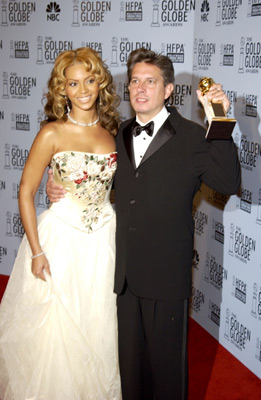
An Interview with Oscar Nominee Eliot
Goldenthal
You recently scored Frida, directed by
long-time collaborator Julie Taymor. Was it through Julie that you got
involved in the project?
Yeah, but I wanted to make sure that I was the right person for it, and both
Julie and Selma Hayak felt comfortable with what I had to offer to the project.
What kind of research did you do for Frida?
I knew a lot, from my trips to Mexico, and appreciation of Mexican art. I
have always loved the work of Diego Rivera, and through Diego I came to love the
work of Frida Kahlo, and the other great painters of that era, specifically
Orozco. He was the most magical of the painters at that time, but I
admired them all.
How early were you involved in the film? Did
you work through production?
I had to do some pre-records, because a few of my songs are in the film, like
the tango-esque number. I needed to compose it well enough in advance, so that
they could choreograph the movements around the song. And the song
"Viva La Vida", heard on the canal, needed to be coordinated so that
the musicians singing the song cross the camera for a brief instant in sync.
So, it needed to be all worked out and coordinated and rehearsed and sung.
It might seem effortless, but it took a lot of coordination.
There's also the end title song, "Burn It
Blue". Where did that come from?
It all comes out of the last cue of the film. Shards of other themes
heard throughout the movie are weaved into "Burn it Blue", the lyrics
of which were written by Julie.
Both the tango and "Viva La Vida" were written for the movie, and
are worked into the score here and there. The "Viva La Vida"
melody appears in the opening of the film, played by the glass harmonica and
accordion. The tango melody appears in two or three places, and the
melodies in "Burn It Blue" also show up numerous times in the score.
When did you start working on the score?
As they were filming the movie, I would constantly get rough assemblies, and
I would compose to those, and make adjustments as they came in. I knew
that specifically on this movie, other than in a few places, the film would be
driven by melody as opposed to specific cues. So I knew that if a scene
got shortened or lengthened, it was easy to adjust because of the melody - you
could stretch it.
How long were you working on the project?
It was approximately a one year period. I didn't work every day, and I
also did another film in that period, The Good Thief, with Neil Jordan.
There are a lot of guitars in the score to Frida. What kinds did
you use?
The basic instrumentation was going from a high to low, a vihuela, which is a
tiny guitar; nylon and steel string guitar; classical guitar; a big bass guitar
called a guitarron; Mexican harp; glass harmonica; hammer dulcimer; tenor and
bass accordion. That was my basic band, and I would use strings here and
there.
There's a segment in the film, the dream after the
accident, where the score takes on a rather unsettling quality that is different
from the rest of the score...
Well, yes and no. It was solo rhythm guitars played in a Mexican
stylistic fashion, but with completely non-Mexican rhythms and chord changes,
with very jagged rhythmic orchestra (string quartet, then orchestra) with
saxophone and vocal coyote imitations. It was a bizarre scene, because it
was a dream. But all of the dream sequences have a very surrealistic
quality. They're kind of related: the bus crash is related to the broken
column, which is related to when Trotsky is looking at her painting. It's
a much gentler thing, but what it is, is these unusual sounds and layers and
textures that go over one basic texture. So it was the only place that had
that kind of animation, and it might have felt individual and unique because of
that.
There are also some other songs on the album, that
you didn't write...
"La Llorona", "El Conejo", and "Carabina
30/30". Those and a few other songs were ones that Diego and Frida
loved to listen to, and we wanted to include those in the film. Many albums will
have stupid old pop music that companies want to sell, but in this case we
wanted to put things that Frida and Diego really liked, to put us in that world.
We were lucky enough to have the involvement of people like Chavela Vargas, who
was 90 years old and sang in the movie for us. We used a recording of a
song she sang 40 years ago, and then she sung a song in the film on screen.
Yeah, she did sound a bit different on the two
songs.
Well, of course. I'd like to hear me 40 years from now -that would be
nice! [laughs]
Do you sing?
I do actually, but it's not my focus.
Have you sung on any of your albums?
Yeah! Quite a few: Cobb, Alien 3, Drugstore Cowboy,
The Butcher Boy (in the film, not on the album). But it's not my
focus.
Anyways, we were lucky to have Chavela Vargas as a singer, Lila Downs as a
singer. She sang a few of the songs on the album, and the duet with
Caetano Veloso, who is a legend in Brazil, and we were lucky to get him.
The fact we got him to sing in English, and we went down to Rio to record him is
an amazing thing. He's just huge - like Gandhi or something down there.
It's unbelievable.
How did you pick him?
Well, he has this worldly quality about him that he doesn't limit himself to
feeling like Brazilian music. He actually has an album dedicated to Giulietta
Masina (Fellini's wife) and he sings many of the themes of Nina Rota. He's
known as a great singer in the tradition of Bossa Nova.
A little while back, you also did "The Green
Bird" on Broadway with Julie. When did you start on that project?
We started back in 1998, and put it out on the New Victory Theater off
Broadway. Then it came out here to La Jolla, and then went to the Court
Theater for the Broadway Debut. It did very well considering the type of
material, which is Italian Comedia del Arte, where the first act was
non-musical, and the second act was a musical. It's very unusual stuff.
Yes, I noticed that he album has a lot of
"score" in the first half or so.
That's right - it wasn't a musical, it was a demi-musical. I had been
working on it on and off for years, tuning it up, and tweaking it, and getting
it more and more to the way we wanted it.
In 2000, you scored Final Fantasy: The Spirits
Within. Had you played any of the games, or listened to any of the
music from those games before working on the film?
Nope!
How complete was the film when you came on board?
It was very spotty. It took 3-4 years to make, and I commend them. They
really stuck their neck out -and got their heads cut off - but it was a worthy
experiment. And it was great working with the London Symphony Orchestra
for 10 days, and I enjoyed working on that project immensely.
You used a rather unique orchestral arrangement for
that score, featuring 16 French horns! Why did you make that choice?
It was that type of movie. At one point I had changed them to Wagner
tubas, which are similar but the bells are different. I preferred the
French horns in the end, they sounded brassier - it's a great sound to hear.
You should have been there!
The end credits song is based on a theme from your
score. Who was the lyricist, and how did you get involved with him?
Richard Rudolph was the lyricist. He was the music supervisor on the
movie, and he has been a lyricist around Hollywood and pop music for years.
He had many hits in the pop world, and the beauty of it is that he speaks
Japanese, and lives out here. So he was the perfect choice to go back and
forth between the Japanese and the Hollywood crowd. They trusted him, so
he was really good at that, and wonderful to work with.
The DVD for Final Fantasy has an isolated
score with your commentary. What are your thoughts on isolated scores -
are they good or bad?
I have no opinion on that. If it's good for students or people who are
really interested in the art of synchronization of music to movies, then I think
it's a good thing.
Did you enjoy doing the commentary?
No. It's kind of tedious, because you're sitting there and watching the
whole movie and talking about it as the scenes are going by, and it doesn't lend
itself to the nature of music discussion. The movie is going linearly from
side to side, but you have to talk about music vertically. It would be better to
discuss the score separately in an interview where I could talk about a few
scenes, separate from the film. It's much more sensible.
They did that on Titus - I was interviewed in a studio and could talk
about different elements. It made more sense. And the isolated score
in Titus is good because with Shakespeare, there is so much text and language
that it's an interesting study for a composer interested in that Shakespearean
kind of work to see what I chose to do, to dance between the raindrops of text.
What do you think of your film works?
Well, for me the way I see it, I am not disappointed in many things that I've
done. I might not listen to these things for 4-6 years, and then I'll go
back and listen to it and be like, "oh wow!" [laughs]
Your score to Interview with the Vampire was
written in about 2 weeks. Do you feel that you were pushed creatively, and
the resulting score was more "raw and pure" as a result? Was
there no time to second guess?
No, there was time to second guess! Everyone was working 20
hours a day, and I'd play something and the director might or might not like it.
So it didn't seem like there would be time to second guess, but there was.
I think what happened was a combination of a few things:
First off, I locked into a concept pretty fast that the music would go in a
chronological development. From arcane sounding music with viola da gamba
and boy soprano singing Latin and stuff like that, to the harpsichord, to the
modern piano, and the 19th Century orchestra, to sort of the Polish avant-garde,
and finally to "Symphony for the Devil". So, having that kind of
"up the ladder" of the chronology of music was something that Neil
Jordan and I felt comfortable with. The other thing was that there wasn't
much time for other folks (editors, the studios) to second guess it.
You recently finished The Good Thief for Neil
Jordan. What is it about?
It's a retelling of a 1955 French movie called Bob le flambeur (Bob the
Gambler). It stars Nick Nolte, and a cast of North African and
European actors and actresses. Tchéky Karyo is in it. It's a very
"out there" movie for the genre.
What kind of score did you write for it?
The music is very experimental. A lot of homemade instruments are used,
it's inspired by North African rhythms and sounds and American jazz, and it's up
against the backdrop of Algerian rap. I also had an opportunity to do an
arrangement of the Sinatra tune "That's Life" with Bono. That
will be out this spring.
What kind of homemade instruments are you talking
about?
All the instruments were created by a gentleman named Mark Stuart. They
were plastic knives, spoons and forks put on a resonating board, and then
pitched.
What projects do you have coming up?
Oh, I have a lot lined up! My ballet "Othello", was recorded
for "Great Performances" by the San Francisco Ballet and will air on
PBS soon, in the late fall or spring. I'm writing another ballet based on
the subject of Artemis. It will be about a half hour - not a full evening
like "Othello" - and will open with the American Ballet Theater, at
the Metropolitan Opera House, and then go to Athens next summer. There's
my opera "Grendel", which I've been working on for some time. At this
point, the plan is to have it at the Los Angeles Opera Company in 2005, then
going to Lincoln Center the same year, and then possibly to Vienna. Julie
and I are working on other things in the theater. So between my orchestral
work, theater work, and film work, I'm basically kept off the streets for good!
I'm still focusing on all the responsibilities I have on making sure that
people enjoy the music from Frida, because it's unusual for me to have
such a melodic score. You don't have to be a total freak to enjoy a
Goldenthal score this time!
What do think of your fans?
They've got to be insane freaks! [laughs]
Special thanks to Soundtrack.Net, and to Monique Ward and Jeff
Sanderson at Chasen & Co. for arranging this interview.