NASA Fakes Jupiter MoonsMoon "Io" is really a rotten melon, according to former NASA worker. | ||
|
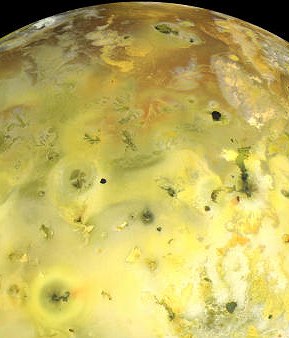
We got a hold of a janitor who worked at the NASA JPL space probe control centers. He claims that NASA faked the Jupiter moon images when the Voyager 1 probe had a zoom-lens camera failure just days before the closest approach to Jupiter. According to the janitor, who we will call Ben (not his real name), the images you see of the moon Io is really just rotten fruit found in the JPL break room refrigerator. Ben: "I walked in to the break room to move the chairs so that I could mop the floor. Normally the break room is empty at that time of the night. However, this particular night something really weird was going on. About four of the long-time JPL scientists were digging around in the fridge and carefully studying the items they pulled from it." "Scientists are generally a wacky bunch anyhow. But this time was different. They seemed worried and in a big rush rather than just curious. They said, "Oh, we are just cleaning out our stuff." But, scientists make lousy liars, you see. If they were good liars, they would be managemers (laughs)." "There was this melon or grapefruit, I don't remember which. It was all rotten and moldy and dripping with sh__. They kept looking at it from different angles. I pretended not the care, but I could not figure out why so many rocket scientists were fascinated by rotting fruit. Everybody knew about the important [probe] flyby, so I figured that they would be focusing on that alone. But, here they were playing with crap from the deep side of the fridge. Usually it is my job to handle the yucky crap." "There were some other odd clues, but I did not think much about them until the [newspaper] came. Right there on the front page was that very same rotting melon I saw in the break room. However, the photo was tinted orange, the background was black, and they altered it to make it look rounder than it was. The actual melon was a little lopsided, you see. My stomach jumped when I read the title, 'IO: Strange Moon of Jupiter'. I was thinking, 'what the f___, is this some kind of joke? That is a moldy melon, not a far off moon!'" "I then looked at the new pictures of the other moons. The other strange things I saw going down started to add up. Around the time of the fridge incident, I saw people in a lab doing weird things to bowling balls. They dipped them in that cold, smoky stuff they show on science shows. What do they call that, liquid nitrogen or liquid carbon or something?" "The next day or two I came into the lab to clean out the waste bins. Sitting on some tables were cracked bowling balls. I don't mean cracked, as in broken, but with shattered, icey textures. I also saw some BB balls on the floor, and noticed little holes in the bowling balls that I think were caused by shooting BB's at them. There was also a lot of sand on the floor." "I thought it was a little strange, but forgot about that until I saw photos of [the moon] Ganymede in the paper. I had already freaked out about the melon, so I was looking at the photos very closely. Ganymede was one of the f___ bowling balls I [had seen] the other day! I bet the other moons were also all bogus. I just did not see it when they [faked the other moons]." "I eventually also remembered some mumbling in the hallway about a camera problem that was stumping everybody. This was a few days before the fridge party." Ben and our team arranged to meet with a space expert. Ben used a remote conference call because he didn't want his identity exposed. Although the space expert did not fully believe the faked moon theory, he did offer us some interesting insights and speculation after pondering it for a few weeks. One line of speculation was that the scientists invented the idea that Io is volcanic because unlike the bowling ball, the fruit would rot more and change over time. So they needed a way to explain why Io was different each time. They could alter the fruit, or just let it naturally rot for related probe flybys, but totally replace it with another rotting melon for flybys that are years apart. For example, Io was completely different between the Voyager 1 and Voyager 2 probe flyby's. However, the Galileo probe flew by Io every month or so because it orbited Jupiter instead of just flying past. Thus, they may use the same fruit for month-by-month shots, but a different one for multi-year gaps because they can, and do, simply say that the active volcanos "remake the surface" every year or so. The speculation is that because they had such short notice after the camera failure, they did not have time to think about later probes. They grabbed a fruit, and photographed it. But later probes would be shooting at different angles and different lighting conditions. It is tough to take enough photos to cover every angle and every lighting condition in advanced, the expert said. So, they had to invent the idea of volcanoes that changed the surface often as a cover up. The bowling ball models are not going to change. Thus, they simply lock them away, and bring them out when new probes come along. The expert thinks that Callisto, another large Jupiter moon, may have also used the bowling ball techinque, because it is similar to Ganymede but with less white shatter marks. In other words, it is a simpler version of Ganymede. "If you can make a Ganymede in the lab, then you can use a subset of the same techniques to make a Callisto also", he said. We are now searching for someone with the right equipment to freeze a bowling ball in liquid gases, shatter it by dropping it or hammering it or dipping it in warm water, sandblasting it, then shooting BB's at it to see if we can make our own Ganymede. When I was a kid, I used to heat pieces of glass on the stove using kitchen prongs, then suddenly dip them into hot water. It did indeed make some spacey patterns by causing tiny, frosty cracks. I tried rotting a melon to make an Io, but my wife tossed it in the trash just as it was showing promise. I am now working on my second Io. Now that the secret is out, you too can make your own Jupiter moons in your very own backyard.
NASA Links | ||
Other Stories
Copyright 2002 by Findy Services. All rights reserved.
