
Government employee union policies and practices tend to be the primary cause of this. Here again, unions did not purposely set out to discriminate; it is just an unfortunate by-product. It is actually not directly age discrimination, per se, but "experience discrimination" to be more exact.
A primary goal of unions is to help existing employees get more pay. This not only increases the union's overall income, but also makes employees more likely to support the union. One way to do this is through the familiar wage bargaining process and strike threats. However, another approach to increasing wages is to make it easier for existing union members to get promotions. One effective way to do this is to prevent or reduce competition from non-union workers, which usually means outsiders. The union tries to make sure that union employees get first shot at any new openings, especially higher-paying positions.
New positions open up mostly from regular attrition (quittings, firings, retirements, etc.), and sometimes from agency growth. Some of these openings will be entry-level positions, and some will be highly-skilled positions. Obviously, the union wishes its members to have the higher-skilled positions because they pay better and offer more opportunities. Union contracts are thus worded to pressure management into considering only or mostly existing union members for promotions. This means that union members are going to get most of the higher positions that open up.
Most of the remaining positions are entry-level. Union members tend to move up the ladder, filling the higher-level positions, and leave openings at "the bottom". These bottom-level openings are the positions most likely available or accessible to the public (non-union employees) for the most part. Most outside hiring by the government agencies is done for entry-level positions. For this reason, a recent college graduate has a higher probability of getting hired in the government than an experienced professional. Thus, an outsider is facing experience discrimination.
One can argue that the experienced person can take an entry-level position and then move up using their experience. But, in practice such persons are often viewed as "overqualified" and passed over. The interviewer may be concerned that the experienced person will get bored and/or try to get other positions once "inside", and thus move out of the position sooner, leaving the interviewer more likely to have to endure the interview process for a replacement again.
The second concern is probably justified, being that moving around is often the best way to move up the payment ladder using one's skills. Even if this is not your goal, the interviewer cannot tell if you are an exception to the rule. (And, they would risk age-discrimination lawsuits if they asked.)
The big picture of the process is that by rewarding seniority on the inside, seniority (experience) on the outside is devalued to balance out. To put insiders into good positions, you have to fill their prior positions with less experienced people. Fixing the problem would require an entire overhaul of how unions do business. Either you find a way to violate the laws of mathematics, or somebody loses out.
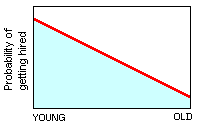
This graph shows the approximate conceptual relationship between the probability of getting hired with the government and one's experience.
Imagine an organization saying, "Well, sure, we tend to hire fewer minority X people on the East coast relative to their population there. However, we do hire more minority X on the West coast, so it balances out." I doubt this argument would stand up in court. For one, it is too close to the Southern "separate-but-equal" laws that were tossed out by the Supreme Court during the civil rights revolution.
In reference to the famous phrase, "some people are more equal than others", those inside the system are "more equal" than those on the outside.
The Exam Dam
Another cause of experience discrimination is
written exams. Some written exams will use
college-like exam questions that have marginal
bearing on real life. A person who may have
graduated from the formal education system
decades ago may have long forgotten such
knowledge. One may have never encountered the
need to know the formula for calculating the
volume of a cylinder since college. (Or perhaps
looked it up the few times they did.) However,
that does not prevent the question from showing
up on an exam.
A younger person with a college degree is more likely to remember these kinds of facts than an older person with a college degree, despite the fact the older person may have several years of practical, real world experience under his or her belt. Fortunately, this practice seems to be on the general decline, but not altogether gone.
