Readings: Walbank, p. 13-45; Austin, p. 1-38
•Greek parochialism prevented any kind of unified action.
•401: The episode of the retreat of 10,000 Greek mercenaries showed that the Greeks were militarily superior to the Persians.
•But their disunity prevented the Greeks to attack Persia.
•Only after the Greeks had been united under an outside power (Macedon) could they move east.
•Indo-European population living directly north of the Greeks.
•They did not originally speak Greek, but their language was close to ancient Greek.
•Having lived close to Greece from the beginning of Greek civilization, the Macedonians were heavily influenced by the Greeks
•Soon after the time of Alexander the Macedonians apparently did adopt the Greek language.
•The Macedonians were ruled by a dynasty of kings.
Money
•In Philip's reign, large gold mines were opened, which gave him a far greater income than that of any city state.
•Thus, this resource allowed him to maintain larger armies than they could.
Manpower
•Large peasantry, which served in the royal army.
•At a time when the population of the Greek city states was growing increasingly reluctant to fight in armies themselves (use of mercenaries).
Military superiority
•The Macedonians used a new formation (Macedonian phalanx).
•Long spears, less dense units, more flexible.
•Very good heavy cavalry (not the case in Greece, a mountainous mainland).
•In 361, end of the Theban supremacy in Greece. No more dominant Greek city.
•Under these circumstances Philip aimed at establishing Macedonian supremacy in mainland Greece.
•Athens was now the strongest city, but by no means a dominant power in Greece.
•The city is divided:
–Some wished to come to an accommodation with Philip.
–The others (led by Demosthenes) staunchly defended the democracy and advocated war with Philip.
•Demostenes was one of the great orators of antiquity, and his many surviving speeches are very hostile to Philip.
•Portrayed as the defender of Greek liberty (a lost cause):
–Athens did not have the resources to stand up to Philip
–The Greeks could not unify against him.
•By 346 Philip established himself in central Greece.
•At the same time, Philip conquered Athenian Amphipolis in the north, and in 346 a peace was made between him and Athens.
•But in 341 Demosthenes persuaded the Athenians to challenge Philip.
•Athens and Thebes fought with Philip near Chaeronea (a city in Thebes) in fall 338.
•Their complete defeat marks the end of independent Greece.
•From now on, Greeks would be ruled in one form or another by Macedonian kings.
•The Greek polis (city), theoretically independent, lost in fact its ability to operate freely in foreign policy.
•In 337 Philip announced the formation of a Greek league whose aims were
–to wage war on behalf of Greece and her gods
–to free the subject cities of Asia Minor
–to punish the Persians for the acts of sacrilege commited by Xerxes.
•Virtually the same objectives as those of the Delian League set up a century and a half earlier.
•Before he could start his war against Persia, Philip was assassinated (336) and succeeded by his son, Alexander III.
•While Philip was a cautious man, Alexander was audacious.
•Like most ancient monarchs, Alexander had to secure his position when he came to the throne.
•He put down a revolt among various tribes and killed rivals from his own family.
•Meanwhile, the Greeks rebelled for a time, but submitted when Alexander captured and destroyed Thebes in 335 [Austin, # 2].
•King at 20.
•Exceptionally handsome man.
•Heavy drinker, but excellent health (very athletic).
•He enjoyed reading, music, and the theater.
•Educated by Aristotle (from 342).
•Intensely loyal to his friends and the men he led.
•Charismatic.
•A brilliant general.
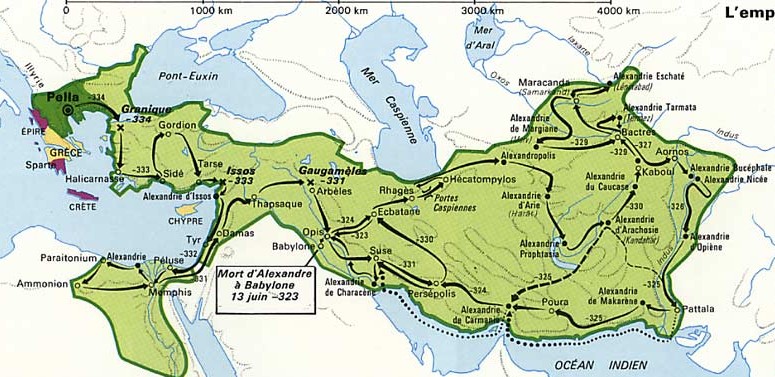
•In 334 he began his invasion of Persian territory.
•Darius III: not a very forceful individual.
•The Persians had little central control.
•Their commanders tended to bicker.
•No strategic sense.
•Alexander’s visit of Troy: shows his intention to lead the Greeks against the East.
•Only 30,000 infantry and 5,000 cavalry [Austin, # 3].
•Only one month of food reserve.
•But in pitched battle, the phalanx, in massed formation, was practically unbreakable on level ground.
•His units were far superior to any they encountered: overwhelming military advantage.
•At Granicus he defeated the Persian forces in Asia Minor.
•Western Asia Minor generally went over to him.
•The Persians had a fleet still, and he decided to disband his own (too expensive).
•If he took all the coastal towns, the Persian fleet would be rendered useless.
•In 333 he conquered eastern Asia minor.
•In the meanwhile, Darius had raised a great army in the east.
•In Oct. 333 at Issus in northern Syria, Alexander destroyed this army.
•Darius fled, abandoning his wife and mother.
•Instead of marching east, Alexander moved south to capture Phoenicia.
•After a very long siege and prodigious efforts on Alexander's part, he captured Tyre, thereby finally securing the eastern shore of the Mediterranean.
•In late 332 he entered Egypt, was crowned as pharaoh.
•In 331 he founded Alexandria at the mouth of the Nile [Austin, # 7].
•He was told by oracle of Ammon-Ra that he was a god [Austin, # 8].
•That year he moved east again, and at Gaugamela near Nineveh destroyed another great army raised by Darius, who fled east.
•Babylon submitted without a siege.
•Alexander captured the old Persian capital at Susa.
•He took over Persepolis and all its money (120,000 talents?). He burns the palace [Austin, # 9].
•Death of Darius.
•Absolute monarchy.
•Imposed his own satraps upon the former Persian provinces.
•After Gaugamela he was acclaimed king of Asia.
•Adoption of Persian customs and dress.
•He used Persian court ceremonial (including proskynesis) and promoted Persian nobles (and then displeased the Macedonians)
•Try to unify Persians and Macedonians.
•Training of a regiment of Persian boys in the ways of Macedonians.
•In 324, mass marriage of his officers with women from Persian high nobility [Austin, # 14].
•Some opposition from his own people (especially about proskynesis).
•Proskynesis: symbolic kissing of the hand that Persians paid to their social superiors [Austin, # 11].
•The Greeks regarded the gesture as the preserve of deities.
•A plot against his life is revealed: his companion Philotas is executed for treason for failing to bring the plot to his attention.
•Parmenion, Philotas' father, assassinated by command of Alexander to prevent his eventual revenge.
•He kills his old friend Clitus the Black while drunk.
•Later in the Central Asian campaign, a second plot against his life: Callisthenes, previously against the proskynesis, is executed (a sham for revenge?).
•Now the goals of the league had been met.
•The troops were released.
•Those who wanted to were invited to rejoin his army to go on his great expedition to the east.
•Starting in 330, he marched through northern Iran,
•down into Afghanistan,
•up into Uzbekistan,
•and finally down to the Indus river in Pakistan in 327.
•There the tired troops refused to follow any further.
•In 323, after a long and dangerous return journey, he was back in Babylonia
•Alexander executed a number of his governors who had misbehaved in his absence [Austin, # 13].
•As a gesture of thanks, he paid off the debts of his soldiers.
•He sent those over-aged and disabled veterans back to Macedon.
•Misunderstanding: mutiny (Alexander criticized for his adoption of his Persian policy)
•He executes the ringleaders of the mutiny [Austin, # 15].
•After that, he dies at 33 in Babylon while preparing a new campaign against Arabia [Austin, # 18].
•In 323 BC, Alexander died of a mysterious illness in Babylon.
•Poisoned? Malaria? Typhoid fever?
•His health had fallen to dangerously low levels after years of heavy drinking and suffering several appalling wounds.
•A fact: Alexander died of a high fever on June 10 or 11 of 323 BC.
•"I foresee a great funeral contest over me."
•His generals will fight over control of his empire.
•He was a great general (tactical and strategic genius, great leader of men).
•He apparently attempted a reconciliation between Greek and Persian.
•Alexander, to some extent, adopted Persian ways, used Persians as governors, married a Persian (Roxane).
•He founded a huge empire (wished to found a world empire).
•True exponent of Hellenism: he tried to spread Greek culture through the establishment of Greek towns in the east [Austin, # 19].
•There were 37 towns named Alexandria.
•Greek culture became dominant throughout the Near East.
•Divinely-inspired mission to unite the human race?
•A megalomaniac bent on world domination?
•Much about Alexander's personality and aims remains enigmatic.
•Ancient sources are generally written with an agenda of either glorifying or denigrating the man
•Difficult to evaluate his actual character.
•The murder of his friend Clitus often cited as a sign of his paranoia,
•His execution of Philotas and his general Parmenion cited for failure to pass along details of a plot against him.
•However, this may have been more prudence rather than paranoia.
•Was Alexander actually attempting to better the world by his conquests?
•Or was his purpose primarily to rule the world?
•Many authors examined Alexander's negative aspects.
•The destructions of Thebes, Tyre, Persepolis, and Gaza cited as examples to show that Alexander preferred to fight rather than negotiate.
•His general tolerance of the cultures of those whom he conquered, his attempts at cultural fusion: only practical decisions?
•Did he actually admired Persian art or culture?
•Was he more a general than a statesman?
•The authors writing about Alexander are influenced by the context of their own time.