Week 2- Early Greece and the Mycenaean Age
Importance of Greece
·
Greek tradition: a major element in the development of Western
thought (in Middle Ages through Latin, and since the Renaissance through direct
study of Greek).
·
Philosophy, history, literature, Classical architecture.
·
Greek: Indo-European language.
·
During the Bronze Age, speakers of Greek entered mainland Greece.
·
Where they came from and when they arrived are complicated issues
(lack of writings).
Archaeology Of Greece
·
Before the 1870s, our main source was Homer (The Iliad,
about the Trojan War).
·
Nobody in the early 19th.century put much faith in all this.
·
To write about early Greek history was considered as impossible.
·
But in the 1870s Heinrich Schliemann used the geographical notices
in the Iliad to find Troy in Western Asia Minor.
·
Other discoveries: Mycenae, home of Agamemnon, in the 1870s and
Tiryns in the 1890s.
·
Mycenae gave the designation of the culture.
·
In 1900 Arthur Evans dug up a huge site in Crete: Knossos.
·
A new culture was found, called Minoan after king Minos.
·
Also at Knossos were found many baked tablets with an unknown
pictorial script on them.
·
In 1939, Americans began digging at Pylos (Nestor’s place) and
found a palace with more of these tablets.
Writing in Bronze Age Greece
·
Sir Arthur Evans uncovered a great many clay tablets inscribed
with an unknown script.
·
Some were older: Linear A.
·
The bulk were of more recent vintage: Linear B.
·
Evans spent the next several decades trying to decipher both, to
no avail.
·
He was convinced that Linear B was a language he called "Minoan."
·
After his death, Alice Kober noted common aspects of Linear B with
Greek.
·
Using this clue, Michael Ventris and John Chadwick, during the
50s, deciphered the Linear B and proved that the underlying language was archaic
Greek.
·
Linear B is thus a script that was used for writing Mycenaean, an
early form of Greek.
·
This early form of Greek preceded the Greek alphabet by several
centuries.
·
Partly syllabic, with additional logographic signs.
·
The other script (Linear A) is still undecipherable.
Minoans
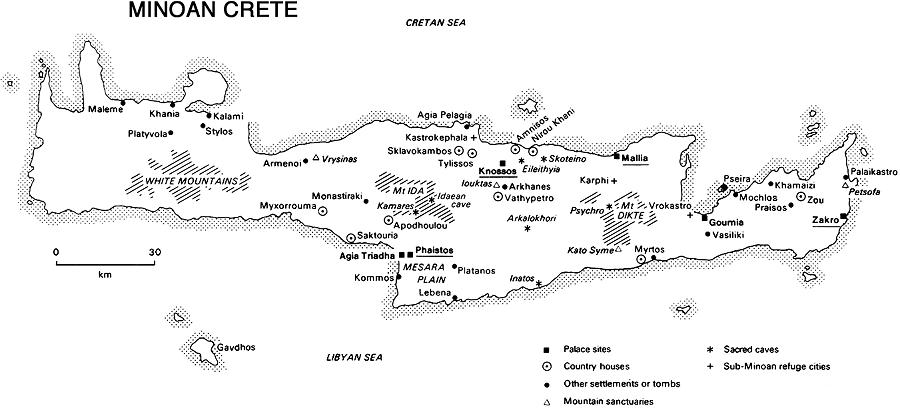
Geography of Crete
·
Located in the center of the eastern Mediterranean at the
crossroads of Africa, Asia, and Europe.
·
About 200 Km from east to west, and between 12 to 58 Km from north
to south.
·
One of the largest islands in the Mediterranean sea.
·
The temperate climate.
·
Decentralized culture based on the abundance of the land's natural
resources, and on intense commercial activity.
·
Important forest in ancient times.
Economy and naval power
·
Crete exported timbers, food, cypress wood, wine, currants, olive
oil, wool, cloth, herbs, and purple dye.
·
Its imports: precious stones, copper (from Cyprus), ivory, silver,
gold, and other raw material.
·
They also imported tin (for bronze alloys) from far.
·
Cultural influences from Egypt, Syria and Mesopotamia.
·
Significant naval power.
·
In contact with all the major civilizations without being
threatened by external forces.
·
Credited as the first European civilization.
Chronology of Crete
·
Archaeological evidence of habitation since the 7th millennium BC.
·
After the 5th millennium BC, first evidence of hand-made ceramic
pottery: beginning of the civilization.
·
Evans named this civilization "Minoan" after the legendary king
Minos.
·
He divided the Minoan civilization into three eras on the basis of
the stylistic changes of the pottery:
o
Early (3000-2100 BC),
o
Middle (2100-1500 BC),
o
Late Minoan period (1500-1100 BC).
·
A better chronology was developed by N. Platon, which is based on
the palaces' destruction and reconstruction (adjusted later thanks to
archaeological discoveries):
o
Prepalatial (2600-1900 BC),
o
Protopalatial (1900-1700 BC),
o
Neopalatial (1700-1400 BC),
o
Postpalatial (1400-1150 BC).
Prepalatial Minoan Crete (3500-2000 BC)
·
Neolithic period: major settlements at Myrtos and Mochlos.
·
Contact with Egypt, Asia Minor, and Syria (trade for copper, tin,
ivory, and gold).
·
Decentralized culture with no powerful landlords and no
centralized authority.
·
Palaces focused around communities.
·
Tholos tombs were the major architectural structures of the time.
·
Society without hierarchical structure : the tholos tombs were
used for centuries by entire villages.
·
Most of the tholos tombs were circular.
Protopalatial Minoan Crete (2000-1800 BC)
·
Began with social upheaval, external dangers, and migrations from
mainland Greece and Asia Minor.
·
Around 2000 BC: new political system, authority concentrated
around a king.
·
The first large palaces were founded: centers for their respective
communities.
·
Development of a bureaucratic administration.
·
Social hierarchy: nobles, peasants, and perhaps slaves.
·
Peaceful and prosperous period.
·
Minoans continued to trade with Egypt and the Middle East.
·
Construction of a paved road network to connect the major cultural
centers.
·
Development of some settlements outside the palaces.
·
Extensive use of tholos tombs.
·
The palaces were destroyed in 1700 BC by forces unknown to us (earthquake?
Invaders?).
Neopalatial Minoan Crete (1800-1550 BC)
·
Destroyed palaces quickly rebuilt on the ruins.
·
Time of Knossos, Phaistos, Malia, and Zakros.
·
Appearance of villas in the rural landscape (modeled after the
palaces).
·
Lesser centers of power away from the palaces, and homes for
affluent landlords.
·
Evidence of administrative and economic unity throughout the
island.
·
Minoan Crete reach its zenith.
·
Women played a powerful role in society.
·
The paved road network vastly expanded.
·
Minoan culture dominates the Aegean islands and expands into the
Peloponnese.
·
The Minoan culture's fusion with the Helladic traditions of the
time eventually morphed into the Mycenaean civilization.
End of Minoan supremacy
·
The Mycenaean civilization challenged the Minoan supremacy in the
Aegean with their own powerful fleet.
·
Beginning of Mycenaean influence in Minoan Crete.
·
Life became more militaristic (large number of weapons).
·
Destruction of most of the palaces and villas of the country side
in the middle of the 15th century.
·
Destruction of Knossos in 1500.
·
During this late period, the Mycenaeans controlled the entire
island.
·
Uncertainty about the causes for this sudden interruption of the
Minoan civilization (invasion of outside forces? eruption of the Thera volcano?).
- After that, diminuition
of Mycenaean influence on Crete (local leaders).
- 13th century:
prosperity again.
- 1200 BC, many Cretan
settlements destroyed and abandoned (Sea Peoples?).
Minoan Religion.
- Religion probably the
base of Minoan rulership.
- Minoan religion: a
hotly contested subject.
- Numerous interpretations
linked to the study of images.
- Elements: caves,
grottoes, mountains, bronze and terracotta figurines, vases, double headed
axes, pairs of horns.
- Remnants of a former
aniconic cult (the cult of the pillar).
- Central female divinity
(Mother Goddess).
- Minoan king: the
presiding priest of the cult?
- Blood sacrifices (bull,
favored victim?).
- Religion intimately
involved with natural life than that of those other cultures.
The Great Goddess
- Protectress of all
living creatures; goddess of the underworld.
- Among figures found,
divinities are overwhelmingly female.
- Great Goddess associated
with doves and snakes (connection with air and earth).
- Also lions.
- Kinship with nature and
outdoor life.
The Double Axe (Labrys)
- The most common of all
Minoan religious symbols.
- A sacrificial
instrument?
- Connected with the
mythological name for Minos' Palace: Labyrinthos.
- It is the house of the
double axe, the temple of the Goddess.
The Cretan Zeus
- The male Deity is rarely
represented and usually on a smaller scale than female figures.
- Young god.
- He may have been
introduced by the Mycenaeans (they had him born by the Earth Goddess in her
own Cave Sanctuary, gave him her symbol of sovereignty – the Double Axe).
- Reconciliation of two
religious systems, one having a God, the other a Goddess, as Chief Divinities.
- Zeus Kourous,
or young Zeus found in Palaikastro.
- The divine young Cretan
Zeus dies and is resurrected each year in the spring to ensure the renewal of
the vegetation cycle.
Mycenaeans (early Greeks)
The Early Helladic Period, ~2750-2000 BC
- Between 3000 BC and 2000
BC, arrival of a metal-using agricultural, non Indo-European people.
- Some of their
geographical names were preserved by the Greeks ("-ssos")
- We know almost nothing
of these people. "Early Helladic" period.
- Around 2000 BC, sites
destroyed in fire or abandoned outright.
- A new invader imposed
himself: the Greek.
The Middle Helladic Period, ~2000 BC-1550 BC
- They settled all the
parts of Greece and began to dominate Greek culture.
- Indo-Europeans (speaking
Greek).
- Society primarily based
on warfare; their leaders were essentially war-chiefs.
- They traded with the
Minoans.
- Under their influence,
they began to urbanize and translated their culture into a civilization.
The Late Helladic Period, ~1550 BC-1150 BC
- Around 1600 BC, their
cities grew larger, their graves more opulent, their art more common, their
agriculture more efficient, and the power of these new warlord cities began to
be felt around the Aegean.
- Period of the Mycenaeans
proper.
- For four centuries their
culture thrived until it fell.
- For thousands of years,
their civilization was only known through literature (Homer), until
Schliemann’s discoveries (Troy, Mycenae, Tiryns).
The wanax
- Archaeology tells us
very little about the Mycenaeans.
- They derived much of
their culture from the Minoans, but with some important differences.
- Mycenaean society was
monarchical : a wanax (king) ruled over a large administration as a
kind of head bureaucrat.
- The kings accumulated
vast wealth in concentrated form.
- Their cities were heavy
fortresses.
- Mycenaean art was about
warfare and hunting.
- Warlike people,
defensive and offensive.
- Hittite and Egyptian
records categorize them as raiders.
- After a series of
earthquakes, the Mycenaeans seems to have conquered Crete and other Aegean
civilizations.
- Legendary Trojan War
(13th century).
Trade and wealth
- Mycenaeans traded raw
goods such (oil, animal skins) for jewelry and other goods from Crete, Asia
Minor, and Egypt.
- Piracy.
- The Kings and a few
officials were very wealthy.
- Wealth spent on warfare
and defense and also crafts, jewelry, and expensive burials.
- Tombs: at first deep
shaft graves, but around 1500 BC: tholos tombs (large chambers cut into
the side of a hill).
- Main purpose: display of
power.
Palace
- Elaborate central
complex (workshops, storage, defense, massive fortifications).
- Cyclopean walls.
- Lion Gate at Mycenae.
- The central palace at
Pylos: a typical mainland palace. Four main elements:
- a narrow court on
which the structure fronts,
- a double-columned
entrance portico,
- a vestibule, and
- the richly frescoed
megaron, or hall (throne room).
- Large archives
associated with palace at Pylos.
Tholos (tholoi in plural)
- Circular building with a
conical or vaulted roof.
- Large ceremonial tombs,
sometimes built into the sides of hills (beehive-shaped).
- Their evolution began in
Minoan Crete but culminated in the so-called Treasury of Atreus at Mycenae
(1250 BC).
- Diameter: almost 50 feet
(15 meters); Height: slightly less.
- Enormous monolithic
lintel over the doorway (120 tons).
- A small side chamber
contained the burials. The main chamber probably reserved for ritual use.
Fall of the Mycenaean civilization
- At the very peak of
their power, the Mycenaeans suddenly disappear.
- 1250 BC: major
renovations to the walls of the major centers (as if the owners expected
sieges).
- Wall built across the
Isthmus.
- 1190 BC major
destruction of these centers.
- At Mycenae: three stages
of destruction (the last around 1150 BC).
- Followed by a minor
reoccupation at an impoverished level (sub-Mycenaean period).
- Population greatly
reduced.
- The sub-Mycenaean period
ends in 1050 and is followed by the so-called Dark Ages.
- When Greece re-emerges
from this shadowy period, its civilization is quite different.
Possible causes of the destruction
- Unlikely to be solely
internal warfare (this wouldn't explain why all centers are destroyed).
- Wall across the Isthmus:
a threat from the North? Not necessarily.
- The date is suspiciously
close to the time of arrival of the Sea Peoples (but no evidence).
- Maybe an economic
collapse drove people from the cities out into the countryside.
- Maybe this collapse is
due to the invasion of the Sea Peoples in Eastern Mediterranean.
- The Greeks themselves
believed in a Dorian invasion (another Greek-speaking people, the Dorians).
- If that were the case,
those chose to live in small, tribal, agricultural groups.
Mycenaean religion
- Much of it survives into
classical Greece.
- Difficult to distinguish
Mycenaean and Dark Age religions.
- Our knowledge based on
ruins and a few fragments of writing.
The sky-god
- Polytheistic and
syncretistic religion (addition of foreign gods).
- Pantheon headed by some
ruling sky-god (Dyeus in early Indo-European).
- Common heritage for all
Indo-European peoples (in Greek, “Zeus”).
- Hindus: “Dyaus Pitar” (“pitar”
means “father”)
- Romans: Jupiter.
The other gods and goddesses
- No priestly class
identified.
- Mycenaean pantheon
reassembled from inscriptions in Linear B found at Pylos and at Knossos in
Crete.
- Some deities are
familiar; others are note (e.g.: Ares = Enyalios, epithet).
- Apollo = PA-JA-WO, (“Paian”).
- A-TA-NA
PO-TI-NI-JA = « Athena Potnia »),
- E-RE-U-TI-JA =
Eileithyia (goddess of childbirth),
- Dionysus,
- Poseidon the “Earth-Shaker”,
- The “Two Goddesses” (Demeter
and Persephone?),
- The Erinyes (or Furies).
- The original Mycenaean
religion persisted and adapted until it finally emerged in the two great epic
poems of Homer.