





|
Finally Going HomeJanuary 26 - February 5, 2001 -- After narrowly escaping a harrowing battle with the sloth, I skedaddle across the border into Panama, taking in Bocas del Toro, Panama City, Isla Grande, and David in my first taste of Panama since 1972. Bocas del Toro
I had met a cool Swedish guy named Jens and we were chatting away when a guy hurried us into a 5 dollar a piece cab, saying it was the only way to get to Bocas before dark, blah blah. We were tired, and took him at his word. Turns out the bus got you there just as quick for a dollar. Oh well. On the way there, we passed another cab that had broken down, so some of us jumped in the bed of the taxi (it was a 4 door pickup) for the rest of the ride, where it promptly started to pour rain. That really didn't matter though. It was lovely staring at the unbroken jungle that covered the mountains all around us. On the hills, I started seeing a new type of house that I hadn't seen before. A-frame huts with wood walls and thatched roofs. Simple but effective. Bocas is a group of islands in the Caribbean in the northeast corner of the country. At Almirante, our rather, um... abrupt...taxi hustler dude was pushing us rather vehemently towards his water taxi of choice. We only wanted to pause for a moment to consult our guide books to see if we were getting a good price, but even after saying 5 or 6 times that we didn't have any questions, we were just checking something, they still kept pestering and pestering. Hum, still a bit early to make a judgment, but I was definitely seeing some differences in the manners here than I had seen in other countries thus far. If I was going to be president of this country, some of this was going to have to change! I considered revoking everyone's citizenship and making them reapply in order to weed out some of the riff raff, but I might have to ease into some of the changes more slowly than that. Right now, I just knew that the fellows around me certainly weren't going to be members of my cabinet or anything, rest assured of that! The water taxi ride was a painless 3 dollar, 20 minute affair, and we were soon ashore on our uncharted desert isle, Isla Colon. OK, it was charted, but I like the ring of that. A young kid nicely walked us to a cheap place called Hospedaje Dixon where we checked in for 6 bucks a piece. Jens and I never talked about whether we were going to share a room, we were just getting along fine and it seemed like the logical thing to do. We wandered around a bit, noting the many houses up on 6 foot stilts to prevent them from getting washed away in hurricanes. After a pizza, we perched ourselves on stools at the Loop Bar, sucking down Cervezas Panama and having the pants charmed off of us by our lovely young Panamanian waitress. Lovely black skin, big dimples, amazing eyes...she had charisma off the charts. We were starting to feel no pain at this point, and Jens started telling me about this traditional Swedish drink. You put a coin in a cup, pour some coffee in it, then add Absolute Vodka (the only real vodka, Swedish of course) till you can see the coin again. Simple right? She goes to make it for him, but she added a lot of coffee, so 3 shots into it, we still can't see the coin. He decided to cut his losses and drink it that way, asking her nicely to please use a bit less coffee next time so he won't have to wire home for money to pay his bar tab :) She pretended to be offended and wandered off, strutting her stuff all the way. The next morning, we were wandering along, and this guy named Randy hustles us into the discount snorkeling / fishing trip. Ten bucks a piece Randy? You've got to be kidding? Does the trip really include the free Ginsu knives and the Old Spice shaving kit? Deal! Where's the boat? Jens assures me that our boat was not carved out of a single log, but I'm not so sure, cause I sat up front and watched water leak in through several large cracks. Our craft was perhaps 20 feet long by 3.5 feet wide and 3 feet deep. Any slight shifting of weight or wave would send us tipping severely to one side. A girl named Brandy had joined us for the foray, and the boatman, Rigoberto, unceremoniously dumped us off ten minutes from our point of departure on a neighboring island, saying he'd be back in an hour and a half after we were done snorkeling. Then Rigoberto putt putted off into the distance. Snorkeling wasn't bad, and I saw lots and lots of fish up close to the rocks, some of them up to 2 pounds. Not monsters, but if the fishing portion of our trip went even moderately well, we'd be eating well tonight. At 20 minutes past 2 or so, Rigoberto putt putted back up to us and tried good and hard to talk us out of fishing. We were soon to find out why. He hadn't gotten any bait he said. No problem, he pulled up to this guy out in the middle of the bay and got us a handful of 1 inch shiners. These minnows were looking a bit peaked. Closer to jerky than the thriving wriggling minnows we would need to fill our fish bucket. Oh well, Rigoberto was the expert, right? Out came Rigoberto's two fishing rigs. Remember, just two weeks ago Dad and I are pulling in 150 pound sailfish using 500 dollar beautiful brass Penn fishing reels. Rigoberto's rigs consisted of two 8 ounce Clorox bottles wrapped with about 100 feet of 15 pound test line, a hook or two, and a sinker at the bottom. You tie on a shiner, roll out some line off the Clorox bottle till you touch bottom, and voila, you are fishing Rigoberto style. Most times I have gone fishing, you motor at least out of sight of the dock. We were maybe 300 yards straight out from all the restaurants on Rigoberto's home island of Bastimentos. Jens and I dropped our lines down, nothing. Rigoberto says we are going to try some other place, so we wind up our Clorox bottles, now expecting to motor a mile or two down the shore to a secret reef or something. Rigoberto motors us exactly 100 yards south. Still nothing. It was cool listening to him talk fishing strategy to us. The pidjin English spoken was noticeably different here than in either Cahuita or Puerto Viejo. Here is was much more similar to the way people spoke when I lived in Jamaica. More English and less Spanish than there had been in Costa Rica. Rigoberto took Jens' Clorox bottle and did manage to pull a 5 inch fish or two from the reef before getting the line wrapped around the prop. We drank beers in Rigoberto's bar for a half hour before he finished cleaning up the line from the prop and dropped us back at the dock. I suppose we should have known better. Pay for the 10 dollar all inclusive snorkeling / fishing tour, get exactly 10 dollars worth of value out of it. I really can't complain. I only go into such great details because it was pretty hilarious and we were wise cracking the whole time about it. Every Swedish person I have met on this trip speaks perfect English, and they truly make me feel a bit embarrassed that Americans on the whole suck so bad at languages. One good trade-off of hanging around with Swedish people though is that I keep learning lots of useful words and phrases. Malin taught me how to say I don't want guacamole in my shoe, and Jens taught me such dandies as: My hovercraft is full of eels, and the word Nipple. At this point, I'm practically fluent. That night, we were back at our favorite bar Loop for awhile, then off to this other bar on the water that I don't know the name of. The highlight of that bar was that I sat out alone on the dock for an hour, watching shooting stars and the big Panamanian sky overhead. The half moon smiles down here. The moon back home looks like the tip of a fingernail on its side, but down here, the orientation to the earth is different and it looks like a smily face. Also, the Big Dipper and all of the other constellations are turned topsy turvy. Pretty neat. The dock lights were attracting schools of hundreds of the shiners that Rigoberto had procured for us. The shiners were leaping out of the water as bigger (3 or 4 inch) fish surrounded them and gorged themselves on them. This dance continued this way for hours. I have no idea why the shiners didn't swim off, but they never did. My hacking dry flu was turning into bronchitis, and I kept spitting green globs into the water. The shiners occasionally took little breaks to munch pieces of my globs, but other than that, spent the most of their time fleeing for their lives. Fish are strange. Sunday morning, we decided to head towards Panama City and get as far as we could. We tried to catch a water taxi to Chiriqui Grande, the town roughly in the direction we wanted to go, but the service had been discontinued since the Lonely Planet had been printed, so we were out of luck. Back to Almirante we went, and then by minibus to David, a Full Bladder ride. Just before the minibus took off, a group of about 30 bike riders who were trying to qualify for the Panamanian national biking team took off on the same road we were heading down. This was a paved road, and some of the guys didn't look set up for it. Some had street clothes or tank tops, one guy had a pretty good beer gut on him, one kid was a gangly 14 year old, and several riders had big mountain bikes with knobby tires. When we caught up with the riders, beer gut and gangly were pulling up dead last, big surprise eh? Well out in front though was this one guy on a mountain bike. Shoot, if he had the correct street bike, he would be really smoking them. I was definitely pulling for him. A bit further on though, a big semi and its trailer had tipped over. We couldn't proceed, but the bikes could. They came screaming by us on the hill we were on and either walked their bikes by or sneaked by on the right. It didn't seem that the obstacle effected any of the positioning though. After 20 more minutes, we too were on our way. After Chiriqui Grande, we started up over the Continental Divide. Up and up we went, into some very excellent cloud forest. At one point, the minibus stopped and someone on the bus bought a whole bag of oranges from this kid for a dollar, and then she passed them out to whoever on the bus wanted one. I had two...delicious! Oh, I should mention, the currency of Panama is the Balboa, but it is precisely the same American dollars we use at home, minted in the US with George Washington and company's smiling faces on the bills. A bit disorienting, but it sure makes it easy to figure out what you are paying for things. Panamanians use our coins too, but they have some of their own coins mixed in of about the same size and shape but with conquistador's heads on them. Pretty neat. We stopped for lunch at this roadside restaurant. The lady was rude, saying what else, what else, what else....cutting you off before you even had a time to point at something else. The food was tasty though, I had some beef jerky type stuff, some french fried yucca plant which tastes a bit like yams, and some chicharrones. Unlike at home, the west side of the mountains down here are in the rain shadow, and it got dramatically drier and sunnier over there. The winds were at least 50 miles per hour at the top, but dropped significantly as we lazily wound our way down the mountains. Gone was the dense jungle and cloud forest of the Caribbean side, replaced by rolling savanna, hardwoods, and farmlands...cattle country, ya dig? At the bottom of the mountains, we came into the town of David and jumped a bus for the one hour ride up into the town of Boquete to spend the night. Panama City was just too far to make it to that day. Boquete
Panama City
The main bus station in Panama City is the largest and most beautiful bus station I have ever seen. It is a beautiful orange pink color, and the place looks like a modern shopping mall, decked out with lots of shops selling cellphones and what not. Jens and I caught a cab to the Hostel Voyager, a place a girl I met in Mexico City recommended to me. It was pretty expensive...9 bucks a piece for crappy dorm beds, and was pretty far from the city center, so as it started getting dark, we caught a cab for the historic San Felipe district. The first cab driver we hailed wouldn't even take us there, just wagging his finger that it was too dangerous. We had read about the dangers of being mugged there, but that made it hit home a bit. We had the next taxi driver drop us off right in front of the Hotel Central where we got a room for 5 bucks a piece a night with private bath. The place was run down, but the ceilings were very high, and we had a private balcony that looked right out onto the pretty Plaza de la Independencia. In fact, the female president of Panama lives in a Palace just two blocks away, and there are guys with guns on every corner for blocks in all directions. Jens and I wandered out for food, and this guy came up and started to hustle us. At first, I bought his line that he had a restaurant right down the street, but it really didn't seem right after a minute or so of his shpeel. He seemed fairly harmless though, and he did lead us to a cheap cafeteria slop buffet for a buck fifty a plate. I only felt slightly scammed when he asked for a tip, but he did give me quite a bit of good leads on places to see while I was in Panama. He also made it good and clear that life was really bad for the Panamanians since the US had bombed the place and then pulled out. There weren't any jobs, and people were mad at the US and were turning to crime so they could eat. He warned us again and again to be careful in the streets and advised me to say I was Australian. I was inclined to believe him, since I had expected at least a smile or something when I told people I was born here, but no one had seemed to give too much of a darn when I told them about it. A couple old men had smiled though, which made me feel good. We finished eating, and by this point, Jens was feeling really sick with the flu and I was hacking up globs myself, so it was an early night. We both woke up a couple of times with fevers and what not. Darn. The next morning, we wandered around a bit and saw some historical buildings in the area. We wanted to get out to see Miraflores Locks on the Panama Canal where they raise and lower the ships on their journey through the canal, but first we had something to clarify regarding tourist cards. We had received conflicting information from other tourists who had bought a five dollar tourist card, and the Lonely Planet indicates we should have bought one passing through the border, but we never bought anything. First, we went to the US Embassy, just so I could see what it was like, and we were whisked through a special door for citizens while all the other poor saps had to wait out front. You walk through a metal detector and guys with guns search your bags and check your passport, but it is all pretty tame after that. In the waiting room, my number got called right away, and the lady told me I needed to go to Panamanian Immigration and purchase the card. Once we got there though, an old hustler started acting like he was staff, grabbed our passports, wandered around a bit, led us outside, told us he was a lawyer, we didn't need a tourist card, and held our passports till we gave him a dollar tip each. He was demanding more, but I grabbed our passports and told him to get lost. Man, I really didn't like this whole pushy, sharky feeling I was getting in some places here in the motherland. I mean, I was the gullible one, but these guys were pushing it up a notch and didn't seem to give a crap whether you got a good snorkel trip or cab ride or good information at immigration...they seemed to just want your dollars. Oh well, now I knew to ignore all of these folks and thicken up my skin to be more assertive. We made one last effort to get the truth about the tourist cards by taking another cab to the Panamanian Tourist office, IPAT. The guy there assured me that I didn't need a tourist card for stays under 30 days, but after we had thanked him and said goodbye, I read some of the literature he had handed us and it clearly indicated we needed the card. Oh well, I would continue to worry a bit about this on and off till I hit the border, but I figured they would straighten me out or fine me or whatever once I got there and I had really done all I could to sort it out by this point. The cab driver who took us over to the bus stop to catch a bus out to the locks tried to convince us that it was going to cost us 10 bucks a piece on the bus to get out there, but out came my thick skin and I decidedly told him to drop it after three tries on his part to mislead us. The bus only cost 50 cents, of course, and we were out there in no time. The Panama Canal is a total marvel of modern engineering. Over 22,000 people died of malaria and yellow fever in the construction of the canal, but when it was done, it dramatically reduced shipping time for the world's cargo. The Caribbean and Pacific sides are at different elevations, and that is why there are several locks or areas where water is pumped in and out to lower and raise the ships on their journey. Midway through the canal is one of the largest man-made lakes in the world, Gatun Lake. Miraflores Locks, are very close to the Pacific entrance to the Canal. We watched two gigantic ships, one 300 meters long and over 30 meters wide, the other just as wide and maybe 40 meters shorter, be lowered 27 feet on their journey from the Atlantic to the Pacific. The journey through the canal, with the waiting in line, takes 24 hours. The big ship was charged a whopping 120 thousand bucks, the smaller ship 107 thousand, but the shorter transit time saves them lots of money. Aside from the impressiveness of just seeing these huge supercargo ships, it was incredible how many cargo boxes they had stacked on their decks. I didn't catch how recently they started stacking the boxes on the decks like that, but the lady was saying that it has revolutionized the way the move cargo and dramatically increased the amount of stuff they can ship. Tons of what look like railroad cars lying on their sides minus the wheels are stacked on the deck. You have to see it for yourself to believe it, but we are talking big ships and a LOT of cargo. After we got back from the locks, I paid for a cab ride out to Fort Kobbe so we could see that and Gorgas Hospital, where I was born. Unfortunately, when we got out there, there were all these serious looking Panamanian guards in reflective sunglasses refusing us entry unless we had a special permit from some high government official. From what I gathered and what the cab driver later told me, they now use the fort to monitor drug traffickers, and the hospital is closed now anyways. Bummer, at least I tried. If I had gotten there before the US handed over the forts and total control of the Canal to the Panamanians at the end of 1999, I would have been able to see it for sure. I guess I just got there a year too late. The last thing we did that evening was see the very interesting Canal Museum which is located next to our hotel. If you ever have the opportunity to see a documentary or read a little bit about this thing, I highly recommend checking it out. That night, we partied out on the balcony with our neighbors in the hotel. Drinking cheap local firewater and grapefruit juice from the box. This guy came along and tried to convert us to Christianity. Jens recited this latin poem in the most satanic voice imaginable, preaching down at this dude while making the sign of the devil with both hands. It was hilarious, and it scared the pants off the guy. Also, I never would suggest getting in a drinking contest with a Swede. Jens can plow through a fifth of vodka and wake up feeling refreshed in the morning. Long live the vikings. That day and the next were dedicated to long bus rides. We made it all the way back to the town of David, way up north in Panama. The next day was a similar long grind, a full day on the bus back up into San Jose, Costa Rica. San Jose was just about the same the last time I saw it, except this time, I knew where the cheap internet and a great bowl of Chinese soup was right away. We did find one of the best cheap hotels of my stay so far. Hotel ABC changed the sheets every day, had towels and soap and really hot water, and only charged us 7 bucks a piece for these luxuries. The laundry service nearby tried to charge me 12 dollars to wash my laundry though, so I ended up washing my stuff in the sink and hanging my things up in the room. This worked really good actually, and I might do this in the future to save money, although nothing beats getting your laundry back folded and clean from the cleaners. After a couple of days of chilling, Jens wanted to accompany me up into Nicaragua. Funny how seeing the sloth got me thinking about going home. Then Panama didn't turn out to be that great, so cruising northward seemed to be the thing to do. Also, I had gotten mail from Malin, the Swedish girl and Roshini, my friend from Zipolite back in Mexico. I had tentative plans to visit Malin for a few days in Honduras, and Ro for a few days at a Rainbow Gathering up in Guatemala. And then there was my friend Victor from Mexico City who I really wanted to see again. Lots of fun stuff to look forward to on the way back home, and only four or five weeks left. Definitely time to get a move on! |
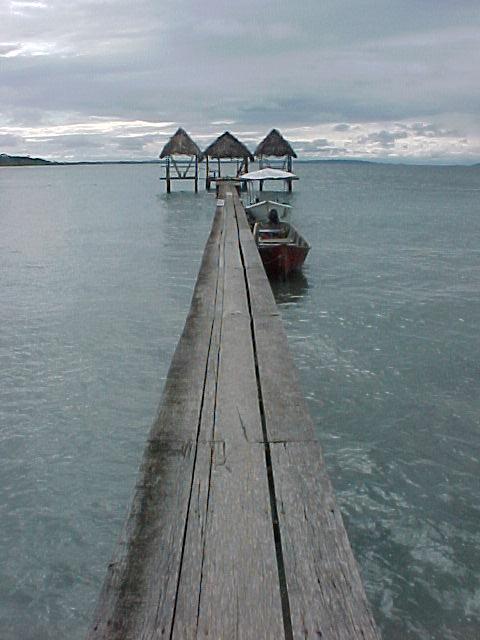 The bus ride from Puerto Viejo to the Panamanian border is only 50 kilometers, but what with a pee break for the driver and with the dirt road, chuck full of potholes, it took two hours. Further, the bridges weren't real bridges, instead they were old railroad trestles that creaked and groaned and popped every time we drove over one, causing the co-pilot's face to screw up nervously each time. This did not amuse me. The skidmark town on the Costa Rican side of the border is Sixaola. Border crossing procedure is thus: go to the grocery store and purchase for 300 colones a postage stamp that is clearly marked 200 colones. Inquiring about this Idiot Tax only brought a smirk from the cashier, so I just paid it and wandered off to the immigration office where they affixed the stamp and processed me through. The actual border crossing is a 200 yard long railroad trestle over a muddy river. Many boards are loose and missing and the passage is further enhanced by tractor trailer rigs cautiously nudging up behind you in single file. The two puddle town of Guabito is on the Panamanian side of the river. Someone had to roust the immigration lady from her siesta, but she finally stamped us through. Her office looked like it hadn't been dusted since 1972, but hey, that was tangential, and I was finally home!
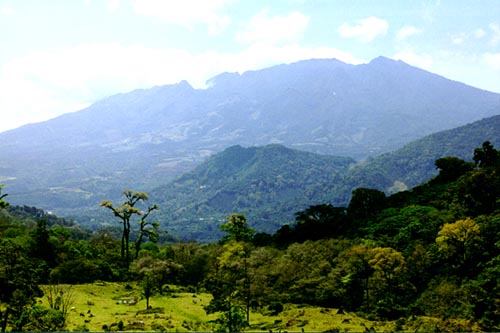 Boquete lies at the foot of Volcan Baru. The climate is quite brisk, and it looks like the mountains of Utah. The hills are all covered with pine trees, and there is a lovely stream running through town that is said to be loaded with trout. The housing and the way the town is set up looks like it could be anywhere in the US. I had the very disorienting experience of a middle-aged woman wearing a straw bonnet and driving and Isuzu Trooper down the street toot her horn twice, smile, and wave at me. Very strange. Jens and I were getting along great, so we checked into Pension Marilos for 7.50 a piece and enjoyed the private bathroom with hot water. For me, it had been two weeks since I had done my laundry, so I was disappointed to find out that the pension had discontinued their laundry service. Bummer. Another bummer was that Jens now had my hacking cough, and I definitely had a nasty sinus infection and bronchitis with no signs of it letting up anytime soon. That night, we ate at the Santa Fe Grill, had chicken burgers and fries, and watched the Super Bowl as the Ravens decisively won. ESPN and the very American feeling restaurant definitely rounded out the impression for me that Boquete is the undiscovered home away from home that many US retirees would flock to if they knew about it. There are less than 3000 residents, so George and Mildred, grab up your plots of land while the gittin is good!!!
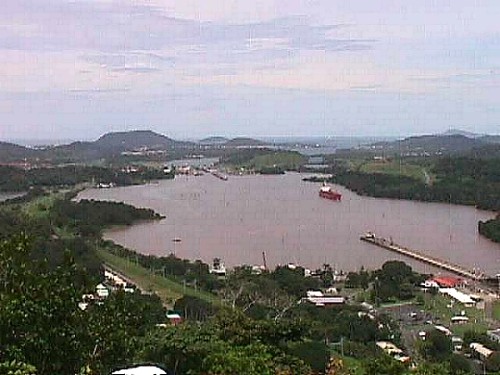 The next morning, Monday, we boarded the bus for a quick hop down the hill to David and a Busted Bladder ride to Panama City. The Interamerican Highway at this point continues in the same tradition as it did back in Guatemala...windy, two lane country road, best suited to 45 miles an hour, which is about what we did. The land is mostly dry, grassy fields with the occasional stream, and lots of hardwoods rounding out the hills and knolls. Funny how these landscapes repeat themselves. Before I came, I had no idea that so much of the land on my trip would remind me of home. One thing that was definitely different between Mexico / Guatemala and Costa Rica / Panama though was that gone now were the patches of corn tucked in every conceivable nook and cranny. Myself, I kind of liked seeing the corn everywhere, but I'm not the one who has to hoe and water it, so that's just the way it goes. The first view of Panama City is the magestic Bridge of the Americas, spanning the Pacific entrance to the Panama Canal. I was so excited to see all this stuff, as I knew that only a couple of miles off to my right, I was born and my parents had lived and my dad had worked. He was in the American Army down here for 2 1/2 years during the late 60's and early 70's, and all the stories I had heard about my early childhood stemmed from their adventures in the land I was seeing all around me. Pretty neat. I only wish that they could have been with me to tell me all about it. I couldn't help but wonder what was the same and what was different in what I was seeing and what they had seen.