This a draft, not a completed version. Please treat as such.

Moto Guzzi V11 Sport basic suspension setup

Notes:

  1. Your author is not a Moto Guzzi expert, what you will find below is a combination of basic mechanical experience and advice from people who are experts.
  2. Only you can determine if you should undertake this work. If you are at all uncomfortable consult an expert or simply take your bike to a professional mechanic for this work. You can make your bike unsafe by miss-adjusting the suspension. Proceed at your own risk.
  3. All of this should come apart and go together with a minimum of force. If anything requires more than a slight push STOP, something is wrong. If you can't figure out what is causing the problem consult an expert.
  4. Cleanliness may or may not be next to godliness but it is a very good thing. Keep your tools clean, the surface you are placing parts on are clean, etc.
  5. It is optional but anytime steel is threaded into aluminum it is a good idea to use a small amount of anti-seize paste to prevent corrosion from bonding the parts together.
  6. Read the whole article before you pick up a tool.
  7. I will not be covering how to do the actual mechanical work, if you need help to do that you may want to think before you make changes to your suspension.
  8. You must have a way to support the bike with the wheels off the ground to adjust the suspension. Your local Guzzi dealer (or, if you are like me and don't have a local Guzzi dealer MG Cycle, MPH Cycle or any of the dealers who sell via mail order) sells a very nice shop stand with a "spool" to support the front end. You can see the stand by following the MG Cycle link above and selecting the "V11 Sport". This stand or something like it is required for suspension adjustment.
  9. The factory manual is not great but it is good to have. The real thing in expensive and not always available. A couple of places offer photocopies. Sport Cycle Pacific for one. The book Guzziology is invaluable for a Guzzi owner. Read a sample of Guzziology at the Moto International web site. You can find the book at your Guzzi dealer, Moto International or at Amazon.com.

Before we start:

Some definitions and thing to keep in mind:
    Travel: The distance suspension moves from fully extended to fully compressed
    Sag: The distance the suspension compresses under the weight of the bike and rider
    Stiction (1): The static friction is a system. A word created by from combining the words static and friction.
    Stiction (2): In suspension the effect of stiction, i.e. the parts may not more back to the "normal" position due to effects of static friction.
    Damp: To slow the motion of something as in suspension damping the movement of the wheels.
    Dampen: To make wet, has nothing to do with suspension unless the damping fluid leaks.
    Sprung weight: The parts of the motorcycle supported by the suspension, e.g the engine, frame, rider, etc.
    Unsprung weight: The parts of the motorcycle not supported by the suspension, e.g the wheels, tires, brakes, etc.
    Spring rate: The amount of force needed to compress a spring a give distance. In the modern world this is expressed as kilograms per centimeter. In more primitive places it is expressed in pounds per inch.
    Pre-Load: Placing the spring under compression before the weight of the load (bike and rider) are added.
    Note 1 on spring rate and pre-load: This two should not be confused. Changing pre-load has no effect on the spring rate, it simply changes the amount of force needed before the spring allows the suspension to move. Trying to use more pre-load to make up for a soft spring results in stiff initial travel ( and therefore poor compliance over small bumps) and will still be too soft once past the first part of travel.
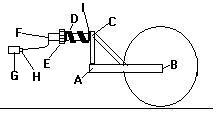
    Note 2 the rear suspension of the V11: The V11 rear end has roughly a two to one ratio between the movement of the axle and the compression of the shock. The drawing in the next frame is intended to illustrates this. Note that the distance from point "A" to point "B" in roughly twice the distance from point "A" to point "C". Keep this in mind when making any changes to or taking any measurements from the rear suspension.
    Note 3 on shocks used on the V11: This page will assume the reader has a V11 with the Sachs-Boge rear shock. If you are lucky enough to have a V11 with an Ohlins shock it may be slightly different.

V11 rear suspension:

    A: The swing-arm pivot.
    B: The rear axle.
    C: The rear shock mount.
    D: The spring.
    E: The pre-load adjusters (castle nuts).
    F: The front shock mount
    G: The remote reservoir
    H: The compression damping adjuster
    I: The rebound damping adjuster

Drawing no to scale.

OK, so what can I do with this suspension?

You can adjust three things:
  • The pre-load (via item E)
  • The low speed compression damping (via item H)
  • The low speed rebound damping (via item I). This page will cover setting pre-load and offer some suggestions regarding damping.
  • Setting the rear pre-load

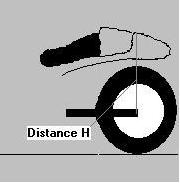
    Put the bike on a stand with the rear wheel off the ground and measure the distance from a fixed point directly above the axle on the sprung part of the bike (e.g. the seat, tail section, etc.)to the rear axle. We will call that number Distance H (DH).

    Now, make the same measurement with the bike off the stand and rider sitting on the seat. Having a helper at this point is somewhere between very good and mandatory. The difference between DH and this distance is the sag.

    To increase sag, decrease pre-load by moving the adjuster "E" toward the front shock mount "F". To decrease sag, increase pre-load by moving the adjuster toward the rear shock mount "C". Note that there is a limit to this adjustment. Moto Guzzi specifies the adjusted spring should be between 152 and 157 MM long. If you have adjusted the pre-load and the spring is less than 152 MM, the spring is too soft and should be replaced. If the spring is over 157 MM it is too stiff and should be replaced.

    So, how much sag is correct? There is no single answer but instead a range. I'd say the absolute minimum is 20% of the travel, the maximum is around 33% of travel. If you fancy yourself a sport rider, go toward the lower number (say 25%) a more sane rider might use 30%.

    Applying this to the V11 we find the rear suspension travel to be 128 MM (~5") so a very aggressive setting (20% sag) would be 25 MM (~1"), a very touring oriented setting (33% sag) would be 42 MM (~1.6"), a good starting point for most folks would be around 33 MM (1.3").
    Hosted by www.Geocities.ws

    1