
The engine oil is cooled further by an aluminum high-capacity Steffs oil pan. To be honest, 700 hp never sounded or felt so good thanks to the 2-1/8-inch-diameter custom-built headers and 3-1/2-inch lead pipe that transitions into a massive Flowmaster big-block muffler and 3-inch tailpipes. All ceramic header coating was applied by Airborne Coatings of Oklahoma City.With such a tremendous amount of horsepower on tap (did we already mention 700 hp?), the rest of the drivetrain had to be bulletproof.
A GM Turbo 400 transmission with a manual valvebody and a 10-inch Coan converter, and an 8-inch Fluidampr harmonic balancer was selected as the leader of any forward charges that the truck takes. An Art Carr partial shifter allocates the gears for both the transfer case and the transmission. An aluminum TCI transmission pan and Fluidyne Enduro HD transmission cooler keeps the fluid flowing with no interruptions between the sudden gear shifts. Once again borrowing from other motorsports technologies, such as monster trucks and tractor-pulling, Bryan bolted an SCS quick-change transfer case rated at 3,000 hp to the Turbo 400. His reasoning behind the quick-change setup was so that he could alter the gear ratios as he went from normal everyday street driving to slow rockcrawling territory.
The front and rear driveshafts emanating from the transfer case are custom-balanced and -fabricated 3-1/2x0.120-inch-thick steel units that house 1410 Spicer U-joints built by Longhorn Truck and Trailer of Wichita Falls. Front and rear axles were prepped by Dynatrac. The matching center pinion-situated Dana 70 HD units with 4-inch tubes were stuffed with 5.60 ratio Dana Power Lock units and covered up with finned aluminum Off Road Unlimited covers. Hardened 35-spline outer shafts were appropriately installed. At the end of each Dana 70 is a set of 35-spline Warn Premium locking hubs. A Borgeson offset steering box and joints along with dual hydraulic steering cylinders assist in pointing the massive 16.5x14-inch Weld Super Single Racing wheels with 39.5x18x16.5 Interco Super Swamper TSL Boggers wherever they must go.
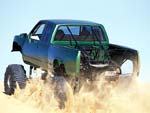
As previously mentioned, the factory cab was one of the only remaining original components of the '96 Chevrolet. However, even that component had to be altered as a result of the radical frame and vehicle configuration. For starters, the entire floor of the cab was cut out and channeled to fit over the frame so that the original design and safety of it wouldn't be compromised. Then, the factory firewall was removed, a new one was fabricated out of 16-gauge steel and installed 4 inches back from its previous location. This was done so that the up-front weight from the motor could be distributed more evenly upon landings so as not to have the third member housing puncture the oil pan. The bed sides with the hand-rolled 3/4-inch lips are fiberglass Pro Truck Racing units that have more than hundreds of hours of labor in them. When the team of Paul James and Mark Coleman were complete with the bodywork, the team of Danny Moreno and Kane Hibbs of Classic Paint and Body in Wichita Falls began to apply the '99 Ford Ranger Jalapeno Green paint, with a PPG clearcoat to follow. After curing time was over, all of the factory glass was reinstalled including the rear smoke-colored Lexan window.
One glimpse of the Budnik GT billet aluminum steering wheel with the carbon-fiber trim ring and you begin to make the association with the interior design of the truck as a cross between an F-1 racer and a full-on SCORE Trophy Truck -- thanks to the use of the carbon-fiber-faced Auto Meter gauges and shift light, which all seek refuge in the custom-built carbon-fiber panel that fits inside the tricked-out dashboard and custom-built console. Nestled comfortably between the two gray tweed Beard seats with five-point Simpson Cam-Lock harnesses is an Art Carr gated shifter. For ease of cleanup, the carpet was replaced with a Texomo Rhino Linings-applied black Rhinoliner. All interior wiring of the gauges and electrical systems was performed flawlessly by Ron Francis Wire Works, also of Wichita Falls.
Perhaps the best part of this whole project is the fact that Bryan's dream truck is 100 percent street-legal, which makes it more than possible for him to enjoy seven days a week -- especially now that he is working on building a '68 Pro Street Camaro that requires many trips to the parts stores. So the next time you think you saw a flash of green, remember that it can be either one of two things: Mother Nature's green flash or Bryan Taylor's. Honestly, we'd take Bryan's any day of the week, so long as we were the ones doing the driving.
