
Nalheárlu
alphabet is a modified Latin alphabet, including a number of 8 specially
designed letters, expressing sounds that don't exist in English (Gh, Lh, S, W, H
in Latin script) or sounds having particular morphological characteristics.
Latin
script for Nalheárlu:
Aa
Bb Dd Ee Vv Ff Gh gh Xx Ii Kk Ck ck Ll
Lh
lh Mm Nn Oo Pp Pp pp pf Rr Tt Uu Ss Ww Hh
Attention! F in original script becomes V in Latin transliteration.
V, K,
P indicate voiced consonants (v, g, b) in intervocal position and invoiced (f,
k, p) in all others.
F, Ck,
Pp indicate always invoiced consonants (f, k, p) – all three
slightly aspirated, Ck glottal.
Gh indicates
voiced roughly aspirated g [gh]
X
as ch in German machen. (!)
Lh indicates
l with rough aspiration afterwards [lh].
S
as shr in mushroom (!)
W
is a German ü, hardly labialised so it's close to w.
H is a sign of rough voiced aspiration.
Nalheárlu doesn’t contain sounds s, z, j, ch, zh.
Movable & Immovable consonants.
There are unvoiced consonants that become voiced when pronounced between two vowels, just like S in English, German, French. In Nalheárlu there are 3 unvoiced consonants that behave this way. Each of them has an unvoiced pair consonant that NEVER becomes voiced. They are:
| Movable | Immovable | |||
| letter | unvoiced | voiced | letter | |
| V | [f] | [v] | F | [f-]* |
| K | [k] | [g] | Ck | [k`]** |
| P | [p] | [b] | Pp
B |
[p-]*
[b] |
* [f-/p-]: "-" shows rough aspiration
** [k`]: glottal clicked [k] as in Georgian.
The movable unvoiced consonants become voiced when:
in the beginning of the word:
the word is preceded by:
- a relative object or possessive pronoun
- a relative adverb
- a relative adjective
in the end of the word:
when the suffix or an ending after it begin with a vowel.
! Immovable invoiced consonants are written only in places where the movable ones become voiced: in the very beginning or the very end of the word or between two vowels in the middle. In all other cases, the movable pair is written.
The letter B is written only in the position where the P isn't read as voiced (e.g báhi to give)
Example:
nalheárlu script:
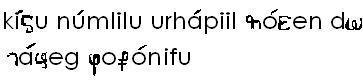
latin script:
hálheg ppofónivu
transcription:
['kishru 'numlilu u'rhabiil 'ghoken dy 'halheg po'fonivu] *italics indicates single sounds
translation:
Stars go at night and sun goes at day
([ancestors] make go stars night and sun day)
Stress
All the words that have more than one syllable are written with the stress shown by an acute accent on the stressed vowel. If the word group has both the primary and the secondary stress (e.g a noun wiith an adjective, or a verb with an adverb), or even several secondary ones, the latter are indicated with a grave accent. The use of primary and secondary stress in groups Adj-N and Adv-V depends on what is considered more important.
The stress has a tendency to change in emoted speech. If the emoted part of speech is long, it is stressed by a constant pattern (e.g `_`_`_... [`s showing the stressed and _s the unstressed syllables] or `_ _ ` _ _, or _`_ _`_ _`_ ... etc) in no regard to original word stress. If only a short phrase or a separate word are emoted, the stress remains in most cases unchanged. The verb aspect affixes are always stressed in emoted speech and never in inemoted.
In writing, the patterned emoted speech show only primary stresses indicated as by the pattern. The separated emoted affixed verbs are written with both stresses - on the emoted affix as primary, and on the original verb's stressed syllable / or on the second from the affix, if the original is next to the affix as secondary.
E.g: donúmlihu inemoted
dónumlìhu emoted