 Sectored
Light Modulator
Sectored
Light Modulator
In this case we must answer
the question - can we modulate the solar light with the necessary frequencies?
Buchman modulated the solar light with the frequencies of a plauground
swing - which can be anywhere from 0.2 Hz to 1 Hz. We need a greatly extended
range of frequencies, which will be easy to implement and control.
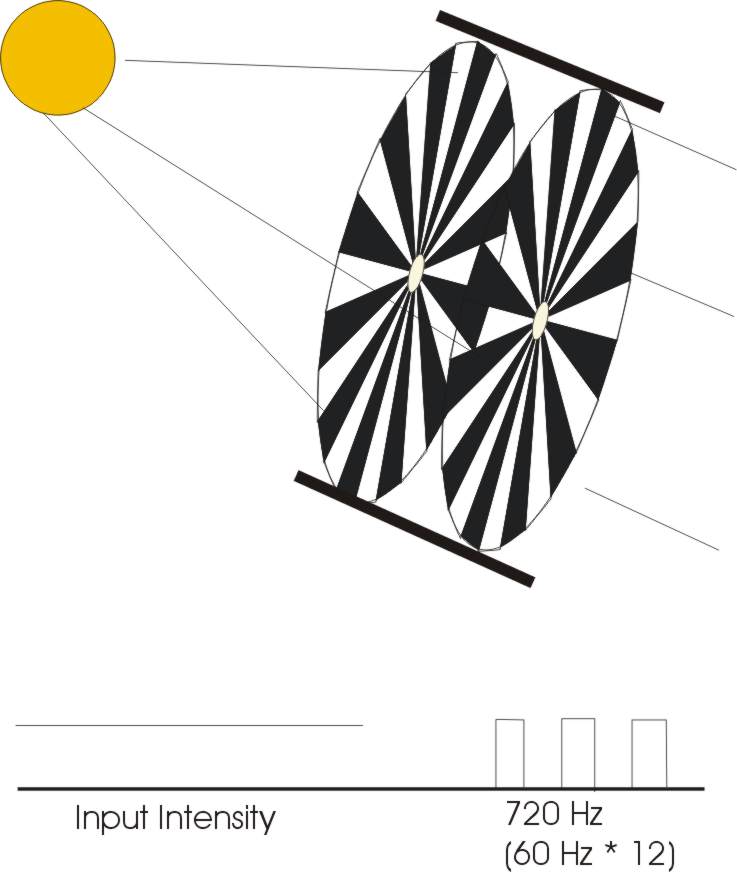
Fortunately an easy and convenient method is right at our fingertips. A simple sketch will make clear the idea - two disks, one resting and the other rotating, will periodically open and close the path of the incident light. In the example shown, the rotating disk turns at a rate of 60 revolutions per second, and has 12 sectors. The resulting frequency of light pulses comes to 12*60=720 pulses per second, i.e. 720 Hz. Making a disk with 100-200 sectors is not much of a problem, making it turn up to 400 revolutions per second is also possible. Since rotation speed can be precisely synchronized with a crystal oscillator, any modulation frequency within 15000 -20000 Hz can be conviniently implemented.
Sectored
Light Modulator
Combining both Buchman's method and Sectored Modulation
method, it is possible to achieve many various modulation patterns, the
limit here is set only by the creativity of the operator.
First and simplest one would be built straight according to Buchman's scheme - in the very simplest version it will be just the concave mirror equipped with some clamps to fix it to external swing. The diameter of such a mirror could be about 1 - 1.3 meter, Focal Distance - about 5 meters. For technological simplicity this mirror could be manufactured as spherical, with the R=10 meters (R = 2*F.D.). In this case the client can be positioned either at 3-4 meters, or at 6-7 meters from the mirror, avoiding the F.D. area ~ 5 meters, where the sunlight concentration could become excessive.
This simple system could also
be produced and marketed as a completely self-contained unit, with console
stand and swing hinges, such unit could be positioned on the ground, on
the roof of a car, on the picnic table, anywhere according to need and
to the local landscape. This unit could have a replacable main mirror,
which would allow the usage both as a food heating/boiling device and as
a Helio Massager.
Considering the possible
enhancements, even before introducing the H.F. modulation, a very desirable
feature for the Helio Massage unit will be the automatic Solar Tracking.
Solar tracking might not be a problem for lay casual user, who will rather reposition himself or turn the unit manually. However, any therapist wishing to make good use of the unit must know that once the sun is available, the unit will automatically position itself so that the client will get the necessary intensity of Sunlight.
In its low-tech implementation this tracking system might simply be based on a spring-wound clock, this will require some initial positioning and leveling of the system, but will keep all system free of solar batteries and other electrical equipment.
A more high-tech solution will involve installing several photosensors to detect the Sun, generating some electrical power with the help of solar batteries, and building an electronic/motor system to position the mirror assembly according to the Sun position. This system might also have a second mirror, which will allow it to direct the exiting light beam always precisely in the same direction, regardless of the Sun position in the sky.
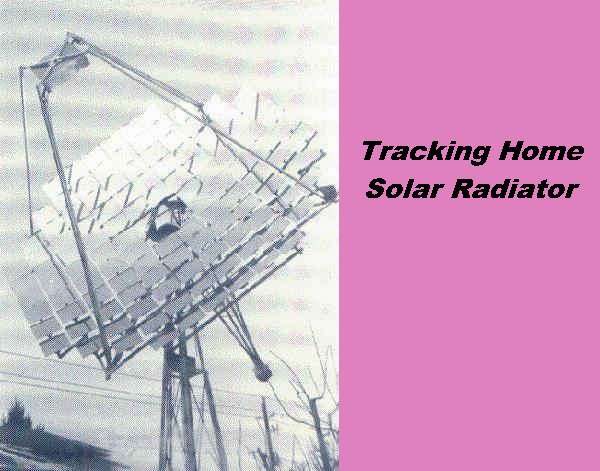
An old (but still sound) approach to the tracking problem is presented by Wayne Roderick in:
Modern approach would involve building the system around a microcontroller board. Microcontroller could take care of all system features, including Sun Tracking and both kinds of modulation - Low Frequency and High Frequency.
One good site for microcontroller
systems is < http://www.newmicros.com
>. Their products are Motorola-based, in particular, some of them are based
on 56800-series DSP processors. Included with the systems is the FORTH-based
programming language IsoMax, which yields easily to the tasks on hand.
================= 000 =================
The author of this site lives in San Diego, California.
He can be reached at < [email protected]
>