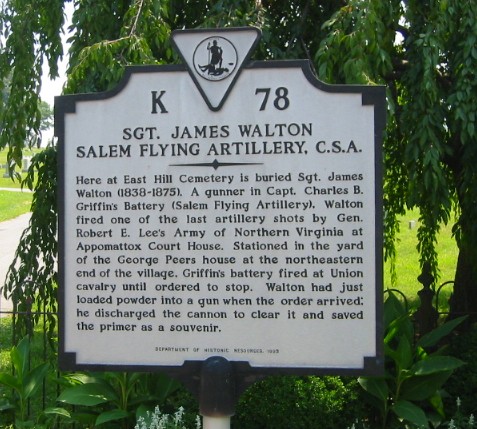
 |
| The Salem Flying Artillery, C.S.A. Army of Nrthern Virginia |
| One man, Abraham Hupp, seems to have been the rallying force behind a military presence. On August 4, 1840, he organized and became captain of the Salem Yellow Jackets, a unit attached to the 157th Regiment, Virginia Infantry, and one of six such militia groups in the county. Then, after it disbanded, he organized and commanded a successor company, the Salem Light Infantry Grays. While the volunteer Yellow Jackets and Grays had a nominal capacity for military action that was never required, their primary function, aside from some training, was performing at dress parades for occasional celebrations, perhaps accounting for their transitory existence. In contrast, Captain Hupp's next unit, the Salem Flying Artillery, was early into the fray and credited with firing the last shot at the surrender at Appomattox. In between, its men fought at Fredricksburg, Chancellorsville, Gettysburg, Spotsylvania Court House and Cold Harbor, among other places. Hupp organized the Flying Artillery January 30, 1860, when volunteers were enrolled in a corner of the courtyard marked today by a Confederate monument. A month after Virginia's 1861 vote for secession, he led its volunteers in their send-off parade from the courthouse to the Virginia and Tennessee Rail Road station, then to Lynchburg, where they were mustered into service of the Confederate States Army. Hupp had obtained a position of prominence, riveted by success as a manufacturer and distributor of metalware. He was a staunch supporter of education, active as a trustee in the establishment of Roanoke College and a principal in organizing a circulating library. Fire destroyed his metalshop adjacent to and east of the courthouse. After rebuilding, he not only took the lead in organizing a volunteer fire company but donated the town's first pumper. He was a founding partner of the Roanoke Red Sulphur Springs resort in the Catawba Valley and, as an Odd Fellow and a member of the town's board of trustees, he was a leader in building the first town hall. His imposing brick residence across Main Street from the courthouse was beautifully landscaped, eclipsed only by his gardens a short distance north of town that he opened to the public. Hupp's Salem Flying Artillery was designated Company A, 9th Regiment, Virginia Volunteers, during a year of training and service at Craney Island in the Elizabeth River near Norfolk. During reorganization in May 1862, the unit became Hupp Battery, 1st Regiment, Virginia Artillery. Ill health overtook Hupp later the same year and forced his retirement from the field. He died of cancer at home September 2, 1863. His military command went to a fellow townsman, Captain Charles Beale Griffin, a physician, who enlisted as a private in 1861 and was promoted to first lieutenant a year later and who led the battery until the surrender April 9, 1865. That Captain Griffin's artillery fired the last shot at Appomattox is documented in an article in the July 1869 issue of the magazine, The Land We Love, published by General D. H. Hill. Braced for an enemy charge that was already within pistol shot, the battery was in a commanding position overlooking the town when a Confederate general some distance away ordered a cease fire. "The hoarse sound of the cannon had died away in every part of the line except this, the extreme left, which was soon after silenced, and with it the last gun of the Army of Northern Virginia," the article said. Another account of the surrender in Harper's Weekly confirmed that the guns of the Salem battery "fired the last shot, on this occasion, at the Federal Army." During the spring of 1861, as a surge of loyalty to Virginia erupted in the western mountains, Salem's court green was the mustering point for four volunteer companies, including the Flying Artillery. While Hupp was drilling his men on the fields near Salem in anticipation of a call to service, the Roanoke Grays were organized in March 1861 and joined the C.S.A. ranks at Lynchburg in April, a month earlier than the call-up came to Hupp's unit. In command was Captain Madison P. Deyerle, who left law school to enlist, and who, at age 22 was killed at the Battle of Williamsburg April 5, 1862. Deyerle had refused a promotion to colonel and transfer to a higher command in order to stay with his men in Company I, 28th Regiment, Virginia Volunteer Infantry, 1st Corps, Army of Northern Virginia. The unit saw action at First Manassas in 1861; at Williamsburg, Seven Pines, Malvern Hil, Cold Harbor, South Mountain, Antietam, Fredricksburg and Second Manassas in 1862; at Gettysburg in 1863; and at Five Forks in 1865. The other brother, John S. Deyerle, was captain of the Roanoke Guards at the time of its organization in July 1861 and its assignment shortly thereafter to the Western Army as Company K, 54th Regiment, Virginia Volunteer Infantry. Its battles were at Harrodsburg and Richmond Ky., Chickamauga, Ga., Knoxville and Missionary Ridge, Tenn., and in the Georgia campaign from Dalton and Atlanta and into Tennessee. Deyerle was promoted to major and transferred to Virginia in 1863; then, using a medical degree he earned in New York just as the war began, he left the infantry and served as a surgeon in a calvary unit until it ended. A fourth brother, Ballard P. Deyerle, was only 16 when he served as a first lieutenant in his brother's company in Kentucky, later he rode with the calvary. |
 |
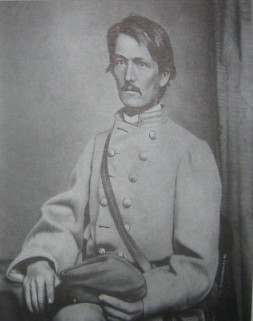 |
| Captain Charles Beale Griffin Salem Flying Artillery |
| Griffin, Charles Beale - Captain. Born 1833. Student at UVA 1852-1853. Medical school at University of Pennsylvania. Occ. Physician. Enlisted May 14, 1861 at Salem for 3 years, age 27. Elected 1st Lieut May 8, 1861. Acting surgeon May 14, 1861 - July 6, 1862. Trans. from 9th VA Infantry May 8, 1862. "Relieved from duty at Battery 5," Richmond, July 6, 1862. Promoted to Captain Sept. 2, 1862. POW Sept. 1862 in Maryland, exchanged Oct. 6th at Aiken's Landing. "Absent by certificate of Medical Dept. for 30 days from Oct. 24." Chimbarazo Hospital #1 Jan 27 - Feb. 7, 1865., fur. 35 days from hospital starting Feb. 7th. Paroled at Appomattox Court House April 1865. Died September 17, 1885 in Salem, buried West Hill Cemetery, Salem, VA, no marker. Source: Powhatan, Salem and Courtney Henric Artillery. Virginia Regimental History Series. By: Richard L. Nichols & Joseph Servis 1997 |
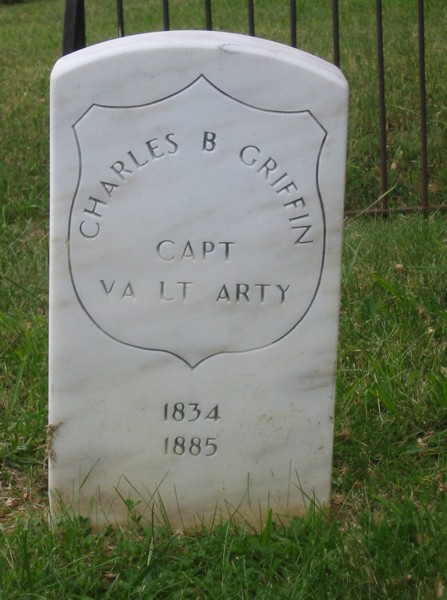 |
| Headstone Placed By The United Daughters of the Confederacy |