   
|
 Men's fashion in the early 1920's was the same as it had been for the rest of the century. Sacque suits were worn during the day, sometimes with bowler caps, and tailcoats were worn in the evening, with tophats. London was the center of men's fashion influence at this time; baggy pants, or "Oxford bags," became popular in 1925, when Oxford University banned its students from wearing knickers. Jazz suits were also in style, though they quickly became defunct once the twenties were over. These suits were tighter and less boxy than their predecessors, and they were generally worn with belts instead of suspenders. In the spirit of twenties style, they created a slim, boyish look, which was popular among both sexes. BACK TO TOP |
 1920's women's fashion is famous for the scandalously high hemlines of the flappers. Skirt length, however, actually had a wide range during this decade, and for most women, the hems of dresses and coats stopped mid-calf. The more simplified dress styles of the twenties allowed the line between upper and middle class to blur; more women could now afford the fabric and patterns necessary to make up-to-date, stylish clothing. During this period of time, a straight up-and-down silhouette became popular for women. The hourglass figure of the Edwardian age was no longer desirable, the preferred look being a youthful, fit body more like that of a 15-year-old girl. Many women bound their chests in order to fit this curve-free ideal. BACK TO TOP |
 The twenties marked the first instance of women wearing makeup in polite society. Generally a dark-lipped, round-eyed style was preferred, like the makeup worn by silent film stars onscreen. Black eyeliner, mascara and eye shadow (or "eyelid-darkener") were heavily applied, as well as rouge on the cheeks and lips. Hairstyles were short -- the twenties saw the emergence of the bob haircut -- nearly the same length for males and females. Women who didn't want to cut their hair would generally have a few strands bobbed in front, and wear the rest in a bun. Waves were a popular embellishment to a hairstyle, preceeding the tighter curled styles of the 1930's. BACK TO TOP |
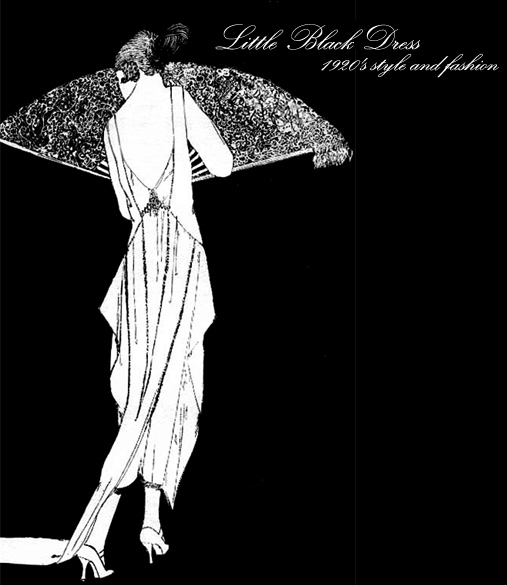
 The Flapper style really only emerged between 1926 and 1928, contrary to popular belief. Film stars like Louise Brooks embodied this ideal, which was glamorous, elegant, and rather risque for the times. Flappers were the rebels of 1920's society, wearing skirts that showed off their knees, wearing makeup indiscretely and applying it in public, smoking with long cigarette holders, and showing as strong an affinity for drinking and dancing as men did. The French term for Flapper was gar�onne; basically, "female boy." The Flapper period in fashion marked Coco Chanel's rise to fame as the creator of the epitome of 1920's fashion: the "little black dress". BACK TO TOP |
|
Pictures & information gotten from: fashion-era.com The 1920's Experience Just the Swing reVamp Vintage The Louise Brooks Society |