Business & Money
- "When you (consider) Web-storefront hosting services, challenge them . Ask them to cite more than 5
Web-based services that are generating significant sales' profits by selling everyday items. That is, not
computers, CDs or offbeat stuff that you would have to buy in a gift shop (collectible - ed.) or overseas."
- - D Joacim, Internet Week 9/29/97
[ Then ask them if they use Kiva Enterprise Servers : " No matter what we threw at the software, crashing
process after process in attempts to bring it down, it readjusted, reconfigured and kept on going." , said PCWeek
pg1 1.19.98
Then ask them if they'll let you buy a $3,995 client-based seat for their copy of ]
Internet Mall first & biggest. Nearly, if not THE, cheapest
place to set up a virtual storefront.
OrderEasy Internet Mall's set-up & transaction location
for shop holders.
Quicksite Internet Mall authoring program from Deltapoint for
creating storefront
ShopSite Manager by ICentral $500 commerce site authoring app
incl. secure transactions & catalog.
FirstHost - local San Diego vendor of ShopSite Manager
CheckFree - leading provider of e-commerce processing
services & software.
Also home banking & bill payment. Includes E-Bill, a consolidated utility bill
eCharge - allows retailers to add payment to their customers' phone
bills. Simple to add micropayments to retail website.
CommerceNet - for companies using, promoting and building
electronic commerce
Stamps bought over the internet - new US Postal Service stamps in
the form of bar code
How to do it and how not to
- Internet business strategies of 2 major newpaper
syndicates, esp. comic strips.
"Every comic is for sale as a framable copy, whether you come across it on your own or get it in an e-card-in
fact, cartoons received as e-cards are so retail-friendly as to verge on unseemly, with prices right there on the card.
You can buy it signed or unsigned, framed or unframed. And if you "buy now," you get the comic for about half what
you'll pay if you wait 24 hours. This is wicked smart thinking.
UExpress wouldn't tell me how much it makes from the online comic sales, but it did say it amounts to more than
half of its total commerce revenue. The remainder comes from a conventional licensed merchandise store. Ad
revenue is slipping. Its commerce revenue in a given quarter, though, is generally three times what it stood at in the
same quarter a year earlier. And well it should be. Selling content directly-and virally-is the ultimate in targeted
marketing."
CPA Webtrust - a seal of approval sanctioned by the non-profit American institute of Certified Public Accountants &
the Canadian Institute of Chartered Accountants for business practices and security mechanisms at commerce-
oriented web sites. VeriSing Inc. technology. Better Business Bureau offers similar seals. (Internet Week
9.29.978)
liability terms - informed & practical template for liability waiver
Open Trading Protocol - IBM and thirty + more for " rules set for many aspects of
a consumer electronic transaction, ranging from offers for sale and choices of payment vehicle to product delivery,
receipts, and problem resolution."
First Auction - Home Shopping Network sibling
Federal Auction and sales
Onsale - refurbished equipt
Egghead.Comm's
eBay - used goods
FairMarket AuctionPlace - hosting and support services
for
person-to-person and business-to-consumer online auctions.
Mercata / Accompany -
more people who want to buy something, the lower the price.
Andy's Garage Sale - "nwe stuff, dirt cheap"
Seized Property Auctions / U.S. Department of the Treasury Auctions
Give OnLine -intended to validate or verify charitable
status
Financial Aid and
scholarship database
Consumers Action Network - clearinghouse for on line
scams
Internet Fraud Watch
Cybersource - help for credit card fraud
US Postal Service
Junkbusters - protect privacy from direct marketing
postal calculator - postage charge
for any
size & weight of letter or package
FedEx
UPS
DHL
Sales prices - on over 10,000 homes in
San Diego
County, broken down by city and ZIP code. Also an alphabetical bankruptcy index for the Southern
District.
Equipt Leasing Association
IPrint - takes web orders for custom printing ( incl. logos on
golf balls,
aprons and sticky notes )
Internet marketing references - L.A.
Times
Left Business Observer "accumulation & its
discontents". Heavily statistic based anti-capitalist journal by Doug Henwood, "the Marxist Wall St.
couldn't ignore"
Entrepeneur magazine databases incl. business
forms
entrepeneur forum Inc. Online
Smart Business Supersite narrow focus expert articles
Business Owner's ToolKit bus. forms, checklists, Excel format financial
worksheets
Small Business Tax Review taxes & management for small business
Small Office on-line form for calculation of business start up costs
Small Business articles L.A. Times
Small Business Investment Companies
Netcenter - Netscape's business oriented
dervice center
free seminars Inc. Online
Virtual Coach resource for business executives
Idea Market nuggets of business wisdom for sale
Business Booktalk
interviews with authors whose books became classic
HemNet - executive summaries on information technology
ThirdAge marketing to seniors
PacBell Yellow Pages sales
Hoover's Handbook of American Companies -
courtesy of L.A. Times. Ten thousand companies, public and private, are listed in our company-capsule
database. Each capsule includes a description, address and phone number, officers, sales and employment
figures, and hyperlinks to more information, like financial reports, stock quotes and SEC filings.
Commerce Business Daily - Federal listings of
subcontracting, procurement, contracts & surplus
Commerce Dept. Stat USA - $50 annual fee
|
10 myths of the new economy
10.01 Peter Fingar & Ronald Aronica, auth
The Death of "e" and the Birth of the Real New Economy
Meghan-Kiffer Press, 2001. Explains new business models for
value chain optimisation & collaborative commerce. Reveals critical role of enabling technologies for
conducting business at the network's edge: Web-services, peer-to-peer computing and intelligent agents as well as
integrated commerce resource platforms.
E-business has become just business. e-Commerce has become just commerce. The new economy has become
just the economy. The new economy is dead. Long live the real economy, where business fundamentals count.
The Internet is not the economy; it's a channel: you don't drive it, eat it or live in it.bIit's the information channel
tracking what you eat, drive, and live in. You cannot even see it; its central nervous system is in cyberspace moving
around in geosynchronous orbit. Today, only a small fraction of the transactions of the economy flow through it, yet,
its force is reshaping the way buyers & sellers of economic goods do business. The events in 2000 signaled
the end of the Internet bubble and marked the start of real digital transformation in the economy. Advertising &
marketing specialist Ashok Dongre provides apt summary, "All the people, who jumped on to the Internet
bandwagon because it was fashionable, are now abandoning it. But that is simply good news for serious users.
… " hype & myths that surround Internet-based business.
1 There is a new economy.
We still live in the age of oil, in an industrial economy, not a post-industrial, intangible, space-based information
economy. When asked if we are in a post-industrial economy, Univ. of Washington Inst. for Public Policy
& Management sr fellow Glenn Pascall replied, "No, we live in a knowledge-based industrial economy. By the
|
numbers, making & selling physical products remains the dominant activity. Manufacturing employment drifts
down steadily but the value of output from this sector holds steady at 25% of gross domestic product. Some
analysts believe business service inputs to manufacturing account for another 25%." There is no "new"
economy, but there is something very new in the real economy. The Internet provides a powerful new business
infrastructure, a universal information system, for handling the transactions of the economy, bringing radical new
efficiencies to both buyers & sellers of goods & services. The advent of e-commerce does not eliminate
the business cycle nor will it create a new economy where the old rules are thrown out and productivity gains spiral
only upward & upward. In almost all cases, the Internet does not change fundamentals of business
- capital, innovation
- profits
- cost control
- liquidity
- quality
|
Nor does it change the basic demands of customers:
delivering value.
|
|
The dot-com phenomenon was concerned with B2C retailing, and though it generated the e-hype, market frenzy
and all the press, it is the business-to-business connections that make up the lifeblood of the economy that is at
issue. Those B2B connections
- are a hundred fold larger than the B2C connections
- are at the center of the search for economic transformation & hyper-efficiency
- frictionless commerce
- where supply chains of inventory are replaced by value chains of information.
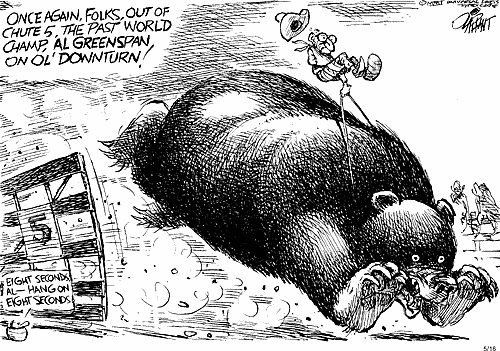
In remarks before the U.S. House Committee on Financial Services in March, 2001, Federal Reserve Chairman
Alan Greenspan said the prospects for productivity growth in the U.S. economy remain bright, in part because of
B2B e-commerce technology that has sped the reaction time of companies to ebbs & flows of supply &
demand. "Extraordinary improvements in business-to-business communication have held unit costs in check, in
part by greatly speeding up the flow of information," said the chairman. "New technologies for supply-chain
management & flexible manufacturing imply that businesses can perceive imbalances in inventories at a very
early stage, virtually in real time, and can cut production promptly in response to the developing signs of
unintended inventory building." "A couple of decades ago, inventory data would not have been available to most
firms until weeks had elapsed, delaying a response and, hence, eventually requiring even deeper cuts in
production. In addition, the foreshortening of lead times on delivery of capital equipment, a result of information
& other newer technologies, has engendered a more rapid adjustment of capital goods production to shifts in
demand that result from changes in firms' expectations of sales & profitability. A decade ago, extended
backlogs on capital equipment meant a more stretched-out process of production adjustments."
During the past few decades, manufacturing was globalized and the Western economies, once the
manufacturing monopolists, were transformed. In the knowledge-based industrial economy, white collar work
will likely be globalized because that too is now possible. Why would a New York corporation pay a quarter of a
million dollars a year to a CFO in New York when the same services are available for $30K year in South Africa?
Same certifications, same quality. Already computer programming has moved to India, engineering design to Asian
Tiger countries and basic research to Russia. The fundamentals of business are still intact despite the pundits
yelling "throw out the old rules" and "forget everything you know." Moving forward, B2B will mean "back to
business", and B2C will see dot-com whiz kids going "back to college," hopefully to a good business school. We will
need more work horses than show horses to build the Internet backbone for the hyper-efficient economy of the 21st
century. It is going to be a lot of work & heavy lifting in the years ahead.
2 The Internet is a business fad that faded in 2000.
Despite the dot-com crash of 2000, the Internet still changes everything. Could a business work today without the
telephone or fax? The Internet, too, is fundamentally reshaping businesses, the information systems that run them
and the industries in which they compete. This profound change has only begun and is so overwhelming that it will
take several years for businesses & industries to learn, adapt and harness the most significant information
medium of the 21st century. Unlike any information network before it, the Internet is pervasive, interactive,
multidimensional and capable of delivering value chains of information never before possible. Companies should
no longer worry about their industry getting "Amazoned," they should worry about getting "GE'ed." In an interview
with BusinessWeek Online, GE's legendary Chairman & Chief Executive Officer, John F. (Jack) Welch said,
"Where does the Internet rank on my priority list? It's number one, two, three, and four. I don't think there's been
anything as important or more widespread in all my years at GE." His theme for GE's business unit executives has
been "destroy your business." The idea is to study & discover how the Internet competitors wanted to destroy
GE's business and change existing business models in response to these threats. The second part of the exercise,
"grow your business," conceives how the Internet can be used to reassemble sustainable competitive advantage.
Why is Welch so excited about the Internet? The Internet exposes so many possibilities to so many facets of
business, that the ultimate question any business must ask is "what can we now do to gain competitive advantage
that we could not do before the Internet?" What's the business impact on the business when the entire world can
share one computer, one information system, one marketplace? What's possible when customers & suppliers,
both their people & their computers, share the same information base? Answers to these questions will vary,
industry by industry as leaders redesign & stress test end-to-end industry business processes, wringing out
friction, inefficiencies and disconnects in the overall economy. The Internet is an infrastructure for a whole new way
of doing business
3 The foremost goal of a company is to deliver shareholder value.
In the era of too much cash in the public markets, it seemed that shareholder value (especially the stratospheric
IPO) had replaced the customer as king. Not so. Thanks to the transparency the Internet introduces into markets,
consumers have grabbed power from producers and transformed customers from kings to never satisfied dictators,
demanding impeccable quality, the best price & excellent support. Glenn Pascall paints the picture, "A basic
reason shareholder returns can't give purpose to corporate life is the length of time a stock is held. The U.S.
longevity champ is General Electric, where shares stay in the same hands an average of 3.5 years. For Microsoft,
the average is 3.5 months and for Yahoo! Inc., it's 3.5 days. "Even if a company embraces shareholder returns as
its reason for being, what should it do if the average shareholder is gone before the impact of any strategy can play
out? Moreover, what is behind the stock market surge, other than a vast pool of hot money floating around the
globe and alighting for brief periods on targets of opportunity? Can such a "customer" serve as the proper focus for
corporate strategy? The question answers itself."
4 Clever ideas make new wealth.
Zillions of dot-com ideas amounted to nothing. The primary reason was baseless business models. Just because a
business can be ported to the Internet, that does not mean it should be or that the venture will succeed. The new e-
business had better add compelling value that is not available elsewhere. Even with a sound business model,
success can be difficult to achieve and requires ongoing effort just as any business venture. Success in using the
Internet as a new business medium is all about execution. Fresh ideas are necessary in light of the possibilities
posed by the Internet, but only execution is sufficient. Ideas, plans, and strategies are one thing - implementation is
something entirely different. CEO Jeff Bezos proclaimed that nothing Amazon.com does is very original; it just
executes better than anyone else. Strategy is nothing without execution, and execution requires firing on all
cylinders: product planning, technology, marketing, promotion, fulfillment and customer care. Amazon began as an
Internet pure play, but kept running hard until it too became a brick & mortar company with real warehouses
& logistics systems. Furthering these moves, in March 2001, Britain's Sunday Times reported that Amazon,
the best-known internet brand in the world, had begun talks to form a strategic alliance with WalMart Stores Inc.,
the world's largest retailer.
[ Before or after Amazon sued WalMart for theft of trade secrets via predatory hiring of Amazon
employees ? ]
5 B2B marketplaces should be the focus of e-business efforts.
During the business reengineering movement of the past decade or so, some companies downsized &
outsourced themselves until they became anemic. The cost side of the business is vital, but the real prize of any
business is to provide value to its customers and make a healthy profit in the process. B2B marketplaces &
trading consortia will continue to be a moving force in the economy, but the danger, due to their popularity in the
trade press, is that companies can commit too many resources on the buy-side of the business at the exclusion of
the customer-facing initiatives. In this age of the customer, a company's differentiator will be pleasing never
satisfied customers, not just squeezing costs. McKinsey & Co. assoc. principal Sam Nickless says, "it is wrong
for companies to view an online exchange as the exclusive focus of their e-business strategy, adding that the focus
on online exchanges might be blinding them to better e-commerce opportunities elsewhere in their business.
Nickless estimates that a business can save 7-10% on purchasing costs by simply cleaning up its internal
processes before joining an exchange, which might only achieve additional savings of 1-4%. Given that there is
only a limited amount of time & energy that you can spend in the management of e-commerce, you may be
better off focusing on e-commerce that is customer-facing rather than supply-facing." B2B is not the opposite of
B2C, business-to-consumer. With the demise of the dot-com retailers, companies must not be distracted by crash
& burn stories. They should keep their resources targeted at the customer, whether that customer is another
business or the retail consumer.
6 B2C e-commerce is dead.
Sr analyst Ramin Marzbani says the only aspect of the B2C e-commerce market
that should have been, and was, written off was the astronomical valuation given to pure-play Internet stocks.
Looking beyond the U.S., Marzbani says the growth of B2C retailing is evident in Australia, "It was about $920
million last year and is on course to do about $2.9 billion this year in Australia. That figure is 1.5% of all retail
consumer spending, so it's gone from being 0.5% to 1.5% in a year. It's still a small number, but its growth
rate is huge, and it's very, very real, and will continue. The thing is that most of the B2C is going to be done by
established businesses & established brands. Anyone who says that B2C is over is stupid. All that has
happened is that we know how much Pets.com should have been worth, and it was not $10 billion."
7 The need for speed is central to competitive advantage in the Internet Age.
Time-to-market has been trumpeted as absolutely essential in the Internet marketplace. First-mover advantage is
everything, goes the maxim. Black Christmas 1999, however, challenged that myth and the business world
recognized that the ability to deliver was far more important to sustainable success. The ability to deliver depends
on having a sound business design, depth of resources and proper positioning in a given industry. Total demand
does not magically go up because businesses use the Internet, and companies must still earn their share of a given
market. Only the best, not necessarily the first, can do that. "Accepted business wisdom holds that the moment one
company in a market comes up with a revolutionary new idea, its competitors will try to copy that idea as quickly as
possible. E-commerce is no different. Although a 'first mover' may be able to achieve an initial advantage, and
perhaps fatten its bottom line as a result, that benefit may be short-lived as its competitors race to introduce
copycat strategies. "Despite the multitude of e-commerce business plans that have been introduced over the past
year or so, at a macro level most are remarkably similar (for example, online trading marketplaces). The real point
of difference comes in the execution of those plans. Research co. Gartner Asia-Pacific vp Bob Hayward describes
the situation as a zero-sum game: at the end of the activity no one company is markedly better off than any other.
He says the companies that have benefited most from the e-commerce revolution have been the suppliers of
technology & consulting services for making it happen, although he rejects the theory that e-commerce is a
conspiracy by technology companies to increase their profitability. "Ramim Marzbani says that, regardless of the
wonders of e-commerce, many companies are too reliant on sales in their domestic markets and have no way of
increasing the demand for their products. If you were selling shoes or toothpaste yesterday, the demand for your
products didn't change one bit as a result of e-commerce. Market demand does not change in the short term for
anything, so if everyone else is doing this e-commerce stuff, the first thing that happens in the short term is that
everyone's cost of doing it goes up. So profitability has got to get hurt." The zero-sum game does not eliminate the
need for speed. That speed, however, must relate directly to the ability to sense and respond to changing customer
demands & market conditions, not just to be the first off the starting block.
8 The Internet disintermediates.
Why use middlemen, wholesalers, distributors & resellers, when the Internet enables companies to sell
directly to the end customer? Although some companies such as Dell bypass traditional channels and sell direct,
intermediaries have added & continue to add value. They finance inventories, they warehouse, assemble and
distribute products and they service & support customers. Knowing the true value of middlemen, most
companies are not the least bit interested in disintermediating them. Car manufacturers now let their customers
customize & order online, but the sale is redirected to a local dealership. When intermediaries add value, the
Internet can bring efficiencies to, but not dislocate the middleman. If the middlemen do not add value, they will be
eliminated as observed in the travel industry where the travel agents' primary value online would be to deliver a
paper ticket. Only travel agents who act as travel consultants thrive in these times. Travelers who know where they
are going, how to get there and where to stay when they arrive do not use travel agents, they use online booking
services. Instead, thriving travel agents serve those who need the added value of advice & assistance. What
happens to those that do not add such compelling value? They're gone, replaced by the e-ticket. These
fundamentals apply to the pure net plays. Online e-marketplaces, MetalSite for steel, Transora for consumer
product manufacturers, PlasticsNet for plastics, that only aggregate suppliers' products without significant value
add will fail. After all, they are only Web sites and the conventional intermediary is so much more. But traditional
brick & mortar middlemen cannot rest on their laurels. To succeed in the digital economy, they must add new
value through providing information and aggregating services not previously available. Companies such as the
huge PC wholesaler, Tech Data, were early adopters of the Internet and played a leadership role in setting new
standards & processes for their industry,Tech Data by becoming a founding board member of RosettaNet in
1998. RosettaNet is a non-profit consortium of major information technology, electronic components and
semiconductor companies working to adopt common business processes to advance IT supply chain interaction
worldwide. These standards form a common e-business language (the organization's name was adopted from the
ancient Rosetta stone), aligning processes between supply chain partners on a global basis. When brick &
mortar Tech Data joined RosettaNet in 1998, the Fortune 500 company generated sales of $7.1 billion. By the end
of 2000 the click & mortar middleman had generated sales of $17 billion and reported record earnings. Rather
than be disintermediated, Tech Data harnessed the Internet to become a super-intermediary.
9 Built it & they will come.
Traditional marketing is still the key. Long time technology writer, Clinton Wilder, filed this report, "Once again, the
theory is simple enough: The Web is the first communications channel that enables cost-effective one-to-one
marketing on a huge scale. Marketing to a "segment of one" has long been the goal of database marketing, data
mining, and telemarketing, but Web technology enables marketing of unprecedented exactitude & low cost.
But how do companies get people to come to their Web sites in the first place? "Customization &
personalization are fine for customer retention but not so good for customer acquisition. In the global world of the
Internet, what counts is brand. That's why Yahoo posted billboards at San Diego's Qualcomm Stadium during the
World Series, and why Web shopping site Buy.com kicked off a $25 million mass marketing campaign with ads on
Monday Night Football, and that won't happen with only targeted Web banner ads. "Mass marketing is also a
necessity for the captains of online industry. Dell isn't the largest online PC seller only because of execution; it also
heavily markets its direct-selling approach on prime-time TV & elsewhere. In E-commerce, branding &
mass marketing are more important than ever. Ultimately, that's just common sense, at least, for those who
understand there's more to E-commerce than click-throughs. You can't just build it, because they will not come."
10 E-commerce is dead.
E-business is certainly not dead. The e-myth, however, is dead. It crashed & burned in 2000. Electronic forms
of business & commerce have been deployed since the advent of the computer. With the introduction of the
Internet, this trend takes a quantum leap forward, allowing even the smallest business to participate in electronic
trading. Electronic forms of business have been embraced & evolved for over a half century, becoming
increasingly powerful business tools. The world's first global electronic network was capable of connecting a
company to its customers & suppliers anywhere anytime, in real-time. A hundred years ago, however, the
press did not rush all about calling it t-commerce, t-business, t-banking or t-whatever. For sure the telephone was a
disruptive business technology and every business had to have one, but the t-hype did not emerge to confound
public financial markets. Nor did the first ubiquitous document technology. Facsimile technology did not trigger a
Wall Street stampede for f-commerce or f-business IPOs. As e-commerce & e-business emerge from the
mystique of the IPO frenzy and become mainstream, the "e" will simply go away.
 Fame.org contra fiat money
gold treaty
The Bank for International Settlement keeps its balance sheet in GOLD FRANCS.
Currently $58 ea. Jan.01 Au $265
[ p.o. box 31576 Phoenix, Az 85046-1576 602.569.2336 fax .1353 email ]
B.I.S. was formed in 1930 for the specific purpose of being the "Central Bankers" Central Bank.
Ownership of B.I.S. is 84% held by foreign, privately owned, Central Banks, and the remaining
16% is owned by certain elite private investors. Ten times a year the Governors of the Central
Banks of The Group of 10 meet at B.I.S. Headquarters in Basel, Switzerland to set monetary
policy for the world.
Gold Francs are fractional currency. Highly negotiable, they contain .1867 Troy ounce of fine gold.
The diameter is the size of a U.S. Nickel and the approximate thickness of a U.S. Dime. We
typically deliver coins which are at least one hundred years old and usually are about 125 to 150
years old. They come in extra-fine condition which means everything is bold and clear on these
golden antiques. While these coins may be obtained very close to their melt value and held for
their bullion value, they are considered to be "coins of special collector interest". This makes them
Private when you buy and when you sell. (Unlike modern foreign monetary bullion which requires
IRS Reporting at liquidation.)
The BIS announces the withdrawal of all shares held by its private shareholders
against payment of CHF 16,000 per share
Jan 8 2001 The Extraordinary General Meeting (EGM) of the Bank for International
Settlements (BIS), held today in Basel, approved the proposal of the Board of Directors
announced on 11 September 2000 to restrict the ownership of BIS shares exclusively to central
banks. All BIS shares currently held by private shareholders are being withdrawn against payment
of compensation of CHF 16,000 (approximately USD 10 000 at today's exchange rate) per share.
Following this decision, BIS shares, trading in which was suspended today, will definitively cease
to be negotiable and will be delisted in accordance with the procedures in force on the markets
concerned.
Decision to withdraw the shares
The Extraordinary General Meeting (EGM) of the Bank for International Settlements (BIS), held
today in Basel, approved the proposal of the Board of Directors announced on 11 September 2000
to restrict the ownership of BIS shares exclusively to central banks and to withdraw all BIS shares
currently held by private shareholders against payment of compensation of CHF 16,000 per share.
The EGM accordingly adopted amendments to Articles 6, 12 and 15 to 18 of the Statutes of the
BIS and a new Article 18A containing provisions relating to the withdrawal. The text of the
amended Statutes can be found on the BIS website (www.bis.org).
The operation was publicly announced on 11 September 2000, when the Board of Directors of the
BIS proposed that the right to hold BIS shares be restricted, in future, exclusively to central banks
and that all privately held shares be withdrawn against payment of compensation of CHF 16,000
per share. After re-examination, the draft decisions and the proposed text of the necessary
amendments to the Statutes were approved by the Board of Directors on 18 December 2000 and
placed on the agenda of the EGM held today.
Rationale for the transaction
The BIS is an international organisation whose principal object is to promote cooperation among
central banks and thereby to contribute to international financial stability. Unlike a commercial
bank, the primary objective of the BIS is not to maximise the return on the financial investment of
its shareholders but rather to utilise its resources in fulfilling its public interest mission. The
restriction of its shareholdership solely to central banks is therefore necessary to enable the BIS
better to attain these objectives, all the more as the existence of a small number of private
shareholders whose interest is essentially financial is no longer in conformity with the international
role and future development of the organisation.
Compensation payable to the private shareholders
In accordance with the proposal of the Board of Directors of the BIS, the amount of compensation
payable to the private shareholders was fixed by the EGM at CHF 16,000 per share. This amount
is significantly higher than the price at which BIS shares were traded for a number of years prior to
the announcement of the transaction: in particular, it represents a premium of 95%, 105% and
155% over the closing prices for the American, Belgian and French issues respectively on 8
September 2000 (the last trading day before the announcement of the proposed transaction). The
price was determined on the basis of the valuations carried out by JP Morgan & Cie SA and the
confirmation of the fairness of that price provided by the independent experts Arthur
Andersen.
JP Morgan & Cie SA were charged by the Board of Directors of the BIS with conducting a
valuation of the BIS shares held by private shareholders. On the basis of the valuation methods
and recommendations of JP Morgan & Cie SA, the Board of Directors adopted a price of CHF
16,000 per share. In early December 2000, the Board of Directors asked JP Morgan & Cie SA to
review their valuation in the light of the most recent market developments. JP Morgan & Cie SA
confirmed their initial report, and in particular that under current market conditions, their
calculations produced an equivalent result to the earlier valuation used by the Board to determine
the compensation. Arthur Andersen, acting as independent experts, confirmed that the valuation
methods chosen were appropriate and that the compensation of CHF 16,000 per share was fair.
The conclusions of the work undertaken by the two firms of experts were summarised in the note
to private shareholders of 15 September 2000 (which can be viewed on the BIS website).
The shares being withdrawn
The issued capital of the BIS is divided into 529,165 shares, of which 456,517 (or 86.27%) are
currently held by central banks, which moreover exercise all voting rights. The 72,648 shares (or
13.73%) that are held privately (ie not by central banks) stem from three non-fungible issues
traded up until 5 January 2001 on two exchanges:
33,078 shares of the American issue, traded on the SWX Swiss Exchange in Zurich, security no
131553;
16,415 shares of the Belgian issue, also traded in Zurich, security no 131547;
23,155 shares of the French issue, traded on the Paris stock exchange (ParisBourse S.A.) security
no 911085.
Practical & legal aspects of the transaction
Pursuant to Article 18A(1) of the Statutes, the registration of all private shareholders in the BIS's
books has been cancelled. In place of their shares, these shareholders have acquired the statutory
right to payment of compensation of CHF 16,000 per share. BIS shares are henceforth no longer
traded on the Paris and Zurich exchanges and will be delisted in accordance with the procedures
on these exchanges. All private shareholders of the BIS will shortly be receiving a note setting out
the details of the transaction, together with a "Declaration and payment instructions" form for
particulars relating to payment of the compensation. This form should be completed and returned
to the BIS to enable the compensation to be paid at the earliest possible date. The transaction has
been carried out in accordance with the BIS's special status under international law as laid down in
particular in the Hague Agreement concerning the BIS of 20 January 1930, the Bank's Constituent
Charter and its Statutes. This special status provides inter alia that disputes concerning the
interpretation or application of the Bank's Statutes, in particular between the Bank and its
shareholders, must be referred for final decision to the Arbitral Tribunal provided for under the
Hague Agreement of 20 January 1930.
Further information
This press release is available in English,
French and German from the Bank for International Settlements, PO Box, CH-4002 Basel,
Switzerland, as well as on the Bank's website (www.bis.org). The latter also provides more
detailed information on the transaction (see in particular the press release of 11 September 2000
and the note to private shareholders of 15 September 2000)
Further information on this transaction can be found on the BIS's website (www.bis.org). Requests
for information may also be addressed to the BIS: Tel: (+41 61) 280 8188 (general information)
(+41 61) 280 8167 (information for shareholders) Fax: (+41 61) 280 9039 E-mail:
[email protected]
easy offshore credit
card
the better way to pay labor w/ shares
WSJ: Money and Investing Update
more freebies from WSJ
iPIN - online billing software:
"Internet content and service purchases and have them applied automatically to their monthly
ISP
bill"
Trivnet Wisp server software -
"automatically charging on-line purchases to consumers' ISP bill. ...
requires no software download or prior involvement by the consumer."
Qpass - "Web-wide transaction and
customer
service network-enabling commerce in digital goods and services, ...close partner of Andersen
Consulting".
Accepted
by WSJ. Req. CC#
eWallet - "Purchase online by simply dragging your credit
card of
choice from your eWallet to a checkout form." Req. download.
InstaBuy - technology from CyberCash, leading provider of secure Internet payment
solutions. Banks
including First USA offering the Instabuy service." Req. CC#
DigiCash - declared Chapter 11 11/98. Smartcard
oriented;
currently in use by leading banks in Europe and Australia.
Microsoft Passport -
electronic
wallet based on technology Microsoft acquired in its $40 million purchase of Cambridge, Mass.-
based
Firefly Networks
in April 1998
Magex - used by providers of content to release onto the
Internet
high-quality digital goods, wrapped in an electronic envelope - the DigiBox(r) container - with rules
controlling
its use and the cost to consumers
 Federal Deposit Insurance Corp. 800.934.3342 to find out if bank is federally
insured
Federal Deposit Insurance Corp. 800.934.3342 to find out if bank is federally
insured
Federal Reserve New York Bank
Fed Minneapolis Bank incl Beige Book on all 12 regions
Fed San Francisco Bank
Fed St. Louis Bank incl Economic Database of newly released figures
Federal Reserve Board of Governors
bank directories
national debt
Telebank
Atlanta Internet Bank

stock market & securities
Riskview - from Infinity Financial Tech
- w/ DowJones & IBM. FREE. Review historiccal performance of stocks & estimate how they perform over time.
Portfolio probability performance compared w/ performance indices of similar or different stocks. Does not do
derivatives.
All-Tech Investments - downton San Diego do-it-yourself trading house. Computers to place your
own orders.
Security APL Quote Server
more stock quotes American Express
Continuous info on the market out of San
Francisco
Edgar - SEC filings, etc.
Hoover's Handbook of American Companies courtesy of L.A.
Times. Ten thousand companies, public and private, are listed in our company-capsule database. Each
capsule includes a description, address and phone number, officers, sales and employment figures, and
hyperlinks to more information, like financial reports, stock quotes and SEC filings
the better way to pay labor w/ shares
commodities are easily whipsawed by market manipulators, esp.
in deflationary period where demand has grossly exceeded supply
Powerize.com - business and stock oriented search
engine
Final Bell Frenzy - theglobe.com's
free, monthly stock market simulation game. Practice your online investing skills and strategies while
competing against others.
Rentline - apartments, condos and houses
American Eagle Star DIRECTORY OF LANDS
AVAILABLE
Commercial & Retail Real Estate Referral
DataBase
Advertising Helper
ChannelSeven incl Euro info
Adweek OnLine
Ad Age
California lottery results ¹
²
Island casino
Sweepstakes
Online
Yellownet
Boyscouts giveaway
$100 certficate
AT&T WorldNet(sm): HomePage
PacBell At Hand
Webstakes - multiple categories
$1000 daily reg
|
Trading Sweat for Housing Shares
8.2.01 Tracie Rozhon NY Times
In an industrial corner of East Williamsburg, in Brooklyn, a two-story brick building reverberated with cool jazz and
sweat equity. A screw gun slammed into Sheetrock, and a table saw ripped through plywood. Herbie Hancock's
"Empyrean Isles" floated above the buzz and bark of the power tools. A glossy, unthumbed copy of "Modern
Practical Joinery" rested on a small table. "So what'd he play?," asked the carpenter, picking up the thread of an
earlier conversation. "He played bass," replied the electrician. "Like most businessmen, he played bass." "Yeah,"
said the carpenter, nodding and moving off toward his sawhorses, "stay away from the bass."
On this unusual construction site, the building's young owners, Sinclair Smith, J Dustin Arduini and Toshi Yano,
work alongside the hired hands to build their own places to live and work. The 3 men, all musicians &
songwriters, will later apportion ownership shares among themselves, based on varying mortgage contributions
and the amount of manual labor performed. The plan, they concede, is fraught with complexity, but it is one they
feel committed to. "I've seen a lot of friendships totally destroyed," said Mr. Smith, 27. "So many people tried to
make lofts, and somebody always does most of the work and somebody else always gets the glory. We are trying
to inject some order."
"It is a lot more work to keep track of everything," he added. "But this way, we are protected, clearly delineating
who does what." For all its perils, the arrangement is, he said, a chance for restless young artists to "step out of
childhood." While all 3 men have carved out separate living quarters, each very much
|
in his own style, they own the building collectively, and will collect rent for two of the five bedroom suites. They also
intend to share (and charge outsiders for) the unusual amenity now taking shape in the basement: a recording
studio. Working with their crew of like- minded artists & musicians, they hauled I-beams and screwed all 100
rotted floor joists to new 4x8s. And ever since they bought the building on June 8, 2000, they've held Sunday
meetings. While they may disagree over construction methods or responsibilities, the partners vow to walk away
from the sessions with their friendship intact.
The 3 are trying to renovate the 7,200-square-foot building at 1 Knickerbocker Avenue, while painstakingly
preserving its funky character. (They like the old peeling wallpaper so much they have polyurethaned over it.) It
might be cheaper to rip everything out, but they want to keep the patina. "It was like surgery," Mr. Smith said. "We
couldn't bring ourselves to destroy the skin, the old beams, the embossed-tin-covered walls, but the skeleton
definitely needed work." Ripping everything out, added Mr. Yano, 28, "was not what this is about."
Local cabinetmakers have built them kitchen cabinets, lying in the back room, and they look for workers like
themselves: young musicians, cinematographers & artists who have settled in this gritty, noisy neighborhood,
2 miles west of the once-gritty, once-noisy (now high- priced) center of Williamsburg. The 3 men have known each
other since 1996, when they worked together as ushers at the Film Forum. Mr. Yano lived at the Flux Factory, a
5,000-square-foot brick riverfront warehouse in Williamsburg, where 15 artists pay rent to work, but not to sleep.
Mr. Arduini lived with his wife at the time in the East Village. He later moved alone to a railroad flat in Greenpoint,
Brooklyn.In 1998, Mr. Smith was in Los Angeles, living out of a backpack.
When he returned to New York after a yearlong stint teaching filmmaking at Cambridge University, he slept on Mr.
Arduini's couch in Greenpoint. They talked about renting a warehouse with friends from the Flux Factory, who
suspected their building was going to be sold. That affiliation was short-lived, and Mr. Smith started looking for a
building suited to no more than five or six artists. "Living with 15 or 20 other people, some relative strangers, is
difficult at times," Mr. Yano said. "When Sinclair asked me to join him in his mission, we'd known each other for six
years. Dustin & I had played music together. I play guitar and sing. Dustin sings. We all had creative dreams."
(The 2 perform together as Gene Dreamy and Gary Sincere.)
Getting a giant warehouse, said Mr. Arduini, 28, would have been silly. "We'd end up being so separate, we might
as well have gotten our own separate places." A sawdust-filled wood shop with the picturesque address of 1
Knickerbocker was the first building they saw, and they eventually bought it for $400,000. Mr. Smith put down
$200,000 with money from the sale of a Pennsylvania farm he inherited from his father, and the former owner
agreed to hold the mortgage. Mr. Smith's partners work at other jobs (Mr. Arduini is a bartender at Enid's, a mile
and a half away in Greenpoint). The two chip in for the mortgage payments. "This building is being paid off over the
next 10 years," said Mr. Smith, a lanky, dark-haired man with a close-shaven head, who keeps meticulous records
in an old black- and-white marbled paper notebook, "and I'm not buying it alone!"
Whenever Mr. Smith runs into old friends and fellow musicians, he puts them to work. "One of my post-adolescent
rock heroes, John Schmersal from the rock group Brainiac, has next to no skills for this," he explained, "so we put
him in the basement with a jackhammer, taking up cement and shoveling dirt." A friend from high school, Eitan
Spanier, another musician, who is the child of a New York real estate family, ordered and supervised the placement
of the 25-foot steel beams, which allowed the partners to remove the old columns that interrupted the span of their
30-by-25-foot basement recording studio.
Although the partners say it's hard to put a price on sweat equity, they expect to pay about $250,000 for materials
(about $70,000 of that is lumber) and cash payments to workers. "I went and sold off the rest of the land my father
left me," Mr. Smith said last week. Still, if East Williamsburg continues to rise, their project will have been a shrewd
investment. Now, a year after the partners bought it, 1 Knickerbocker is worth closer to $500,000, said Fred
Rufrano, a broker with Kalmon-Dolgin Affiliates, a real estate firm. "People are buying and selling, flipping
buildings," he added. "East Williamsburg is like Williamsburg 5 years ago." Within the last year, developers from
Williamsburg have snatched up handfuls of run-down manufacturing buildings near the Bushwick border and
renovated them into small "lofts" that Mr. Smith called overpriced. But these lofts have one advantage: they are
legal residences.
In recent months, the city started a crackdown on illegal loft living by artists in East Williamsburg. Two of the
carpenters working at 1 Knickerbocker, who live in a loft zoned for manufacturing a few blocks away, have received
a summons. "It's just like what happened in SoHo," one of the men said. "The minute the city discovers a
neighborhood that the artists have discovered, they start cracking down." The city will hold a hearing in early
October to determine if the lofts where many of the neighborhood's artists live should be legalized. In addition, the
partners at 1 Knickerbocker say they are renovating their place to residential code and expect the building to be
individually approved for mixed use by the time they finish.
If the gentrification continues, the air-conditioner repair shop next to 1 Knickerbocker, where middle-aged men
stand on the sidewalk and chat in Spanish and work under the hoods of battered cars, may not be around much
longer. Mr. Smith has already been approached by several longtime owners in the neighborhood, offering to sell
him their buildings. "We'd love to buy another building and turn it into an independent film house," said Mr. Yano,
riding the subway to his day job as a researcher for an Internet company. But they would need cash, Mr. Smith
said. "And we'd better finish what we've started first."
Ownership in 1 Knickerbocker has been sealed off � too much work has been done for another partner to enter
the picture. A film editor, now working in Los Angeles, is to rent the fourth bedroom starting Sept. 1.
And there's still that fifth room, which won't go to just anyone who can swing the $1,000-a-month rent. They want
the last renter to share their communal spirit, and maybe pitch in with manual labor in exchange for some of the
rent. "It might be a woman; I definitely think a woman could add something here," Mr. Smith said. "Yes," agreed Mr.
Yano. "We don't want this to be just a male hangout."
(c) 1997 [email protected]


Page hosted by  For Free URL