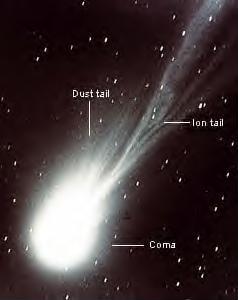
Parts of a Comet
Comets in Human History
Viewing Comets
Comet News
Definitions
Link to the REQUIRED "Page 2"
| L571 Index page | Chocolate page | Ice Cream page | Required "Page 2" |
| Comets are a mixture of ices including water and frozen gases, along with dust. They don't contain fire. They include materials that weren't incorporated into planets when the solar system was formed, so they contain a rich record of the history. Nearly 900 comets have been cataloged and their orbits calculated. However they rarely come more than a few million miles of Earth. |
|
|
Contents: Parts of a Comet Comets in Human History Viewing Comets Comet News Definitions Link to the REQUIRED "Page 2" |
Image found and used according to copyright rules from NASA-Comet. |
Comets are normally invisible. However when a comet nears the sun, the heat melts the ices in the nucleus releasing dust particles that can be seen from Earth. Distinct parts of the comet can be identified including the nucleus, coma, hydrogen cloud, dust tail, and ion tail.
Throughout human history, people have observed comets. As early as 240BC, the Chinese recorded sightings of Comet Halley. Edmond Halley was the first person to recognize that this comet was periodic. It's next close appearance won't take place until 2060.
The Bayeux Tapestry which depicts the Norman Conquest of England in 1066 includes Comet Halley.

1P Halley               76.1 yrs.  1986-02-09
2P Encke                3.30 yrs.  2003-12-28
6P d'Arrest             6.51 yrs.  2008-08-01
9P Tempel 1             5.51 yrs.  2005-07-05
19P Borrelly            6.86 yrs.  2001-09-14
21P Giacobini-Zinner    6.52 yrs.  1998-11-21
26P Grigg-Skjellerup    5.09 yrs.  1992-07-22
Comets can best be observed using a telescope or binoculars. Every five or six years, a comet can be viewed with the naked eye. Comets with long tails are only seen every 10-12 years. Below is a list of selected comets and their orbital periods:
Project Stardust, NASA's recent Comet Sample Return Mission
http://stardust.jpl.nasa.gov/
(try this link if you want the link in a SEPARATE window)
Launched in 1999, the Stardust spacecraft is the first U.S. space mission dedicated solely to the exploration of a comet. On January 2, 2004, the spacecraft flew within 236 kilometers of the comet Wild 2 and survived an impact.
Play at cool game called Tails of Wonder at http://spaceplace.jpl.nasa.gov/en/kids/stardust/index.shtml
I see myself as a huge fiery comet, a shooting star. Everyone stops, points up and gasps "Oh look at that!" Then - whoosh, and I'm gone... and they'll never see anything like it ever again, and they won't be able to forget me - ever.- Jim Morrison
This page was created as a part of Skill Building Activity 1, for Information Architecture for the Web class
Web Author: Emily Morris
Creation Date: September 2, 2005
Last revision: September 7, 2005
XHTML validator used: W3C Validator
CSS validator used:W3C CSS Validator
| L571 Index page | Chocolate page | Ice Cream page | Required "Page 2" |