| Jungle Carpet Python Morelia Spilota Cheynei |
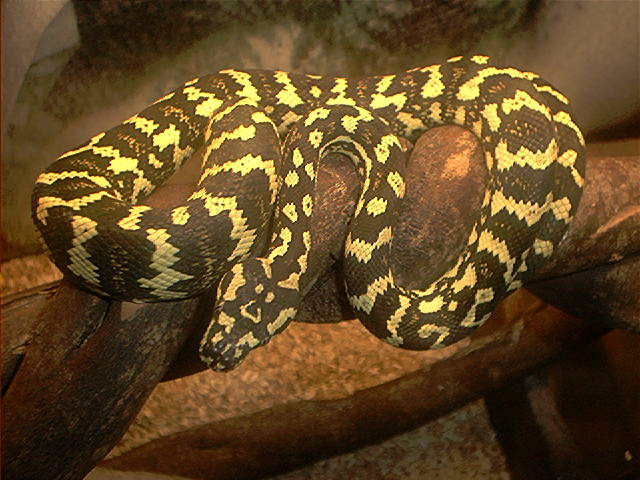
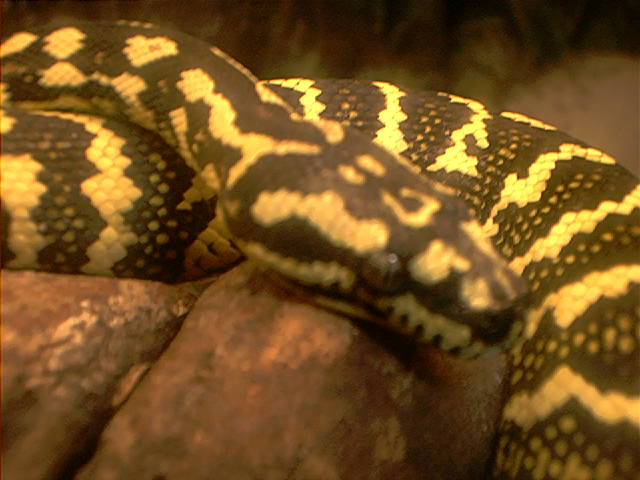
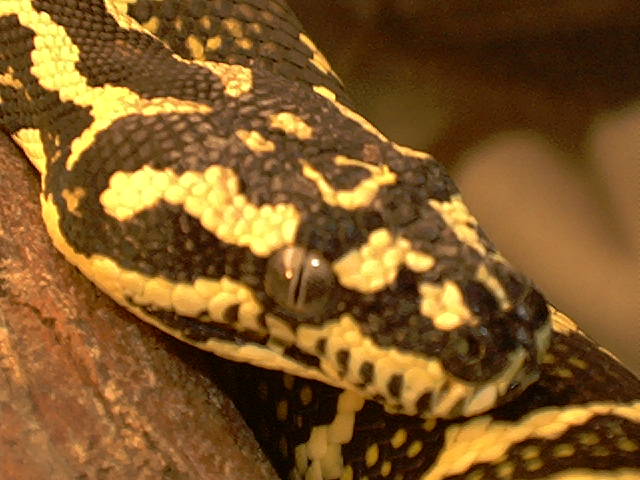
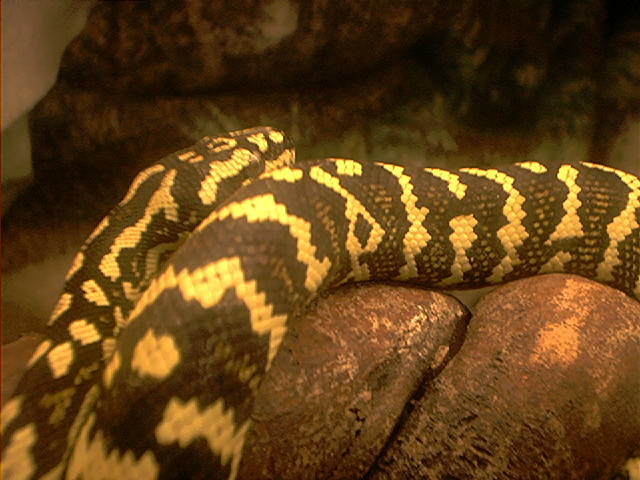
| Basic Facts: Jungle Carpet pythons are medium sized pythons that make excellent beginner snakes for novices wishing to work with pythons. Their coloration consists of a intricate black and gold pattern(in most specimens). The neonates can be nippy but this can be remedied if the keeper handles it frequently while it is young. Like most pythons, the females are larger than the males in this species. The females are 6-8 feet long while the males are 5-7 feet long. The species has a very strong prehensile( which means that the tail can grasp things) tail which means you must be very careful when removing a Jungle Carpet from a branch. |
 |
| Availability: These snakes are sold only legally when they are captive bred because of Australia�s stringent laws on taking any native animals out of Australia(and taking in foreign animals for that matter). However Jungle Carpets have proven to be very easily bred and so you locate a hatchling virtually anytime. |
 |
| Cages: The cage should be secure and well ventilated. A glass cage with a screen top will make a good cage to display Jungle Carpets. But, if a person maintains a large collection and/or has a large breeding operation, plastic storage boxes with numerous holes(of course not so big as to permit escape) for ventilation will work very well. Jungle Carpet hatchlings will do well in enclosures with about 40 square inches of floor space until they are about 1 year of age. The largest adults will do well in 3� x 2� cages. Hatchlings can be kept in a cage with about 40 square inches of floor space until they are about a year of age. Beware that a hatchling in a too large cage may be insecure and not feed. Young adult Jungle Carpets should be given about 120-200 square inches of floor space. Jungle Carpets grow quite quickly to 5-6 feet in length but after that growth spurt, they become a slow growing python. When they�re about 4-6 years of age, most adults will require about 5-6 square feet of floor space. |
 |
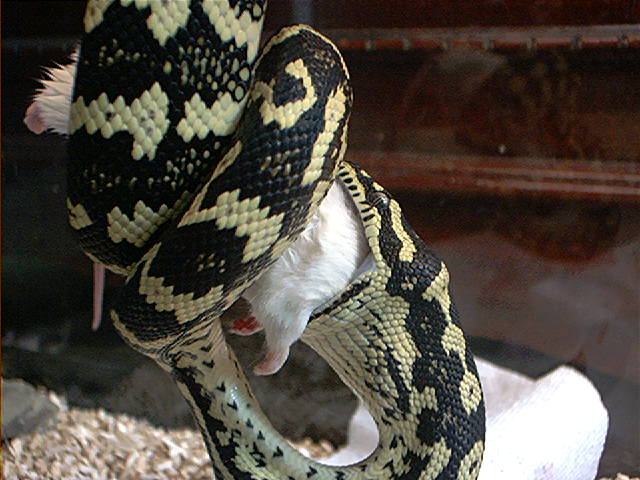
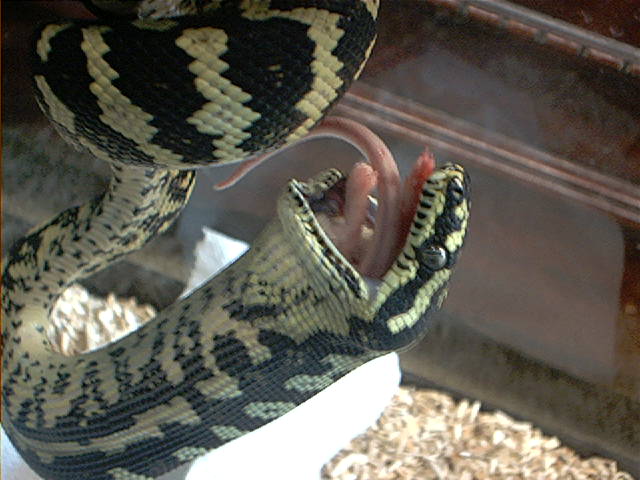
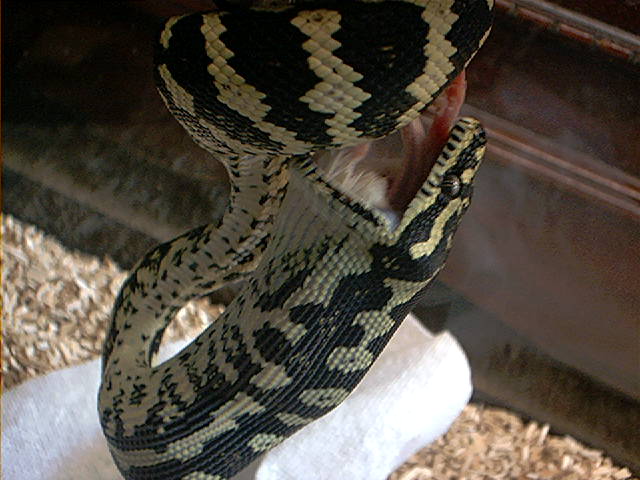
| Temperature and Feeding: A good maintenance practice is to provide a �temperature gradient�. A temperature gradient is created when one side of the cage is cooler or hotter than the other end. This allows an individual to select the temperature that suits it best at any given time. The cooler end of a Jungle Carpets cage should average 77-79 degrees Fahrenheit while the warmer end should average 5-8 degrees Fahrenheit higher than the cooler end. Jungle Carpets should not be exposed to temperature extremes if they have food in their digestive systems. They can tolerate temperature extremes better if their digestive systems are empty. I do not normally handle my snakes for 2 days after they have fed because regurgitation can occur because of stress. They do this because it is a safety measure against becoming another animals dinner. Large meals can slow down a snake that needs critical speed to escape. But, in captivity, this can have adverse effects on a snake because snakes are not built for regurgitating. Sometimes when they regurgitate, some of the half digested food can get into their lungs causing a respiratory infection. Now that I have cautioned you against the dangers of handling to soon after feeding, I will discuss the actual process of choosing what to feed,how to feed, and when to feed. The food of choice for Jungle Carpets is mice and rats. Rats and mice make better meals for captive snakes because they are easy to obtain and do not carry the parasites that lizards and other animals carry(chicks are a good alternative to rodents though snakes usually have more pungent and runny stools, also chicks could possibly transmit Salmonella to your pets, chicks are also only for large full grown specimens for reasons of size). Sometimes, there will be an occasional hatchling that insists upon eating lizards,so before purchasing a Jungle Carpet, question the seller on its feeding preferences and make sure it is feeding on mice. Hatchlings should be fed young mice or rats(choose a size that seems right to you, I feed my juvenile Jungle Carpet hoppers). Large adult specimens typically feed on adult rats. One appropriately sized rodent per week makes a good feeding schedule. Also don�t even try to feed a Jungle Carpet pinkie mice or rats because for some reason Jungle Carpets hate them. The four sizes for rodents are pinkie,fuzzy,hopper,and adult. While a Jungle Carpet is young, you can feed it a fuzzy or hopper. If one rodent doesn�t quite make a full square meal, you can feed two. Jungle Carpets rarely ever start feeding on pinkies or small fuzzies. They seem to prefer large fuzzies or just weaned mice. They quickly grow big enough to accept small adult mice. Rodents are typically sold as alive or frozen(you have to thaw them out). I prefer frozen because they can easily be stored in your freezer, they can be ordered in bulk which makes them cheaper, the dead rodents can�t hurt your snake,and frozen rodents don�t carry parasites because the freezing process kills them. I don�t order more than my snakes can eat in 6 months at a time because they sort of �expire� and they�re not really good for the snake. And don�t freak out when I say they can be put in your freezer because it really isn�t different from storing meat that you eat in the freezer. Follow the same procedures for storing frozen rodents as you would with any other meat. Don�t microwave them to thaw them out because they�ll explode(which makes for a really nasty mess to clean up). I thaw them out slowly by putting them under my snakes heat lamp on top of the recipient�s cage. The scent also lures my snake out of his hidebox and on his branch because I always feed him on there. Don�t make the rodent too warm because sometimes it can break open during feeding. The rodent should be at about room temperature. Also make sure that there�s no frozen core within the rodent because that can be detrimental to the snake as it is digesting the rodent. Please try not to feed live to your snake because a rat or mouse can bite and even sometimes kill the snake. A rodent�s mouth has all kinds of toxins and bacteria that can harm your snake. A live rodent can also carry parasites that could harm the snake. |
 |
 |
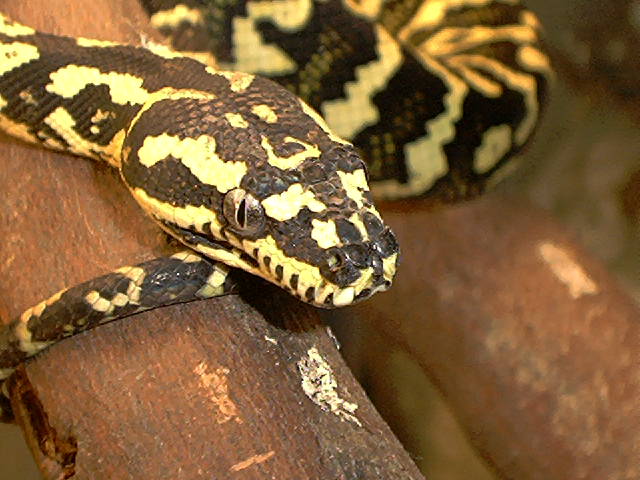
| Cage Decorations and Substrate: Jungle Carpets have very strong arboreal tendencies throughout their lives though adults need branches less than neonates, but they will appreciate a branch or two. Neonates have a stronger pysiogical need for branches. They sometimes will not feed if not given a branch because most Jungle Carpets like to feed from a branch. The substrate can be anything that can be cleaned easily and doesn�t require too much maintenance. Newspaper is very effective though it is not very aesthetically pleasing and may not provide very good traction but it is very easy to maintain. Aspen is a good alternative and much more pleasing to the eye and the snakes probably prefer it to the newspaper (there was a study some years that involved rattlesnakes who had access to different substrates and they preferred the aspen over the newspaper). Another perfectly good substrate that I use is ESU Lizard Litter. It is much better looking then newspaper (In my opinion) and has much of the same advantages as aspen. They will also require a secure hiding area. People usually just use a cardboard box for this purpose. Another alternative is making a �cave� out of rocks. I have just recently refurnished the herps� cages with caves instead of boxes. You can use this approach in naturalistic vivaria. Another good way to create a naturalistic hiding area is to hollow out a stump or a thick branch. |
 |
| Shedding: Jungle Carpets usually shed their skins easily in one piece. Sometimes a Jungle Carpet incompletely sheds and a piece is left on the snake. In that case, you can soak the snake in shallow water(if you want to try, you can make the water slightly soapy). After several hours, the shed skin usually comes off easily. Small pieces of skin that remain on the snake are generally not harmful and the keeper can choose whether to take it off or leave it. However, it is best to see that no skin is left on the face or eyes. Usually stuck pieces of shed will come off with the next shed. Humidity is very important when a Jungle Carpet is shedding and a stuck shed is a sign that the humidity is too low. A good keeper will carefully adjust the humidity. I usually mist my snakes when they�re in shed to ensure that the humidity is high with a spray bottle. Make sure that when you use a spray bottle that it wasn�t used for anything else(like pesticide spraying). You can buy these in the hair department at Wal-Mart. Spray bottles often have different �modes� of spraying that can be changed. Most can spray either a fine,gentle mist or a thin, hard stream of water. The mist tends to work much better(by dispersing the water more evenly and over a bigger area) and it also doesn�t agitate the snake(at least not too much) when you actually mist the snake. |
 |
| Article By: John Veazey |
 |