| Honduran Milksnake Lampropeltis triangulum hondurensis |
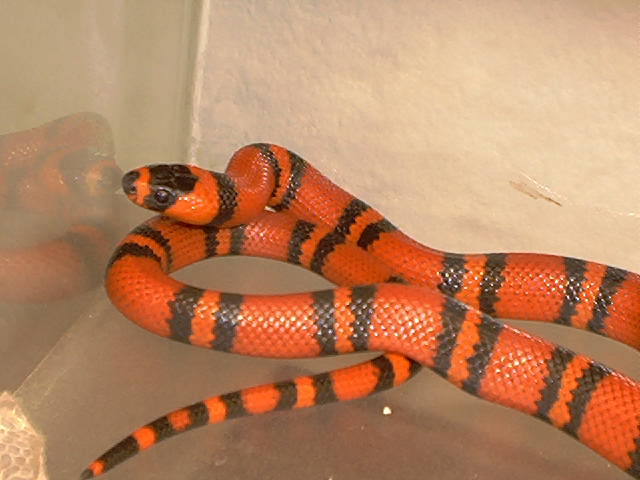
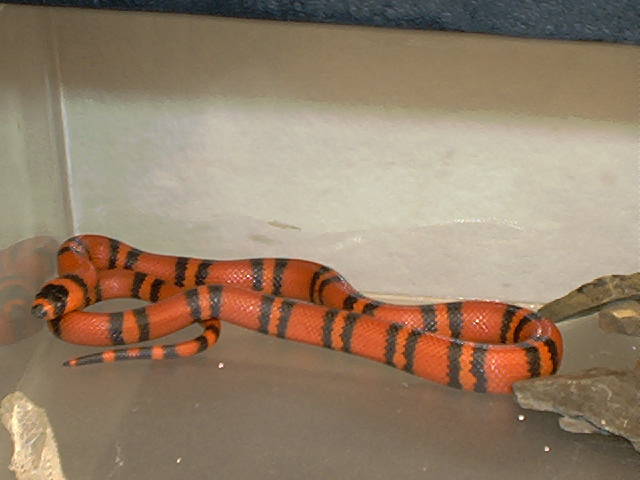
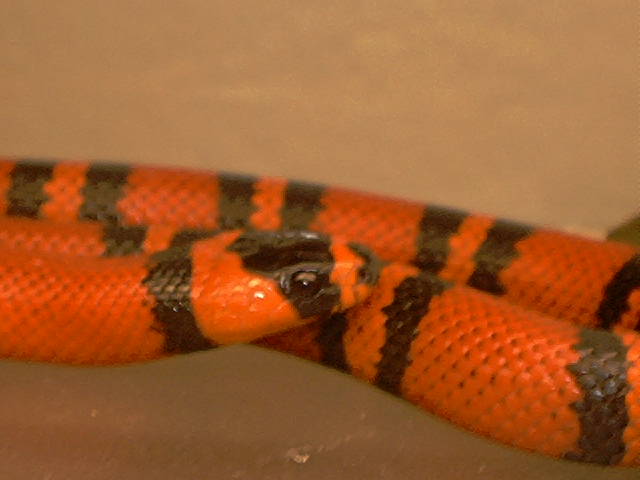
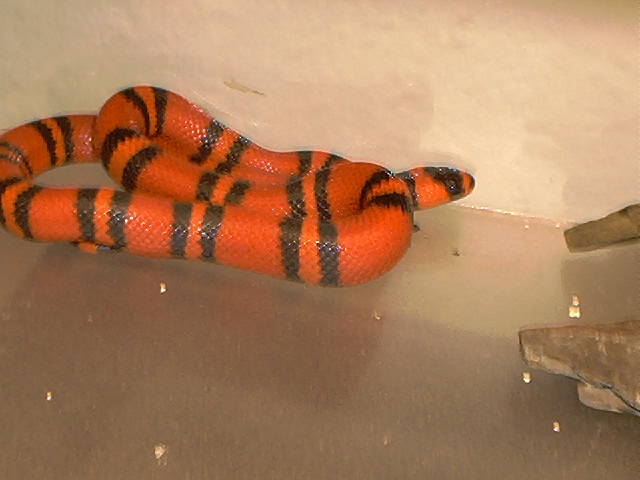
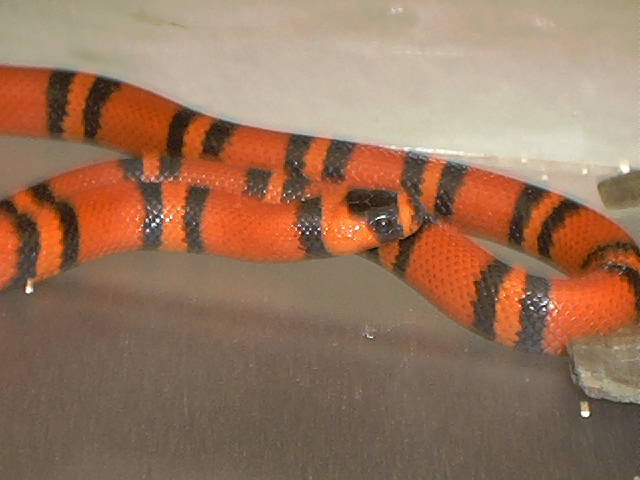
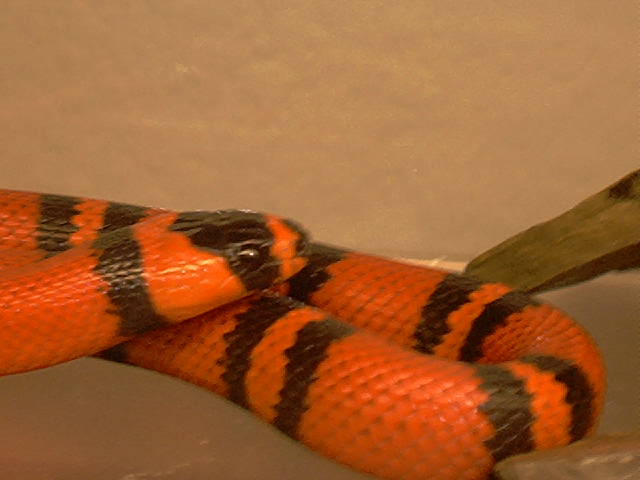
| Basic Facts: Honduran Milksnakes are fairly big milksnakes, averaging about 4-5 feet in length. They are very easy to take care of, a trait of most Lampropeltis milks and are ideal for beginning and advanced hobbyists alike. They are one of my favorite species of milksnake. They are generally even tempered though the babies may be a little nippy, but this will go away with time and some handling (however don�t handle too often as it can stress out the snake). Honduran milks occur in two common color phases in the wild which are tricolor (like most other milks which consists of black, yellow or white, and red bands) and tangerine. The tangerine phase is my favorite because of its bright coloring and beauty. There are a few other beautiful phases which are propagated in captivity which include albino and anerythristic phases (which is a gray and black banded snake and it can be quite stunning though not as much as the tangerine in my opinion). Also, young Hondurans LOVE to hide under their substrate almost all the time but they will become bolder as time goes on. |
 |
| Availability and Prices: Hondurans can range from $50- 100 plus for tangerine and tricolor though albinos and anerythristics cost much more. $50 is an unusual price but that�s what I got my gorgeous male for (talk about a great deal)! The average price is $80-90 dollars and that�s the price for hatchlings, however the adults can cost $100 and higher. |
 |
| Cages: Hondurans need a cage about the size of a 20-gallon long cage. I prefer glass 20-gallon cages because they are good looking and I prefer to display my animals and they are generally constructed pretty well. If you have a large collection and/or a breeding operation, you can use plastic storage boxes with numerous holes (of course not so big as to permit escape) for ventilation in racks. |
 |
| Cage Decorations and Substrate: Hondurans need an area to hide in for their mental well being. They will use a hidebox or another hiding place readily. I have recently started to endeavor to build natural vivaria so I�m using flat stones that I collected from a stream to build a cave. Another option is to hollow out a thick branch or a tree trunks for the snake to hide in. They will also use a branch (though they won�t use it very often) to climb on and a branch also helps in natural vivariums. Hondurans also LOVE to burrow and its often comical to see them burrowing and diving (this behavior reminds me of Bugs Bunny) into the substrate as if the substrate were just water. There are several good substrates like newspaper (but that wouldn�t really allow burrowing), aspen, and ESU Lizard Litter. ESU is my personal favorite because it�s easy to clean, attractive, and it allows the milksnake to burrow easily. |
 |
| Temperature: There should be a temperature gradient which is when one end of the snake�s cage is hotter than the other end which allows the snake to choose the temperature that best suits it at any given time. The temperature should be about 80-86 degrees Fahrenheit on the hot end and about 8-10 degrees Fahrenheit lower on the cool end. |
 |
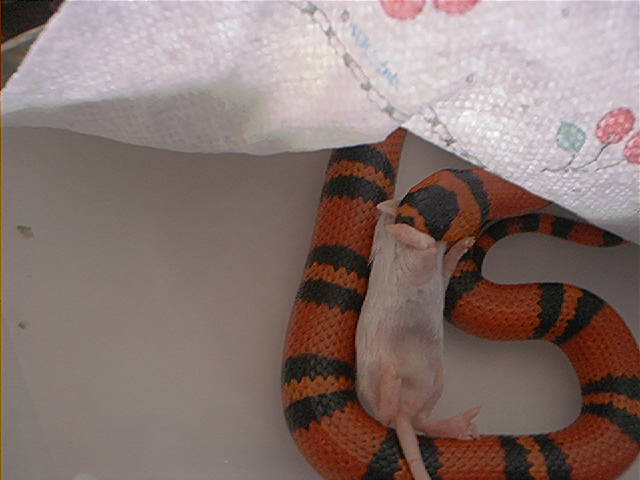
| Feeding: You can offer prey in 3 different ways. Frozen (which you need to thaw out completely), stunned, or live (I do not recommend live mice since they can seriously injure or kill a snake). Frozen is by far the best choice. Above all, they cannot hurt the snake and the freezing process kills parasites. Also, frozen mice are cheap and can be purchased in bulk. You can buy a six month supply (maximum) but after six months, the mice sort of �expire� and they aren�t that good for the snake anymore. If the mice which are frozen don�t look like they were healthy, throw out the batch and if the snake regurgitates mice out of a certain batch repeatedly, throw it out and buy a new batch of mice. There are 4 different sizes of mice (however a Honduran will never be able to take any size of rat except for pinkies or fuzzies due to reasons of size) which are pinkie, fuzzy, hopper, and adult. Baby Honduran milks will usually take pinkies while adults will take large hoppers and adult mice. |
 |
| Shedding: Hondurans typically don�t have a problem with shedding, but sometimes a Honduran incompletely sheds and a piece is left on the snake. In that case, you can soak the snake in shallow water (if you want to try, you can make the water slightly soapy). After several hours, the shed skin usually comes off easily. Small pieces of skin that remain on the snake are generally not harmful and the keeper can choose whether to take it off or leave it. However, it is best to see that no skin is left on the face or eyes. Usually stuck pieces of shed will come off with the next shed. Also, to ensure that a Honduran won�t have much trouble with shedding, you can mist the snake with a spray bottle. Make sure that when you use a spray bottle that it wasn�t used for anything else (like pesticide spraying). You can buy these in the hair department at Wal-Mart. Spray bottles often have different �modes� of spraying that can be changed. Most can spray either a fine, gentle mist or a thin, hard stream of water. The mist tends to work much better (by dispersing the water more evenly and over a bigger area) and it also doesn�t agitate the snake (at least not too much) when you actually mist the snake. |
 |
| Article By: John Veazey |