 |
 |
 |
 |
 |
| moreAboutTaiwan Current Affairs |
 |
 |
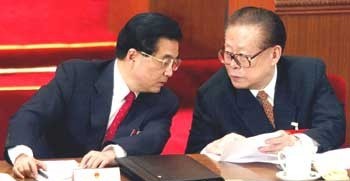
| 09.19.2004 China Daily Hu takes over as CPC military commission chief (Xinhua) Hu Jintao succeeded Jiang Zemin as chairman of the Central Military Commission (CMC) of the Communist Party of China (CPC) at the Fourth Plenum of the 16th CPC Central Committee, which just concluded in Beijing Sunday, September 19. The four-day plenum approved Hu, 61, also general secretary of the CPC Central Committee and president of China, to take over the CMC chairmanship after accepting Jiang's resignation. Jiang, 78, had held the CPC's top military position since November 1989. The plenum also approved Xu Caihou, 61, as CMC vice-chairman. Jiang, after serving as general secretary of the CPC Central Committee for 13 years, bowed out of the Party Central Committee at the 16th CPC National Congress held in Beijing in November 2002.He went on to relinquish the state presidency he had held for 10 years at the annual full session of the National People's Congress, China's top legislature, in March 2003. Hu took over both positions. Hu and Jiang appeared together Sunday afternoon at a meeting with all participants of the plenum. The two shook hands cordially, triggering an outburst of loud applause from all present. In his short yet emotional speech, Jiang first thanked the Party Central Committee for accepting his resignation from the post of CMC chairman, and then extended "heartfelt gratitude" to all comrades of the Party for their support for him all these years. "I hope that everyone will work hard and keep advancing under the leadership of the Party Central Committee with Comrade Hu Jintao as general secretary," said Jiang. "I'm convinced that our Party's cause will witness more and bigger victories!" Hu paid homage to Jiang for his "outstanding contribution to the Party, the state and the people," and thanked Jiang for his "support and assistance" to the new central collective leadership of the Party. "We will definitely live up to the trust of the entire Party and people of all ethnic groups across the country, hold high the great banners of Deng Xiaoping Theory and the Important Thought of Three Represents,...unite together and work hard to further push forward the cause of socialism with Chinese characteristics," Hu pledged. According to a communique released after the closing of the plenum, "the plenum unanimously agreed that this (Hu's becoming CMC chairman) is conducive to upholding the fundamental principle and system of the Party's absolute leadership over the military, and is also conducive to the strengthening of the military's revolutionization, modernization and regularization process." The communique also noted that the plenum had "highly evaluated Comrade Jiang Zemin's outstanding contributions to the Party, the state and the people." "In the 13 years from the Fourth Plenum of the 13th CPC Central Committee to the 16th CPC National Congress, under the extremely complicated international and domestic situation, the third-generation central collective leadership of the Party with Comrade Jiang Zemin at the core had held high the great banner of Deng Xiaoping Theory, unswervingly adhered to the Party's basic lines, rallied and led the entire Party and people of all ethnic groups across the country ... to score remarkable achievements in pushing forward the cause of socialism with Chinese characteristics," the communique said. In the past 15 years as he served as the CMC chairman, the communique said, Jiang had "grasped the development trends of new military reforms in the world with his great insight" and had enriched the army building ideas of Mao Zedong and Deng Xiaoping to "found the Jiang Zemin thought for national defense and army building." "Under his leadership, (China's) national defense and army modernization process had achieved tremendous success," it added. The communique also highly praised Jiang for founding the "Important Thought of Three Represents" after pooling the wisdom of the entire Party. "The Important Thought of Three Represents is the latest outcome of the localization of Marxism in China, as well as a fundamental guideline for the realization of the magnificent goal of building a relatively affluent society in an all-round way," said the communique. "It (the Three Represents thought) must be implemented in all areas of China's socialist modernization drive and be reflected in all aspects of Party building," it added. In a letter to the Political Bureau of the CPC Central Committee dated Sept. 1, Jiang formally requested to resign the CMC chairmanship, saying that he "had always looked forward to the complete retirement from leading positions" for the good of the long-term development of the cause of the Party and the people. "Practice has proved that the central collective leadership elected at the Party's 16th National Congress and the First Plenum of the 16th Party Central Committee is able and competent, and can stand the test of reform, opening-up and complicated situation," said Jiang in the letter, adding that he had decided to resign after "meticulous consideration." |
 |
|
|
|
|
 |
|