| Donald L. Moore |
| (W) 312.322.5879 (TTD) |
| (W) 312.322.5893 (Msgs) |
| Email: [email protected] |
Memorandum
To: W3C (World Wide Web Consortium) / Web Content Accessibility Working Group
From: Donald L. Moore
Date: 07/31/2001 (This document was updated 11/13/2001 - please refer to the new version)
Re: Accessibility of Online Services
and Merchants for Deaf / Hearing-Impaired Consumers
I would like to bring to your attention about the "Accessibility of Online Services for the Deaf and Hearing-Impaired". Based on my preliminary findings, I think the issue is worth pursuing and bring to the attention of industries and businesses that frequently require interaction and communication with consumers. After reviewing your web site, it seems that there has been little coverage or discussion about ensuring that deaf / hearing-impaired consumers are properly identified, and that the proper method of communication takes place.
I examined how accessible on-line services
(such as Internet banking, on-line merchants and financial services)
are to the deaf / hearing-impaired population segment. Since companies
are increasingly using the Internet for marketing, servicing, and offering
of services to consumers, it brings up new problems. Online services
accessibility issues warrants further attention due to the increased
potential for communication mishaps for financial institutions and on-line
merchants not properly or adequately servicing this population segment.
This is an issue worth looking into because there are approximately
28 million Americans that fall into this population segment 1,
2. Furthermore, as the U.S. population lives longer and ages,
more individuals will fall into this segment.
Two examples of potential communication
breakdowns are illustrated below:
Example 1 (On-line Credit
and Loan Applications)
Consumer "A", who is
deaf / hearing-impaired, goes to BankABC's web site and applies for
a loan. The online application requires that they complete the form
with personal information such as: name, address, telephone numbers,
and if appropriate their credit information. Occasionally (and often)
financial institutions need to contact the applicant for more information
and / or to follow up on the application. If the financial institution
does not know how to appropriately contact and work with the deaf /
hearing-impaired applicant, their application may be rejected since
they were not able to conduct a follow up. Consequently, it becomes
an inconvenience for the consumer, increases operating costs for the
bank or business, and potentially places the customer's reputation and
credit information at risk.
The culprit: BankABC's web site failed
to offer additional fields on their online application to allow Consumer
"A" to specify how they should be contacted - whether by TTD,
Relay Service, e-mail, or by other means. They also fail to recognize
the communication problem and properly address it. This is just one
prime example of what could go wrong. Even as online banking and merchants
continue to become more popular and mainstream form of everyday consumer
services, communication problems with this population segment remains.
Example 2 (Job Applicant)
The Internet has also become a popular way to search and apply for jobs.
Job sites such as Monster.com, Hotjobs.com, and organizations allow
for on-line filing of resumes and job postings. Thus, applicants are
usually required to supply their telephone contact information to allow
them to be contacted for further inquiries. However, the organization,
recruiter, or search firm may not be aware that the applicant is deaf
/ hearing-impaired and requires that they utilize other means of communication
such as the TTD and/or relay services.
While Internet e-mail is often a
popular way to communicate, it is not an entirely secure form of communication,
and is not always recommended. In addition, by listing a TTD number
on one's web site does not mean that they know how to service deaf /
hearing-impaired consumers. On-line web forms fail to help identify
the need to use TTDs or other means of communication for deaf / hearing-impaired
consumers.
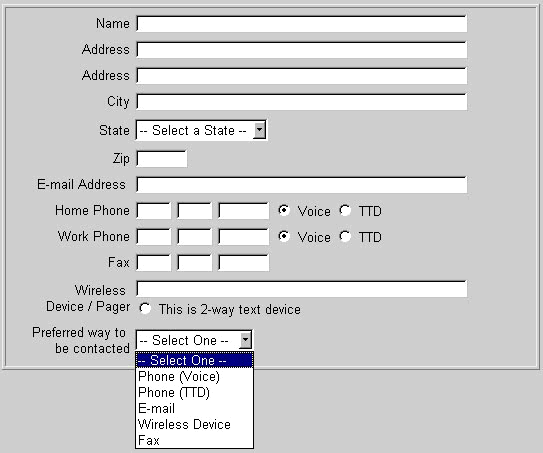
Example of an Web Form
That Helps To Identify How The Consumer Should Be Contacted
(On-line version of this form:
deafcontactform.htm)
Points to consider
- Some people within this community may fear that they would be immediately rejected if it is known that they are deaf / hearing-impaired. While others will greatly appreciate improved levels of communication and services.
- While this recommendation points out deficiencies with web based forms and pages, many organzations still are not familiar with the low cost / free available options for communicating with deaf / hearing-impaired consumers. For instance, many states offer free relay services - which can be used to call deaf / hearing-impaired parties for no charge (cellular and long distance charges, etc. still apply).
- You may want to
consult with other organizations on this recommendation and their views.
The
National Association of the Deaf (NAD) is a potential starting place.
If needed, I could assist in this matter.
If you would like to discuss this issue further, have recommendations on how we can proceed, or have any questions or comments, please feel free to contact me via e-mail at [email protected]References:
1. "About N.A.D", National Association of the Deaf (NAD), http://www.nad.org/about/
2. Carmen, Richard. The Consumer Handbook on Hearing Loss & Hearing Aids: A Bridge to Healing, pg. 21, 2000.
[Return to Main Page]

