On
With regard to her mental state,
she seemed very cheerful. As for myself, I was extremely worried about
the loss of function in her right hand and also whether this problem would
spread to her left hand as well. I thought that it would be terrible, for
someone as independent as Ruth, to lose the use of both hands, especially as
Doctor C (the senior doctor in charge of palliative care and pain control) had
said that she could not guarantee that full functionality would return to her
hand(s)!
[Note: I
learned subsequently from Doctor S that the MRI scan
revealed extensive bone disease all the way down the bones in her spine and
that it was this cancer in her back that was causing Ruth all her pain]
On
Mandy and
David left after
With regard
to all her other symptoms, her pain seemed to have lessened, she was a lot more
mobile on her feet and was in a cheerful frame of mind, cracking jokes and
talking to all and sundry.
Sunday
27/04/03. When Mandy and I arrived at
the hospital, we found her in a very dopey and confused state and it was
obvious that she was completely drugged up. When
Mandy left after midday, Ruth went to sleep.
Ethel and Gillian arrived about 3.00 pm, but did not wake her up. At around
I
remained extremely concerned about her hands.
Her right hand was virtually
useless and the left one was only about 50% effective. I still hoped that she could recover the use
of them both very soon.
The
poor wee soul was relatively cheerful and optimistic about things. I remember wishing that I could feel the
same. But the decline in her had been
so great and so rapid, that it was hard to see how she was going to survive
beyond a few months.
[Note:
I learned subsequently from Doctor S, that when someone is on chemo that is not
working, their decline tends to be gradual. However, as soon as they come off chemo, their
decline usually becomes a lot more rapid, which is what happened in Ruth’s
case]
On
Around
about lunchtime, Colin Ellis came to visit Ruth and he had a wee present for
her – lovely roast beef sandwiches that Ruth enjoyed so much later on. These roast beef sandwiches began to appear
on a weekly basis and were a real delicacy, which Ruth used to really look forward
to.
In
the afternoon, Doctor C came to see Ruth and during the conversation, Ruth
asked her if she could give any indication as to when she could go home. The
doctor replied that before they could release her, they would have to get her
drugs right and make sure the radiotherapy was working. She
then went on to say that they would also have to make sure that our home would
be a safe environment for her and that they would require sufficient time to
arrange all the additional help etc that she would need. She
then asked Ruth if she would consider the ‘halfway house’ option, which would
entail her going temporarily to the hospice, where they would prepare her for
going home. It was the wrong thing to say, because as soon
as Ruth heard the word hospice, she went to pieces and cried. She
then asked the doctor if all this meant that she was going to die and the
doctor replied that with diseases that are irreversible, there was little hope
and that unfortunately the spread of her cancer had put her in this category.
After such
a lovely, cheerful, happy start to the day, it was tragic to see poor wee Ruth
suddenly so upset. Furthermore, she remained very depressed until
Ida and Bill arrived, when she perked up.
Ida and Bill were truly
magnificent, coming up from Lisbellaw so regularly and being so good and kind
to Ruth. I remember with some pleasure the sight and
sound of Ruth and Ida laughing and joking together. Then Mandy and David turned up and this made
Ruth feel even better, because she loved her children dearly and always enjoyed
their company so much. It was really good to see Ruth more cheerful
again.
On
the way back home that night, Mandy told me that when Colin had visited Ruth at
lunchtime, she had told him that she had been informed, that she only had two
months to live and Mandy asked me if this was true. I had no option but to tell her and David
the whole truth about Doctor S’s 4-9 months life expectancy estimate, which
Ruth had hidden from them, because she had not wanted to spoil a wedding they
had been going to, only a couple of days after Doctor S had dropped his
bombshell.
I
remember hoping that poor wee Ruth would not be too depressed the next day by
what Doctor C had said. Although it had
obviously been unintentional, the doctor had really upset Ruth by mentioning
the word hospice, which, as far as Ruth was concerned, unfortunately had a kind
of awful stigma attached to it.
Hospices
are undoubtedly really good places, where the terminally ill receive the best
possible care and attention. Furthermore,
even if someone is terminally ill but wants to go home, the staff in the
hospice will do all they can to help that person achieve their goal. So, as a result, the word hospice is therefore
a very reassuring sort of word to the relatives of those dying and also to
those brave souls, who have come to terms with the fact that they are going to
die, probably in the hospice. But sadly, for those poor terminally ill souls,
who are coping with their condition through denial, being offered the option of
a place in a hospice is not what they want to hear and only brings home to them
the reality of the fact that, barring a miracle, they are going to die,
probably in the hospice.
Ruth never really
felt that she was going to die and always had this hope that she would, somehow
or another, survive her cancer. It was of course a form of denial, but it
helped her cope with the situation. It meant of course that Ruth could never
readily accept palliative care or the option of a hospice bed. To
accept palliative care or go into a hospice meant accepting that she was going
to die and, as far as she was concerned, she was not going to die. I
wonder how many poor souls like Ruth have given up their only real chance for
the best possible care and attention, simply because of their fear of the
meaning of that word hospice. It is such
a pity that the people who run hospices seem to ignore the ‘coping by denial’
approach and cannot use some other term that would not cause so much distress to
people like Ruth.
The simple
fact of the matter is that
Ruth was an extremely independent person, who did not want to be a
burden on anyone and tried her best to remain as self sufficient and as
unobtrusive as possible. But despite
all that, there did seem to be a lack of real nursing care for terminally ill
people such as Ruth, who had no power in her right hand and a limited amount in
her left and whose ability to get in and out of bed and also move around was
severely limited. Although Ruth could not cut her food, she was
never helped in this respect except by the domestic staff, who
were extremely kind. Furthermore, in the four weeks she was in
It was also
quite difficult ever to find out what exactly was going on, but a lot of this
is down to the fact that doctors can only speak to relatives about a patient,
if they have that patient’s permission.
[Note: I
subsequently learned that a “palliative care pathway” is being introduced,
which will involve a lot of additional training for nurses in dealing with
terminally ill patients such as Ruth]
On
In
the afternoon, Ruth went to sleep during another anti-calcium drip infusion and
slept for over 4 hours. But because
Bill and Ida had driven all the way up from Fermanagh to see her, I decided to
wake her up about 7.00 pm. Once again
Ruth seemed to be in good form. She
really was a remarkable person, for in the short time that she had been in that
hospital, she had become very popular with nearly everyone, staff, patients and
visitors– she was certainly very much a people person. For
example, the domestic staff grew to love her and would bring her meals into the
smoking room, cut and butter her toast, seek her out at meal times to ask her
what she wanted and even prepare something special for her. They were all so kind to her. They were fantastic!
SAINT PAUL,
THE DOMESTIC WHO WAS SO GOOD AND KIND TO RUTH
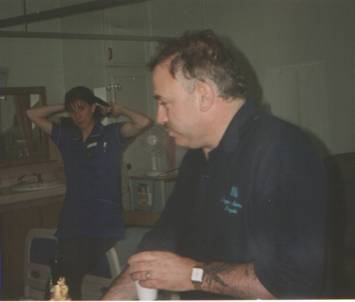
In the
background is Wendy, a really lovely, kind and efficient nurse
At
one point, I talked to Edna Wilson, a McMillan nurse, about Ruth going to the
hospice rehab unit and we agreed, that because of Ruth’s continuing aversion to
the word ‘hospice’, nothing more should be said until Thursday, by which time
we hoped she would be more open to suggestions about going to there.
Pamela
Martin arrived and because Bill, Ida and her were going to be there for some
time, I decided to take a lift home with Billy and Ethel and left a wee bit
earlier than usual.
On
With
regard to the visit by Edna in the morning, they had apparently talked about
Ruth going home and arrangements were being made for an occupational therapist
to come and see Ruth the following morning to discuss this plan further. I gathered from Edna that they would have to
do a kind of survey on our house and then subsequently fit whatever would be
necessary to make the house a safe environment for Ruth (e.g. handrails going
up the stairs etc). It was quite clear
that this sort of survey/work etc would take a little bit of time to arrange
and carry out etc and, as a result, I thought that it would definitely be
better, if Ruth went to the Hospice Rehab Unit while it was all being done,
which I hoped would help get rid of her fear of hospices (I felt that it would
be better psychologically for her to go from the hospital to the hospice before
reaching home, rather than going directly from the hospital to home, because I
thought that if she came straight home and then had to go to the hospice, she
would be absolutely terrified!)
Corrine,
Alan and Richard came in the evening and Ruth really enjoyed their
company. It was good day all round, especially as the
physiotherapist had indicated that her right hand would recover quite soon.
While I was
there, Ruth was seen by Fiona Madden, a McMillan nurse, out in the garden and
although Ruth spoke relatively articulately and sensibly, she seemed very
dopey. She was then seen by the
occupational therapist and the physiotherapist and she was again articulate and
sensible, but very slurred and dopey.
She also seemed very weak and fragile and totally exhausted by the whole
day. Furthermore, even though she was
cheerful and chatty in the smoking room, she was not her usual self.
When
David, Mandy and Willie arrived, she was very dopey, slurred and almost stupid.
David subsequently said he thought she looked
very bad and that she had, at most, only 2-3 months to live. When we left her, she was in good form
mentally but very, very tired.
Although
she had made it clear that she was determined to come home sometime the
following week, I really did doubt if she would be up to it, going on the way
she looked that day. It all seemed to
be an unrealistic pipedream. But I
decided that if she really wanted it to happen, then I would go along with it.
I
hoped she would be a lot better the next day.
To read
about Ruth’s third week as an inpatient in Ward 8B, Belvoir Park Hospital,
click on
To return
to the start of this section, click on WEEK 2
AS AN INPATIENT
To return
to the very start, click on RUTH ELLIS