Campaign
Concerning characters and their goals
At the
heart (no pun intended!) of the fifth Daemon War campaign is the ritual
sacrifice of the four daemonic hearts. Throughout the campaign, characters will
be striving to collect these hearts (and other items for the ritual) for one of
two goals. Characters can either opt to destroy the Hearts at the ritual, or
use them for their own purposes. Unlike the character section of the previous
Daemon War, which divided characters into pre-established parties, the
character section of the fifth war simply divides characters into ‘good’ or
‘evil’. ‘Good’ if the characters wish to destroy the hearts and ‘evil’ if they
seek the hearts for their own purposes.
It
should be noted, however, that within the evil group there are two further
goals available which will no doubt serve as another reason for division
between members of the evil group. Within the evil group there will be those
who wish to carry out the ritual sacrifice of the hearts and gain untold power
from the Dark Gods. But there are also evil characters who have no allegiance
to the dark gods and thus may not wish to carry out the ritual (for fear of the
consequences) and will simply keep the hearts for their worth as magical items.
IMPORANT:
The
hearts are extremely powerful magical items in their own right, and for the
purposes of gaming confer upon the bearer the following rules: +1 to pool of
power dice in each magic phase, +1 wounds, +1 strength. Note: these effects
are cumulative for the individual who has more than one hearts in his
possession! e.g. If someone has two
hearts, he will have +2 to each of the above characteristics.
These
characters who seek the hearts for only their magical worth will be referred to
as ‘neutral’ characters. For the other evil characters, the ritual must be
completed upon the time of the eclipse. While these neutral characters do not
have to race against time to get all the items before the eclipse, they will no
doubt be after all the four hearts for themselves. And if an individual has one
heart it will make him more powerful and thus more likely to carry on in the
campaign. In this way, it is unlikely that any evil character will attain all
the hearts well in advance of the eclipse and thus makes for a more interesting
story (genius, no? =).
Groups and Parties
The party
element of the campaign offers flexible options for the story line. Although
characters have been spilt into ‘good’ or ‘evil’, the campaign encourages
smaller parties to be formed within or between these two groups, e.g. evil and
good characters may join temporarily into a party to defeat a more powerful
character or party. Or a neutral character may join with the good in the hope
of defeating a powerful enemy and then taking the hearts for himself. Betrayal
and treachery will hopefully be rampant amidst both groups! The possibilities
are nearly endless and will serve to the best of the story line.
Armies
Characters
can have command or be part of armies, as giant battles and sieges are often
highlights of a fantasy story. Battles involving armies, however, can obvious
not be worked out with Warhammer rules (as this would take the campaign to new
levels of complexity). Therefore, this aspect of the campaign will be decided
in ‘story mode’, where by characters involved will have to discuss the
situation with each other and the Dungeon master. Characters are expected to
have realistic knowledge on the do’s and don’t of using armies. E.g., no one
can have a legion of 15 dragons, transport an army of a million troops, fight
one battle after another with the same size army, etc, etc, etc.
The Ritual
In
short, there are two rituals that can be carried out
a)
The ritual that destroys the hearts and the souls of the daemons
from whence the heart came
b) The effect of the second ritual depends on which
character performs the ritual. Because this scene will be near the end of the
story, the effect will be for the benefit of the story line and be discussed
and eventually decided by the Dungeon Master, e.g. for Bahl’al, the completion
of the ritual marks him as the new chosen of Chaos. For Oz, the completion of
the ritual will serve as his redemption in the eyes of Khorne.
IMPORTANT: To carry
out the ritual, 6 items in total need to be collected. The book of Omazidahn,
the Dagger of Khaine, and the hearts of the four destined Daemons, Oz, SlythRa,
Pantaphrak and Zegroth.
The
ritual must be completed upon the shrine of Ultimate Darkness in the time of
the eclipse (The finishing time will be set by the Dungeon Master, depending
how the story progresses).
Note: For the four destined Daemons, they will
obviously not be able to hold all four hearts in their hands as one of the
hearts is inside them. Therefore, should one of those daemons collect the three
other hearts and the two items, the ritual will include the Daemon plunging the
dagger into his own heart after sacrificing the others.
Note also, that the four Daemon Lords
concerned do not receive the above bonuses from the hearts within themselves.
Locations and Items
Shrine
of Ultimate Darkness In Naggarroth
“Even now, even here the name chills me to the bone, the name of
the land of the dark kin, the rest of my kin laugh at my notions but I know
better, I have been there and lived, only one other being has done that before
me, eltharion, and he has been punished.
Even as I write this, I know that my time here is short, I can
sense it, I have always had a sixth sense, even more attuned than most of my
kin, and it is what has made me survive for so long, yet I know in my heart
that I cannot dodge fate anymore, the sense of doom is slowly approaching, it
is still far away, but I know that I will not outlive the night, my hope is
that my work will be finished when fate takes me.
Naggaroth,
It is a bleak place, dominated by huge mountains and great
subterranian caves through wich the dark kin constantly patrols, not even the
rat kin, the foul skaven, stand a chance down there, for the underways are also
filled with water, it is from them many of the dark elven raiding ships is
launched.
The dark earth above the lightless caves is dominated by huge
dark mountains, their tops pierce the bleak grey skies above and the wind howls
constantly as a pack of famished wolves, the lower lands of naggaroth is filled
with gigantic black trees, trees that has stood for thousands of years, yet the
dark kin simply cut them down in their greed, thousands upon thousands of
slaves work without rest to built the dark kins ships.
The dark kin has six cities, each and every one of them is a
strong fortress in itshelf, each and every one has it’s own council only
responsible to Malekith, the foul king of the dark elves, the dark forbidden
cities are named,
Naggarond, the tower of cold
Clar Karond, the tower of doom
Karond Kar, the tower of despair
Ghrond, the north tower
The cursed place, the city of executioners
Each city has it’s strengts, for instance the capital of the dark
elves, Naggarond has all the strengts, the greathest mages, the strongest
warriors and the dreaded black guard of Malekith, while Ghrond is little more
than a fortress it also has the main cult of Khaine, it is here the largest
shrine to Khaine is, and here it is rumoured that the dreaded cauldron of blood
resides.
I feel doom approaching quicker than I had thought, I had intended
to go through in detail with every city of the dark kin, but I feel that my
time is runing out, instead I will descripe what placed the doom upon me, the
sight that will haunt me forever, even after I die.
The thing is a huge building made out of pure obsidian, the dark
kin call it the alter of ultimate darkness, it is a fitting name, what purpose
it holds I cannot say, but I know that it is controlled by silent elves who
constantly patrol the alter, whom they serve I do not know, but they do not serve
the witch king, the dark elven king is said to have visited this place too and
comen out changed, it was before he became the with king.
Some speculate that the alter serve the dark chaos gods, by
casual observance I would have felt the same, but I do not think now, whatever
they serve is just as ancient, just as evil, but it’s purpose is not conquest,
what it’s true purpose is I cannot tell, but only guess.
Tread
lightly if you are near the altar, and avoid it if possible, nothing good comes
from that place, nothing good comes from naggaroth”
Hans Glemtrich, Chapter 5, p.253,
Voyages to the Darkest of Realms
(Special thanks to Ruerl for this article).
Important
Rules
Naggaroth
and the Shrine of Ultimate Darkness will be the last step in the Fifth Daemon
War campaign. To reach this location characters can either cross over the
bleak, frozen land in the north that connects Naggarroth to the Realm of Chaos,
travel over sea straight from the old World, or travel over sea with a crossing
over Ulthuan (a more likely option for the good characters). Evil characters
crossing with armies will find it very difficult landing both on Ulthuan and
then at Naggaroth as they will no doubt encounter resistance at both locations.
But depending on the locations of the heart(s) at the time, characters may be
forced to take envy the most dangerous of routes. Only the story will tell.
Keys
Of Omazidahn

Omazidahn,
the first Champion of Tzeentch after the infamous BeLakor, created this
ancient, golden tome. At first glance,
the book’s content seems random and chaotic, with chapters on the forgotten
history of the Old world, Arcane lore on spells and weapons, names and history
of all the great Daemons of Chaos, maps of unknown, distant lands, tablatures
for translating runes, and charts of the night sky with reference to the
movements of planets, stars and moons.
Powerful
magicks make the book seemingly indestructible as no blade can scratch it nor
flame scorch it. Indeed since leaving the hands of its creator, the book has
remained in exactly the same state as it did several millennia ago. No quill
can ever mark its withered pages and all the pages are of the same age,
indicating that nothing has been added. So, when looking over the book’s
chronological records, the educated scholar will immediately notice something
quite odd. The recordings are all up to date. It has led many scholars to the
eerie conclusion, that the book has ever since been its own scribe and record
keeper.
One
cannot help feel that the lore within this tome collectively leads to something
greater, a higher order and purpose, some secret that only its creator knew
about. The book has been in the hands of many, form wisely scholars to
blasphemous daemons, yet it never remains with its owner for long, finding its
way around the world in its seemingly endless search for perhaps its master or
material for a last chapter.
It was
the arcane lore in particular that attracted the Greater Daemon Amon Chakai to
it, and in a further twist of fate the book is set to take its part in the
prophecy that is the fifth Daemon War. As part of his punishment for his
failure half a century ago, Tzeentch bound Amon to the book. The Daemon’s true
name was written onto one of the pages and any who can muster the will power to
speak out that name can willingly summon the Daemon and force him to carry out
the ritual that will fulfil the prophecy and bestow the powers of the gods upon
the next chosen of chaos.
None
can say where to book ended up after it slipping from the hands of Amon Chakai,
but rumour has it that it abides deep in the catacombs beneath the great
library of Altdorf, in the empire, and a evil presence guards it, waiting for
any who would be brave enough to disturb this most sinister of books from its
slumber.
Important
Rules:
The
Book is in Altdorf. The purpose of this location is for characters to come on
their own, as no outside army can ever realistically enter the heart of the
Empire. Characters will have to face a challenge(s) to get the book as set by
the Dungeon Master. Fighting between characters for the book can take place
before of after the book has been taken and in or around the city of Altdorf,
with realistic interference from City Guard, Witch Hunters etc, all of which
are for the purposes of the story and can be discussed by the characters
involved.
The
Book grants +D3 power and dispel dice to its bearer. Roll a D3 at the start of
each turn. In addition, the bearer of the book has a 3+ ward save against all magical
attacks made by Amon Chakai. Amon has been bound to the book and therefore
finds it very difficult to focus his will and cause any physical harm to the
book or he who bears it.
Dagger
of Khaine
Little
is known about this ancient artifact but legend has it that it was the dagger
used for the first ever sacrifices to khiane upon Ultuaun, but was eventually
used by Morathi for her sacrifices to Slaanesh. It is said that Khaine, acting
in his anger against the blasphemous worship of Slaanesh, poisoned the mind of
Morathi’s son and set into motion the string of events that would eventually
lead to the splitting of the Elven race and to many terrible wars that would
later follow.
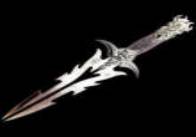
The
dagger gives its wielder an extra attack. This attack always wounds on 4+. In
addition, for each wound caused by this attack, the user gains 1 wound (to a
max. of double his original wounds).
Combat
Combat
between characters can be decided in two ways. Firstly, the individuals
involved can come to an agreement as to whether the combat is a draw (both individuals
are injured and retreat, or both die, or one dies and the other wins). The
second option is decided by normal Warhammer rules, i.e. Using magic items,
stats, special rules, etc. In the case of using the Warhammer rules, the
Dungeon Master will roll dice using the profiles of each character and report
on the outcome on the Ulthuan message board ASAP.
All
outcomes, whether decided by Warhammer rules or not, will be recounted in
narrative form with the recounting of actual dice rolls taking priority.
All
the normal rules for Arena of death apply to combat in Daemon Wars:
Each
participant will roll a dice to decide who gets the first turn, for purposes of
the Magic Phase
Both
participants will count as charging in the first round
Attacks
will be made in order of initiative. In the case of a draw, the character whose
turn it is will attack first.
All
spells will be picked separately for each combat
Before
combat, participants must declare which type of magic they will be using. If
they have different mounts or different characteristics, they must make it
clear which they are using in the ensuing combat.
Magic
can be cast in combat
Psychology tests
The
Daemon War campaign does not operate with distance in inches taken into account.
Therefore all rules and spells involving gaming distance, such as fleeing and
pursuit, go to waste. Psychology Tests will be taken as usual however, for fear
and terror ,etc,
The
heroes involved in Daemon Wars are amongst the strongest and bravest in the
Warhammer world and will never run from a battle. Break tests need not be taken after each round of combat.
Running
from combat is only an option for the purposes of the story and must thus be
discussed between the combatants involved, should such an eventuality arise.
Combat,
however, CAN be affected by psychology. Most Evil character cause fear or
terror and even the stalwart heroes of good may suffer the weaknesses of a
mortal mind. Because both combatants count as charging in the first round of
combat, characters will be forced to take the normal fear tests for charging/
being charged by a fear causing enemy.
If the
test is passed, the character can fight on as normal. If the test is failed and
the character’s unit strength (original number of wounds) is less than the
enemy’s, the character that failed will need 6’s to hit in the first round of
combat.
If the
character fails his psychology test, but his unit strength is equal to or
greater than the enemy’s, he will simply lose one attack.
The
effects of a failed psychology test do not have any effect after the first
round of combat. This represents characters losing whatever fear they had as
they concentrate on the battle at hand.