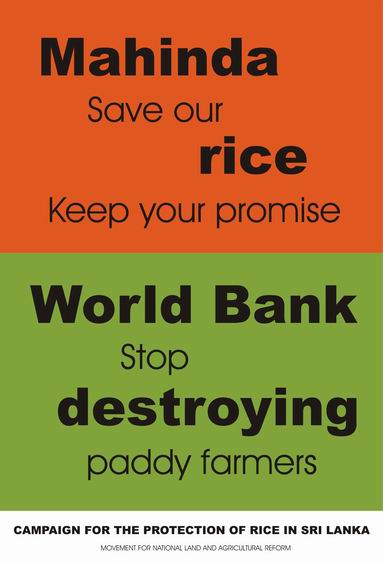
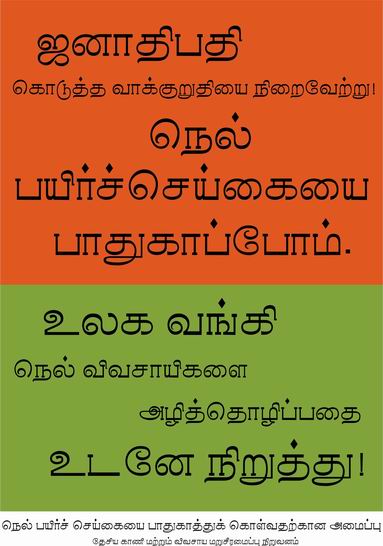
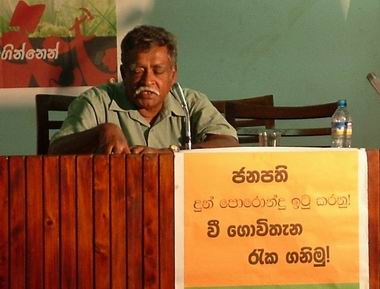
National Farmers' Assembly and Movement for National Land
and Agricultural Reform launched a campaign for the protection
of paddy cultivation in Sri Lanka and small farmers engaged
in the same at a press briefing on August 30th.
Launch statement:
The yala harvest is over. Millions of farmers are waiting
to sell their
paddy. Government has spent millions of rupees to subsidise
fertiliser and has promised to spend millions more to buy
paddy at the guaranteed price, but most farmers will still
receive less than they spent. They will fall further into
debt, some will even commit suicide. It happens every season.
This is the paddy crisis.
There are solutions and they are being discovered by farmers.
The use of ecological methods and indigenous seeds has been
shown to both dramatically cut costs and increase yields.
Farmers can earn a decent living and also provide healthy
rice at a reasonable price, while contributing to a process
of rebuilding our ecology, the fertility of the soil and
the quality and quantity of water sources. The conversion
of paddy to rice by farmers themselves is also on the increase
and releases both producer and consumer from the grip of
the traders who control the market.
Government wants to solve the paddy crisis. It is time
to solve it. The problems have been there for many years
and many governments have claimed to be addressing them.
Plasters have been applied to the wound but it continues
to fester. Mahinda Rajapaksa must go to the roots.
There is also a need for emergency measures. Farmers who
have now spent 12 or 13 rupees on each kilo of paddy cannot
be left to sell it at 10 or 11 rupees to the traders. This
happened after the maha harvest. Mahinda Rajapaksa must
make sure it does not happen again.
The paddy crisis did not come from the sky. It was created
through the
interventions of outside agencies. Destructive and dependent
methods were pressed on farmers during the green revolution
and then support mechanisms were removed under structural
adjustment programmes. The World Bank and Asian Development
Bank are responsible. They believe that rice should not
be
grown in Sri Lanka. Through their interventions, governments
have been compelled to cut subsidies on fertilisers and
seeds, privatise state
fertiliser manufacturing industries and seed farms, sell
off stores, mills
and retail outlets, close the Paddy Marketing Board and
sell off the
Cooperative Wholesale establishment. They have also made
tireless attempts to introduce charges for irrigation water
and to remove restrictions on the lease and sale of land
given to farmers under government grants. These efforts
continue to this day. They must be stopped.
It is for these reasons that the National Farmers' Assembly
and the Movement for National Land and Agricultural Reform
have decided to initiate a campaign. We intend to work consistently
until the paddy crisis is solved, highlighting the solutions
and pressing for immediate relief, while fighting against
the World Bank and Asian Development Bank. We encourage
you to join.