Flight Patterns of Monk Parakeets
Lori S.
Mary S.
Dawn K.
Vicki
Abstract:
In observing the parakeets there appeared to be a social
connection between the birds in that they were flying together either in pairs or groups, and quite
often feeding together. Further research revealed that Monk Parakeets also
raised their young in groups. We decided to investigate if Monk Parakeets fly in groups
of two or more when leaving their nests. What we discovered is that the Monk Parakeets had no set pattern and would either fly
solo, in groups of two or more. In addition, we found that the Parakeets were
more likely to fly in the morning hours, as is discussed later in this article.
Introduction:
There have been numerous investigations across the country concerning Monk Parakeets also
known as Quaker parakeets (Myiopsitis
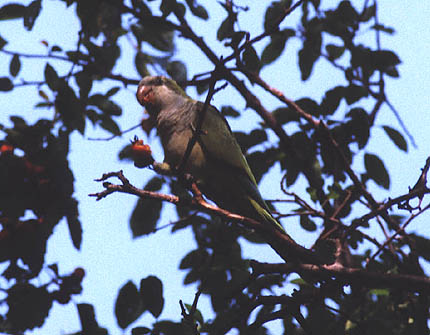
monachus). The name Monk Parakeet reflects the gray
feathers that resemble a monk's hood (Spreyer and Bucher). The feral Monk Parakeets
(escapees) date back to the 1960's. It is believed that a crate was dropped near Kennedy Airport
carrying this exotic bird. A difference of opinion concerning the arrival of the Monk parakeet
prevails and many feel the introduction of the exotic species may have been deliberate.
Since this
incident the Monk Parakeets have migrated throughout the United States including a large portion
of Brooklyn, especially around the Brooklyn College area. Monk Parakeets seemed to have easily
adapted to the changing landscape and began building nests and raising their young.
The species
uses and maintains its unique stick compound year round. Nesting structures contain one to
seven active chambers. The nests are communal and house anywhere from two to twenty birds.
Monk Parakeets will often feed each other's young and many times a young bird will stay at the
nest to help a mother with its next clutch (Zorpette). Monk parakeets mate for life.
The
parakeets usually forage in groups of two to fifty-five birds (Hyman, Pruett, and Jones).
This
habit may explain the parakeet's ability to colonize in areas with colder winters than its South
American region of origin. The bird's apparent great potential for rapid population growth
suggests that they will continue their range expansion and population in the United States.
If
these birds nest, raise their young and forage for food in groups, why not assume that they travel
in groups?
Our experiment was formulated around the following hypothesis: Monk Parakeets leave their
nests in groups of two or more.
Results and Observations
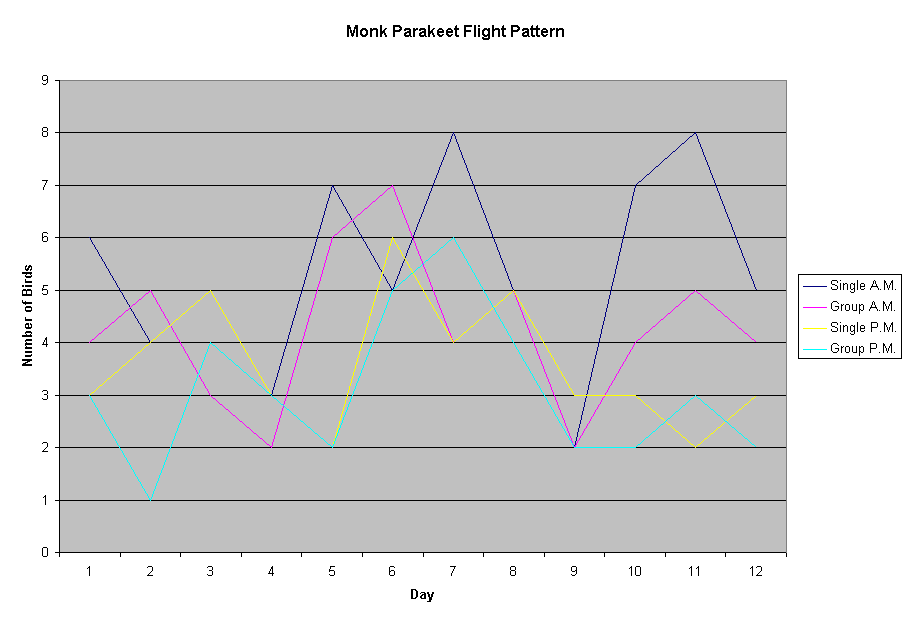
We viewed the Monk Parakeets three days a week for one month. Each session was an hour.
7 a.m. 4 p.m.
Flying alone
65
43
Flying in groups of 2 or more 51
37
(see graph)
The days chosen for our observation were limited by our availablity. We chose every Tuesday, Wednesday and Thursday for the month of October. The dates are as follows:
3rd, 4th, 5th
10th, 11th, 12th
17th, 18th, 19th
24th,25th, 26th
The above tally sheet is a consolidation of our observations. There seemed to be more activity in
the morning hours than the afternoon. Both groups observed the birds flying from their
nests to neighboring trees, other nests located on the field, and the posts near the field library.
Materials
Binoculars
Tally Sheet
Camcorders
Clipboards
Pencils
Methods/Procedures:
Our particular experiment design involved video taping the birds at 7 a.m. and 4 p.m. on the Brooklyn College football field with our camcorders. It was our understanding based on prior knowledge that birds don't fly as frequently during bad weather. Therefore, we viewed the birds on days when the weather was more favorable. That left our only variable - time. Beginning on October 3rd, 2000, two members of the group visited the nest in the morning, while the other two members viewed the nest in the afternoon session. Each group videotaped the nest for one hour each session. We focused on one particular spotlight pole to gather our data, even though all the spotlights contained nests. The nest was located on the far side of the field, to the right of the tennis courts, approximately thirty yards from the back entrance of the building. We recorded our observations on tally sheets (see tally sheet). The sheet contained two sections - one entitled "Monk Parakeets Flying Alone" and the other "Monk Parakeets Flying in Groups of Two or More". After the one-month period, we collaborated by viewing the videotapes as a quartet and combined our data to finalize our tally sheets.
Discussion:
Monk Parakeets appear to be more active in the morning than in the afternoon. It is our opinion that the birds flew less due to the sports teams using the field in the afternoon, the nearby tennis courts being occupied, joggers, students entering and exiting the building for classes, and nearby children playing. There were minimal human activities in the morning. Therefore the birds undisturbed would fly freely to and from their nests. These flying patterns disprove our hypothesis. We have concluded that the birds have no flying pattern leaving their nests. These birds would leave their nests in no particular group size.
As we had suspected, weather was a big factor in viewing the
birds. One would think that basic survival would drive these birds out of their nests even on days
of foul weather. To obtain a more concrete conclusion we would have to change the hours that
the birds are viewed in order to get a wider sampling of flight patterns. Preferably, we would like
to view the nests from a closer vantage point, rather than from the ground on the field. Also, there
should be an opportunity to secure and place an unmanned video camera closer to the nests to
record flying patterns with greater accuracy.
According to the Life Science Standards (National Science Education
Standards), students should
experience science in a form that engages them in active construction of ideas and explanations
that enhance their opportunities to develop doing science. We felt in scientific inquiry, observable
social behaviors are an important skill. Therefore, our investigation of the Monk Parakeets' flying
patterns would enable our students to understand the behavior of individual organisms. We used
data to construct a reasonable explanation to either prove or disprove our hypothesis. This is in
accordance to Content Standard A- Organisms and their Environments. An organism's patterns
of behavior are related to the nature of that organism's availability of food and resources, and the
physical characteristics of the environment. When the environment changes, some plants and
animals survive and reproduce while others die or move to new locations. It is our understanding
that Brooklyn College and its surrounding area has provided Monk Parakeets with their basic
needs of survival. Therefore, with nests in the football field and surrounding areas, Monk
Parakeets have adapted to their environment in order to survive.
In the research we have gathered relevant to Monk Parakeets, no extensive research
has been
documented concerning specific flight patterns. Therefore, it is not possible at this time to
cite similar studies. Our particular data does not suggest that we should be concerned with the
birds' impact on the environment.
Implications for Teaching:
The old Chinese proverb: "Tell me, I forget- Show Me, I Remember, Involve Me, I Understand"
is a teaching philosophy on how children learn best. It's also an essential ingredient for successful
science learning. Developing students' understanding involves active involvement and minds-on
and hands-on experience in science.
Educators must focus on retaining students' interest. Science meets that challenge. It harnesses
the curiosity so natural in young children. They come into the classroom with prior experiences
obtained from a variety of sources such as social interactions, looking at picture books and
reading books, and especially the multi-media, television and computer programs. . To help
children develop the basic concepts of science, we must tailor our lessons at their developmental
capabilities to draw their attention. This way learning is interesting, exciting, and fun.
The more experiences children have in science, the more knowledge and understanding they gain.
Therefore, students need to feel free to ask questions and grope for answers. It's important that
they understand science is not about the right or wrong answers, but the process of scientific
inquiry. As teachers we must develop a risk-free environment and allow children opportunities to
develop their critical thinking skills with a variety of science activities with the connection to
literature both fiction and non-fiction. Also, we make them aware that scientists don't have all the
answers and their contribution is important.
Children make associations through inquiry and process skills as indicated in Life Science -Standard
A by classifying, communicating, gathering and organizing data, generalizing,
identifying variables, inferring, interpreting data, making decisions, manipulating materials,
measuring, observing and predicting. It often starts with a simple question such as the one we
posed concerning Monk Parakeets.
Educators guide, model, support, and provide opportunities for students to do investigations
using inquiry skills. Though a series of questioning techniques, teachers assist students to pose
questions that can be answered via scientific investigation. Often it involves research which allows
students to search for information in print or surf the Internet and establish some base knowledge.
As students, Monk Parakeets launched our spirit of adventure. As teachers we must foster
stimulating learning environments that nurtures growth, and invites curiosity for find answers to
the "Five W's and How". It's our responsibility to provide children with the tools both physical
and mental to examine their world.
Works Cited
Hyman, J., Pruett, Jones S. "Natural History of the Monk Parakeets in Hyde Park, Chicago."
Wilson Bulletin 107, 1995: 510-517.
Spreyer, Mark, and Bucher, Enrique. The Birds of North America, No. 322, 1998 (Excerpts).
Online. http://birdsofna.org/excerpts/monk.html
Zorpette, Glenn "Parrots and Plunder: Are Monk Parakeets Pests? Ornithologists Aren't Sure". Scientific American, 1997. Online. http://www.sciam.com/0797issue/0797scicit2.html
Additional Sources
Spreyer, Mark "The Monk Parakeet:
Guilty until Proven Innocent?". Monk Parakeets in North America,
1998. Online. http://www.monkparakeet.com/spreyer.htm
"The Quaker (Monk) Parakeet Page" . The Pet Bird Page,
Aug 2000. Online. http://www.petbirdpage.com/quaker.htm