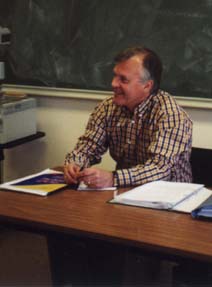
| Hilary | Graham, what’s special about your story? |
| Graham | It’s tempting to say there’s nothing special about it. I don’t even know what my story is, but I suppose what I talked about was the journey from a very working class background to being a television producer through grammar school and things like that. And I talked about values and the difference in values between a very working class background and grammar school and I think I also talked about the way certain feelings that are engendered in childhood can stay with you for the rest of your life, and can be reawakened later. So when I was a television producer and I said something to a director he turned round to the VA and said “Isn’t he quaint?” It went all the way back to a very working class childhood with lavatories in the middle of the yard, no bathroom, and that. So I don’t think that it’s a unique story. I think it’s several people’s story, lots of people’s stories. It’s that sort of social dislocation that happened to some working class people who had an education that took them into the middle class or professional classes and they finished up not belonging in either place: neither the place they’d come from nor the place where they’d ended up. |
| Hilary | What are your views on the project (The Century Speaks)? |
| Graham | I think it’s the sort of thing the BBC should be doing. I feel strongly that it’s important that people’s stories, people’s lives, people’s experiences, should be chronicled, and I think it’s important that the lives and the interesting experiences of ordinary people be chronicled and that that accords to ordinary people the importance that they have. Traditionally in history, when I was at school we only learned about kings and queens: that sort of “important” people. I think it’s important to say to ordinary people: “Your lives are history; the interesting things you did day in, day out, are history.” I think it’s important that that should be done and it’s important that it should be chronicled in their voices. And it should be their voices that are telling us about their lives and not some disembodied voice that’s telling us about someone else’s life. |
| Hilary | You think it is important to preserve for posterity dialects that could be lost forever because of the multi-cultural society we now live in? |
| Graham | Well, I think it is. And I think it relates to what I said about people’s lives being chronicled in their voices. And what it does do is accord a proper importance to how people talk. Without anyone trying to impose a different way of talking on them. Because once we start doing that: once we start criticising how people talk naturally, we start getting at something really deep inside them, and that goes back to that “Isn’t he quaint” because that wasn’t about what I was saying, it was about the way I was saying it, and though I’ve lost some of it, the fact that I still had a Derbyshire accent. |
| Hilary | You’re a professional producer of television and radio programmes. How did you feel about being on the other side of the microphone, being interviewed yourself? |
| Graham | Well. I felt perfectly happy about it. I’ve been interviewed a lot of times and I think that the reason I felt happy about it was that it warn’t an interview. It was an opportunity to talk, and it lasted a long time. |
| Hilary | We are at a unique moment in history: this is the first millennium project. What are your views on the novelty of the project? |
| Graham | I think that what is particular about it is that it has come at this time and this time gives us a reason. But I think what’s impressive about it is its scope and that it’s happening in the same way throughout the country. This is impressive and it should lead to impressive radio programmes. But perhaps more important, it will lead to a sound archive. I think that we should do it privately more often as well as publicly. I regret that I did not do it with my Grandfather, the man who we’d got visiting us. He was a fount of knowledge of our village, and I was always going to do it and then never did. |