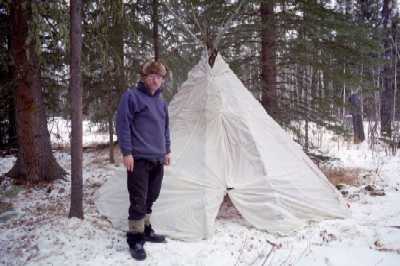
Crafting A Shelter From An Old Parachute
Date: 2002/02/01
Many years ago I abandoned the traditional tent in favor of other forms of shelter. A tarp set up as a lean-to has served me well. Even the cover provided by an old spruce tree and her branch’s is a good shelter. These work well in spring, summer or early fall, but winter weather calls for a different type of shelter. The lean-to with a fire in front will work well, but when I was looking for something else, an old parachute provided me with a unique opportunity to try a time proven shelter. Following is how I rigged it up, provided heat, and my experiences in making use of it. Building a teepee is not new but this is how I went about it.
The teepee has served our first nations people here on the plains for hundreds of years if not thousands. It is cool in the summer and warm in the winter. We live in central Alberta, Canada and spend a lot of time in the foothills of the Rocky Mountains. We have a small cabin out in the bush west of Caroline, Alberta and it provides us with a nice spot to get away from it all. The winters here can get well below zero, averaging around -15º C during the day and dropping as low as -30ºC during the night and occasionally as low as -40ºC. Add the chill factor from a strong north wind and the temperature can drop even further. Having a fire in the center of the teepee works well at keeping the chill out since the teepee is essentially a chimney with cold air coming in at the bottom edge, being warmed by the fire, rising and traveling out through the smoke hole. If the outer shell is kept taut it will keep out wind, rain and snow. The original covers were made from animal hides, with the modern versions making use of canvas. Our neighbor across the road lives in a teepee, has for the last twenty-five years and says he wouldn't camp any other way. They make use of their teepee during all four seasons and feels that it works as well as any other structure would. I spent a weekend in a teepee at a scout camp and for safety reasons we weren't allowed to have fires in the teepees. They kept out the wind but were still chilly. What I liked about them was the room they afforded.
I have a friend who is a skydiver and when he was cleaning out his garage one day he came across some old canopies that weren't useful to him anymore. He sold them to me for next to nothing - nylon canopies and all the rigging! The older unit is a T-555 round white military canopy with a date stamp of 1951. It's about twenty feet across and this is the unit I decided to use for my teepee. My wife made me dispose of the rigging, no doubt fearing that I might try jumping off a cliff if they were still intact.
Dropping the canopy over some poles was the first attempt at a structure. It didn’t work well. I couldn't get it taut enough and it flapped in the wind. I thought that the center hole would work well as a smoke hole but I had no way of regulating the size which made it hard to exhaust the smoke properly. The open fire I built did a fine job of heating the inside but because of the spruce and pinewood we have here it sparked a lot and it made me nervous! Canvas is typically fire resistant, but I wasn't too confident in the nylon canopy. When I talked about this to my skydiving friend, he told me that these canopies are not fire resistant because the fire retardant chemical used weakens the nylon at the creases where it is folded. He told me that there had been deaths as a result of reserve chutes shredding when deployed. An inquiry into the deaths uncovered that the nylon had been treated with fire retardant and mistakenly shipped out as suitable for parachute canopies. Since I don’t plan on jumping with this canopy, it is probably safe to treat it with fire retardant sometime this summer.
An open fire in a structure such as a teepee creates a smoke ceiling and if you keep below this the air is clean and fresh. As I built the fire up, the smoke hole couldn't exhaust the smoke fast enough and it started to collect in the teepee, lowering the smoke ceiling. In order to keep fresh air flowing in to feed the fire I raised the edge along the ground up a few inches but created a draft so laying down to avoid the smoke was uncomfortable. There are ways around this, and I used them in the next version of my teepee. I also used a different heat source for my next shelter. We abandoned the first version but I knew it would work - it just needed some fine-tuning!
While surfing the web, I came across a copy of a U.S. military survival manual. In it they gave advice on how to use a parachute canopy as a shelter. Instead of just dropping the canopy over some poles, they had it folded in half and then wrapped around the poles. This formed the cone shape needed and where the edges met would allow for adjustment of the smoke hole as well as create a suitable entrance. This method also allows you to get the skin taut. The double layer of material would also add to the insulating value of the skin. They also suggested that as few as three poles would provide the support needed. I found that more poles spread the canopy out and made for greater usable room in the teepee. Now I had a new method of covering my teepee poles, but I still pondered alternative heating methods.
I liked the idea of a tin wood burner but needed something small and cheap. While reading through an old book called 'How To Survive in the Wilderness' I came across a section on wood burning stoves. This old book from the nineteen fifties had a number of great ideas. Everything from pails to washtubs to the one I tried out - stove pipe! I dug out some old stovepipe and fashioned a crude stove by joining two pieces of six inch by twenty-four inch pipe at the long edge. I happened to have an adapter collar and fitted the pipe around this for one end of the stove. Some screws and wire secured them together and though not airtight, it would work okay. I used an old tin dog dish at the other end to regulate the draft. I had to buy an elbow in order to attach the upright six-inch by thirty-six inch pipe to the collar. So far the stove was meeting the need to be small and cheap. I also scrounged a deflector for the top of the exhaust pipe. I thought this would deflect the heat back into the teepee rather than let the heat shoot straight out the smoke hole. As it turned out this worked well and did move the warm air back into the shelter.
The traditional teepee uses lodgepole pine as its poles. This pine tree grows in abundance in this area and is well suited to the task of framing a teepee. It grows straight and with most of the branches being towards the top of the tree so little is involved with prepping them for use as poles. The lodgepole is a very resinous tree, which impedes decay of the wood, even when wet. On the down side the resin puts this wood low on the list of preferred firewood since it burns with an acrid black smoke. I decided to forgo the lodgepole pine and use something smaller and easier to work with due to the size of my teepee. The prolific aspen grows in this area so I headed off to the bush to gather ten to twelve poles for my shelter. . The poles were approximately two inches in diameter at the base, an inch or so at the tip and were twelve feet long. In keeping with my normal method, I spread out my harvesting and was careful not to deplete an area. I also said a prayer of thanks when taking these trees.
The three main poles were roped together using a tripod lashing and stood up to form the primary frame of the teepee. I'm certain the natives have a spiritual as well as practical way of placing the poles, but I don’t know what it is. I placed the poles in a triangle with approximately ten feet between them. This placed the cross point at approximately six feet above ground. I used two methods to place my other poles. The first was starting at one side and then while walking around the frame, I placed a pole every couple of feet. The second method was to place the poles on opposite sides of the frame until they were all set in place. This method evened out the placement of the poles at the cross point. My teepee went up quick enough, so even in a survival situation it would afford a fast efficient shelter. As a point of interest, the natives have teepee raising contests at local pow-wows with the winners being selected by the fastest time to raise the structure and its stability.
The parachute’s center cords were tied to a rope that was then passed over the cross point of the teepee poles. This was used to hoist the canopy up to the top. I then spread the canopy out across the poles, pulling it taut as I went along. The entrance is set to the east for spiritual as well as practical reasons. Because the sun rises in the east the natives attach significance to that point on the compass. The practical reason is due to the fact that the wind in this area usually blows from the west or the north. Placing the door to the east keeps the wind from blowing into your teepee. In the military survival manual they suggested sewing the canopy together at the opening but since I wanted to reuse the canopy I used small grip type clamps to close the material in.
Remember that earlier I likened the teepee to a chimney where the cold air comes in the bottom, is heated, then the smoke is forced up and out of the smoke hole at the top. The flow of air can also create a draft, which can be very uncomfortable. If there is a shortage of material then you can build a raised bed from poles and open the outer wall behind the bed to allow the air to flow through under you. If material allows, and this is the more typical method, an inner wall, called a dew cloth, is strung up. This allows the colder outside air to flow between the outer and inner walls, then spill into the center of the teepee keeping you out of the draft. The air gap between the inner and outer walls also acts as an insulator. I strung up some small nylon tarps as my dew cloth on the west side of my teepee. I snugged the dew cloth up to the poles with paracord, taking up any slack in the material. This gave me the room I needed to stretch out my sleeping gear. Since the outside temperature was down around -15ºC I needed to get some heat in my shelter in order to make it useful.
Our winters have been very dry and there wasn't much snow on the ground where I first set up my teepee. As a matter of fact the first location was on dry grass with about an inch or so of hard-packed snow. I didn't like this for a couple of reasons. There was the safety concern of having an open flame so close to dried grass and me at the same time. There was also the physical property of snow being mostly air thus making it an excellent and efficient insulator. That is why igloos or other forms of snow shelters are so comfortable. As long as the temperature is at or around freezing, the snow will stay firm and keep the colder temperature outside where it belongs. Cold frozen ground on the other hand is typically around -5ºC and will not warm up. I wanted the snow to be as deep as possible in order to insulate me from the cold ground. The only drawback was in having the fire melt into the snow. The trick here is to either build a sleeping pad raising you above the snow, or build your fire on a bed of rocks, or as I did, set yourself uphill of the fire.
I relocated my teepee to a new location with more snow and it didn't take long at all. I moved in a couple of closed foam sleeping pads and a wool blanket. I got the fire burning and it wasn’t long before I shed my parka. According to my thermometer about three feet above the ground with the stove burning moderately it was +10ºC inside my teepee. Outside it was still about -15ºC. I also had my carbon monoxide tester with me to ensure the air quality was safe. After an hour my tester still read 0 parts-per-million. I lay down to test the ground temperature and it was fine. There were no drafts and the snow hadn't melted far enough to drown me yet. I put some more firewood in the stove and as I listened to the wind gently whip around the trees outside my teepee I fell asleep. I awoke about two hours later. The fire had burned down to embers, the inside temperature had dropped to zero and the dog and I were fighting for ownership of the wool blanket. I pulled my parka on and proceeded to get the fire burning again.
In this part of the country we have a weather phenomena called the Chinook. This wind blows up from the south and brings warm air with it. There are times when the temperature can rise as much as twenty degrees in an hour or so. Sometimes the Chinook winds last for hours, and sometimes for days. They were blowing outside my teepee this evening and when I checked the outside temperature it had risen from -15ºC to -7ºC. While I sat in the dark and warmth of my teepee, I listened to the Chinook winds blow through the forest around me. The tall pines swayed and did the dance they do so well. I went to the cabin to get my drum. I haven't spent a lot of time drumming but I was aware of its spiritual and therapeutic value. We were a day or so away from the moon being full and it's bright light filled the teepee with a blue glow. The fire crackled, the Chinook wind blew and while I beat my moose-hide drum I left the cares and worries of modern day life far behind me. I was able to blend the past and the present together to provide myself the basics of life: shelter, heat and spiritual tranquility. It was at this time that I reaffirmed why so many of us spend time in the outdoors and in a basic, primitive manner. We live in a time of too much stuff and returning to a simpler lifestyle is relaxing and soothing. It gives us the opportunity to focus on the core values of life and align our souls with the other living forces around us.
My parachute teepee would be easy enough to tow along on a sled or toboggan with the stove and other basics. In the warmer months I will return to my lean-to and spruce tree for shelter but for now the teepee would protect me from the cold blasts of winter. Speaking of toboggans I need to work on improving what I currently use. It drags along like a fully loaded stone-boat. But that's another project!
Click here for a series of pictures on the construction of the Para-teepee