The Making of a Drum
Date: 2002/07/03
 I
first came across drumming as a spiritual event many years ago when a local
drumming group held community drumming nights at our community college.
At first I thought it strange that twenty or so people would sit in a large
room illuminated solely by candle light and beat away on drums. They didn't
all have fancy drums either, empty ice cream buckets overturned were an
acceptable substitute. Standing outside the open door to the drumming studio
for half a minute was enough to convince me that these folks were strange!
I
first came across drumming as a spiritual event many years ago when a local
drumming group held community drumming nights at our community college.
At first I thought it strange that twenty or so people would sit in a large
room illuminated solely by candle light and beat away on drums. They didn't
all have fancy drums either, empty ice cream buckets overturned were an
acceptable substitute. Standing outside the open door to the drumming studio
for half a minute was enough to convince me that these folks were strange!
My wife was interested in getting a hand drum but
only to keep time with during campfire sing a longs. Santa Claus brought
her an Irish Bohdran one Christmas and she tried beating on it for awhile.
It was a fair size drum and was maybe a little too loud for her since she
played softly and was reluctant to take it to the campfire sing-songs.
I tried it a few times and thought it was a lot of fun. I even tried playing
along with the Chieftains, with minimal success!
When a regional native pow-wow has held locally,
I attended since the dances and the costumes fascinate me. The dancers
I had seen before performed to recorded music but at this pow-wow they
used live drummers. The pounding of the big drum sent vibrations through
the floor of the hall and I couldn't help but feel them as I walked about.
The rhythm was infectious and it was then that I started becoming more
interested in the drum as something more than a noisemaker! Moving my way
through the crowd to stand closer to the big drums must have seemed strange
to some of the folks there – or maybe not! The beat of the drums must have
a similar effect on many people – native or not!
There was a booth selling small hand drums, but they
were more than I could afford at the time. What stood out was the fact
that the folks making, painting and selling the drums were not native,
but rather a white couple who looked old enough to be pensioners. Maybe
this was how they supplemented their retirement incomes. Now I understand
why hand drums made from natural materials are priced as they are. There
is a fair bit of manual labor invested into a drum.
While out at the cabin in January it occurred to
me to try drumming for the spirit and to help in meditation. It was while
sitting in my teepee by the light of a full moon and the sound of the Chinook
wind blowing in the forest that the value of drumming for the spirit came
to me. But my wife's drum, was her drum and I had to get one I could call
my own. I set out on that quest in January and though it took me many months,
I now have my own drum, made with my own hands. Here is the rest of the
story . . .
In my freezer was a raw deer hide a friend
had given us a few years ago when I had intended to try my hand at tanning.
It occurred to me that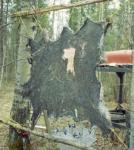 this would make an ideal drum skin, but how? Doing some research on the
internet, it appeared to be fairly simple to make rawhide, easier than
a tanned hide. So off I went to turn this deer hide which still had the
hair, fat and a little meat on it into my first drum skin. For that story
and pictures see the selection called 'Skinning a Hide!' off the main page.
this would make an ideal drum skin, but how? Doing some research on the
internet, it appeared to be fairly simple to make rawhide, easier than
a tanned hide. So off I went to turn this deer hide which still had the
hair, fat and a little meat on it into my first drum skin. For that story
and pictures see the selection called 'Skinning a Hide!' off the main page.
The frame was next. Although many drums
are round, there are also octagon frames. Friends had dropped off some
maple boards they salvaged that were not suitable for the paneling job
they were working on. The boards were about one inch by five and other
than a some heavy grain markings here and there they were in good shape.
The first frame made was from rip sawn maple about a quarter of an inch
by two inches. The angles were cut at 45 degrees and when glued together
it looked pretty good. I thought that the thinner frame, which matched
the thickness of the round plywood frames would add to the sound. Unfortunately
it never got the chance to be skinned. The thinner frame didn't survive
the stress test and collapsed before the skin could be applied. There was
a lesson to be learned there, and since I'm too stupid to give up, I made
another frame but one inch thick.
The one inch frame was good and solid,
but I inserted some thin strips across the joints to add to the strength,
somewhat like a biscuit. I'm not much of a cabinet maker ...I make it up
as I go. I'm sure these strips add some rigidity to the joints and since
they are cedar they also add some character to the frame. The joints were
glued with regular wood glue and clamped with a strap rig. Not very primitive
but effective. I wasn't into making natural glue from hooves and hide -
yet! Maybe next time . . . It was important to sand the wood smooth and
round the corners to avoid any rips where the hide would be stretched.
Again modern methods were used - a power sander! Not very primitive, but
extremely effective! Maple is a hardwood but the job was done in no time.
The dry deer rawhide was soaked for a few
hours in cold water and when pulled out of the barrel was like thick pizza
dough, or rubber. I just had to do some touch up scrapping to get the hide
ready. The rawhide thong about a quarter of an inch wide was trimmed from
an oval piece by cutting along the edge. The hide was lined up with the
frame and was cut to fit over the sides with about an inch overlap. There
were sixteen holes punched with a small paper punch - again not primitive,
but effective! The holes were a little large, but because they are round
they don't rip, just stretch out a lot! The lacing was threaded through
the skin by crossing over the frame to opposite holes. I tried to stretch
the skin as I went, but I also went back and took up the slack. The skin
was fairly resilient during this process. It held the moisture even after
being wrung out. The thongs were pulled together into groups of four and
then wrapped with rawhide strips and snugged tight. The entire process
took about two hours.
The drum was left on the porch to dry.
It was sheltered from the direct heat of the sun. The flow through air
by having both doors open might of added to the drying process.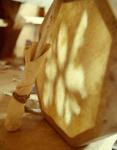 It dried well within three days. The first few taps on my new drum were
magic! Not only did it sound like a drum, but it had a sweet tone. During
the making of the drum I sang to it and told it how great it would be!
I told it how it would have the heart and soul of buck the skin came from.
During the construction of the frame, the scraping of the hide and the
stretching of the rawhide on the frame, I sang happy songs and tried to
think positive thoughts. It all seemed to work - my first drum turned out
well. We went into the bush one night and let my new drum sing to the forest
and the spirit of the animals. It sang loud and clear! We could feel the
spirits surround us. It was absolutely glorious! Painting the drum is next.
I've decided on a symbolized buck deer!
It dried well within three days. The first few taps on my new drum were
magic! Not only did it sound like a drum, but it had a sweet tone. During
the making of the drum I sang to it and told it how great it would be!
I told it how it would have the heart and soul of buck the skin came from.
During the construction of the frame, the scraping of the hide and the
stretching of the rawhide on the frame, I sang happy songs and tried to
think positive thoughts. It all seemed to work - my first drum turned out
well. We went into the bush one night and let my new drum sing to the forest
and the spirit of the animals. It sang loud and clear! We could feel the
spirits surround us. It was absolutely glorious! Painting the drum is next.
I've decided on a symbolized buck deer!
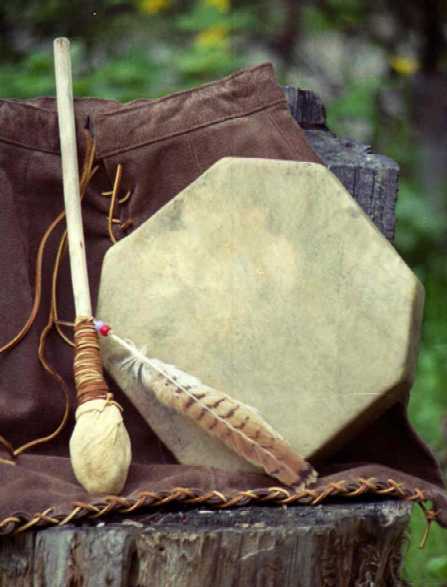
The beater is a length of willow, wrapped
with cotton cloth strips and wrapped with very soft leather. As a matter
of fact I used a polishing chamois for the beater. It works well.
The case for the drum (see the finished
drum photo) was a leather mini skirt I picked up at the local Salvation
Army store. When I told the lady as I paid for it that I was interested
in the leather, she nodded and smiled! My wife didn't help much by making
rude comments! I maintained my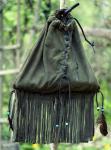 innocence and believe I managed to leave with my dignity intact. The fact
is, the leather used in the skirt was worth more unfinished than what they
were selling them for - I paid $3.00 for the skirt. The zipper was removed
and the bottom laced up. The drawstring is held together by a knuckle from
a deer leg. I also made a medicine bag out of another skirt. I fringed
the bottom and it looks less like a skirt. The kind lady at the store advised
me to check back often since they receive some very nice leather skirts
and I was doing the world a favor by taking them off the clothing market!
Hmmm . . . I wonder what she meant by that?
innocence and believe I managed to leave with my dignity intact. The fact
is, the leather used in the skirt was worth more unfinished than what they
were selling them for - I paid $3.00 for the skirt. The zipper was removed
and the bottom laced up. The drawstring is held together by a knuckle from
a deer leg. I also made a medicine bag out of another skirt. I fringed
the bottom and it looks less like a skirt. The kind lady at the store advised
me to check back often since they receive some very nice leather skirts
and I was doing the world a favor by taking them off the clothing market!
Hmmm . . . I wonder what she meant by that?
As I look back on my drum making project,
it occurs to me that the material was salvaged and other than glue and
the leather skirt for the case, was free! The labour was intense but very
relaxing and meaningful. Not only is playing the drum good for the soul,
but making it was as well!
Click
here to see the photos . . .