|

Updated 15/3/02









Feel free to contact me
and tell me what you
think of my work
or to report any problems
with my site
|
|
Working with
Wire.
By T.C.Lubcke Jnr.
The shaping of the tree
can be one of the most
important elements in creating the
desired look.
As most form of Bonsai rely on
wire for shaping, it deserves at
least an overlook on my site.
You my have noticed that I
said most forms, and not all.
There is at least one form
that I am aware of that relies
on nothing more than careful pruning
to let the tree "find" its
own path- No bad thing (I have
seen some beautiful trees created
this way).
However, the use of wire is
important and should be learnt about
if serious interest exists.
I have learnt the hard way
that not all wire is useable.
Three major points need to be
address when finding a suitable wire.
The first is thickness of the
wire.
Thick wire will not cut into
the bark. I used, at first, a
thin wire I had on hand. To
make it strong enough I doubled
it over and twisted it. Needless
to say- my poor little gum
suffered a number of small scars.
The second is the pliability of
the wire.
The first wire I used again
was not very pliable. Because of
this, you can place too much
stress or force on the tree
and thus could cause a break.
There are tricks I will explain
further down.
The third is the metal property
of the wire.
My first wire was alright in
this category. If the metal used
is easily weathered or poisonous you
run the risk of both staining
and killing the tree. Even if
no damage is done to the
trunk- and by some magic- does
not absorb the metal that way,
it will through the soil/root system.
Please be careful!
G Wiring
G
Often the best place to
find the wire is going to be
a good nursery. Hardware stores can
also be a good place to look
but be careful of the chemical
make up of the wire. Make sure
you do not pay too much for it
either.
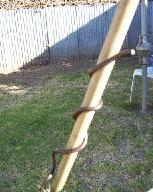
A good way to wind the wire is
to wind it around something of
similar size to that you want.
For my example, I am wiring a
Juniper branch which is fairly thin
and so a stick of bamboo. Make
sure you can get the wire off
afterwards!
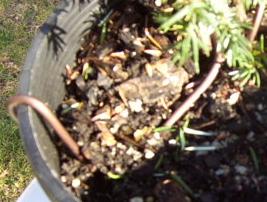
Next, you must anchor the wire.
Depending on the length, either
anchor deep into the soil or
around the pot and along the
surface until you reach the tree
base. This is important in keep
the branches in the desired
direction and angle. From there,
wind the coil around the branch
in question.
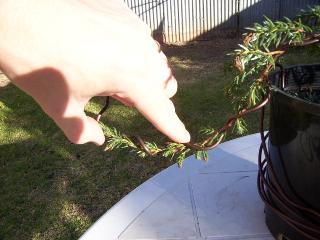
Next comes the bending. It is
often the easier to hold the
point where the wire is anchored
while shaping the branch. Be careful
in how you handle the branch
to ensure that no damage is
done to the plant.
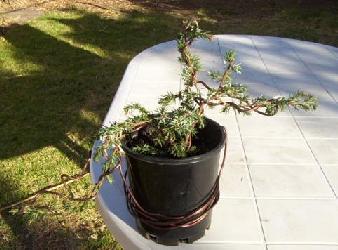
You may want to make a number
of wirings on the tree. I know
that the tree can end up
looking a little under the weather
for it, but trust me, it will
look better one the changes have
been set.
The important thing to remember
is to give a natural look on
a miniature scale.
Individual trees will need different
amounts of time before the shaping
has worker. Try looking on the
species information page, under theory, to
find details on this.
|