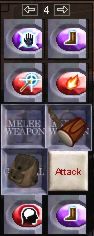
 1. Hymn of Restoration
2. Selo’s Accelerando
3. Damage Song 1*
4. Damage Song 2*
5. Primary Weapon Slot
6. Secondary Weapon Slot
7. Instrument/Weapon Bag Slot**
8. Pet Attack button***
9. Solon’s Song of the Sirens
10. Selo’s Accelerando
Introduction: Bards are hybrids, like Paladins, Druids, and Shadowknights. A hybrid is a combination of two or more classes, sacrificing some of the strength of the parent classes for more variety and broader abilities. A paladin, for instance, doesn’t fight as well as a warrior, or heal as well as a cleric. However, he fights better than a cleric and has some clerical magic that a warrior does not. This is true for all hybrids, usually, and bards are no exceptions. Bards are best described as rogue/shaman/enchanter hybrids, being the most versatile class in the game, and sacrificing specialization for that versatility. With one exception: I believe that bardic charms are superior to enchanter charms. Why? For three reasons: 1) Bardic charm costs no mana if the mob is 37th level or less. 2) Bards can sing their songs (spells) while running. 3) Bardic charm lasts 18 seconds maximum. Yes, this is a good thing, especially considering the charm can be reapplied for free when necessary. All of these things lead to one of the most powerful tools in a bard’s arsenal: Charm Kiting.
Charm Kiting has a fairly simple principle: Find two comparable mobs near each other. Charm one, and have it attack the other. When the charm wears off, re-apply it and send the mob back again. While doing this, you use Selo’s Accelerando to keep out of range of the two mobs. With luck, the mobs will both beat each other down to where you can finish them off yourself, or have your pet kill the other one, and have a very hurt ex-pet to finish off yourself when the charm finally wears off for the last time.
Of course, there are kinks to be worked out. But remember that no PC will ever do as much melee damage as a mob of the same level will. When you charm a mob, you’ve got a better pet than any necro or mage, as long as the charm lasts.
Charm was recently changed, which made Charm Kiting a bit more difficult. In a nutshell, mobs that used to be charmed would remember their targets when re-charmed, and would automatically re-attack them once they were made pets again. Now, charm has been changed to include a memory wipe when charm wears off (except for the aggro on the charmer), so when you re-charm the mob, you have to re-target your prey, and tell the mob to attack again. As compensation, the bard’s charm duration was extended from 12 seconds to 18. While this does make Charm Kiting more difficult, there is a nice upshot to this change, which will be explained further on.
This document assumes you know how to make hotkeys, duplicate inventory slots, how to twist, and how to swap instruments on the fly.
Setup: The key to successful charm kiting is in the set up of your hotkeys. Charm Kiting requires a lot of keypresses fast to make work, so it’s important to set yourself up to save time and keystrokes. Here is my suggestion: You’ll need to reserve one bank of 10 hotkeys in Full Screen mode. Here is what you should have in each hotkey:
1. Hymn of Restoration
2. Selo’s Accelerando
3. Damage Song 1*
4. Damage Song 2*
5. Primary Weapon Slot
6. Secondary Weapon Slot
7. Instrument/Weapon Bag Slot**
8. Pet Attack button***
9. Solon’s Song of the Sirens
10. Selo’s Accelerando
* These can depend on your level. At 30, it’s recommended you use Fufil’s Curtailing Chant and Brusco’s Boastful Bellow. At 38, replace BBB with Tuyen’s Chant of Flame. If you are Charm Kiting at 28 or 29, you might consider putting a utility song or a melee buff in along with BBB.
** It’s recommended that you have one bag that holds all your weapons and instruments in it, and nothing else. Keep that bag in the same inventory slot all the time. This way, all you have to do is right-click on the bag, and all your instruments and weapons are available for you instantly.
*** This button is a social, and should have the following lines of code:
/pause 1,/pet attackYou’ll notice that the charm song, the pet attack button, and one copy of Selo’s Accelerando are all on the far right side of the numberline at the top of your keyboard. This places your fingers near the F8 key when you rest them there. This is important.
/pet target
Technique: Begin by putting your drum in your hand. While it true that Charm seems to be slightly more effective when played with a wind instrument, you will need your speed for safety, and your drum will provide that speed. Also, if you are going to be using Chant songs, you will get a nice instrument bonus for them.
You will also want to get your Charisma as high as you can. There is some controversy over this, with many people claiming that Charisma does not have a significant effect on charm success or duration. I must disagree. Based on my own personal experience, higher Charisma does mean fewer resists and more charms of full duration, especially when charming yellows and low reds. This effect is less noticeable when charming blues. My recommendation: at least 120 CHA for blues, and if you are going for yellows and low reds, 130-150 CHA.
Find a nice, open outdoor zone with mobs of the level you want to kill. Start with blues or even greens, until you get the hang of the technique. Then you may want to try yellows and low reds, if you feel confident enough. Try to pick mobs that are of comparable strength. If one is stronger than the other, choose the stronger one as your pet. Have Selo’s Accelerando playing.
It’s important to remember that our Charm songs have a lot of taunt. So much so that a mob that used to be charmed will pretty much ignore everything else in its attempt to bash your face in. Therefore, it’s a good idea to try to always charm the same mob. If you charm both, you’ll end up with a mob that will be constantly chasing you, even while your pet whacks at its back. If you only make one mob your pet, your target will ignore you in favor of attacking your pet.
The Pet Attack button you made will help you keep your pet targeted. It should automatically re-target your pet after issuing the attack command. If for some reason you have to switch targets and want to target your pet again afterwards, hit F1 twice.
When you find a couple of likely targets close together, switch your camera view (F9) to an external 3rd person, with the camera pulled way back and at a high angle. Target your soon-to-be pet, and attempt to charm it.
If the charm sticks, the mob will come running toward you to stand faithfully by your side. As it does, click on your proposed prey and hit the Pet Attack button. If your pet is close enough, it should immediately turn and start running toward your prey to attack it.
If the charm is resisted, you’ll get a resist message and the mob will come running toward you to bash your face in. Run in a wide circle (Selo’s should still be in effect, even though you aren’t singing it at the moment), and try again. If it is resisted a second time, restart Selo’s. When Selo’s is going again, try charming again. Eventually, you’ll land the charm. Target your prey, hit Pet Attack.
Now, run far enough away from the two fighting mobs so that when charm breaks, you’ll have time to start running again, but not so far that you can’t keep your eyes on them any more. Make sure you get Selo’s going again before you do anything else. Eventually, Charm will break, and both mobs will come running toward you to bash your face in.
Run in a wide circle with both mobs chasing you. You should automatically still have your pet targeted, thanks to the code of the Pet Attack button. Let Selo’s pulse, then recharm your pet. If it sticks, restart Selo’s, and then hit F8. F8 /should/ target the nearest enemy mob to you, which is probably your target. When you have your prey reacquired, hit Pet Attack. Provided your pet was in range of the command, it should immediately turn and attack your prey once more. Run a little bit away, and wait for charm to break. And repeat. If charm doesn’t stick, keep trying until it does, remembering to keep Selo’s up constantly.
Keep an eye on the health bars of both your target and your pet. You will probably not want your pet to kill your prey- you want to do that yourself. And you definitely don’t want your pet to get killed by your prey, because you’ll not get any XP or loot. When either your pet or your target is about to die, it’s time to stop charming and finish it off yourself.
Finishing: Prior to the change in charm, bards suffered the same penalty as other pet classes. That is, if a pet did more than 50% of the damage to a mob when it dies, and the pet’s owner was not in a group, the owner only got 50% of the experience. But with the new memory-blur of the new charm, bard charming has a pleasant windfall. Mobs no longer ‘remember’ that it was a pet that did damage to them. Which means you can Charm Kite a mob until it is almost dead, let charm wear off on your pet, and finish the mob yourself using damage songs or similar, and earn FULL experience for the kill. This fact alone, in my opinion, makes up for the inconvenience of having to re-target your prey.
There are a few ways to finish off the mobs you’re Charm Kiting. The first way is to simply let your pet kill your prey. This is easy, and requires little risk and effort, but will only earn you 50% of the experience you would earn otherwise.
The most common way to finish off a mob is by using damage songs to kite it. Run in a circle around the mob, (the other mob will still be chasing you, too, if it’s still alive) and use Bellow, or Chants to finish it off.
If you have only one mob left, and it’s so low on health that it’s already trying to run away, you can feel free to melee it if you like.
When both mobs are dead, loot up. Alternatively, if your pet is still pretty strong, find another target and send it after that one. You can chain Charm Kite this way for hours, provided the mobs are available. When you need a new pet, finish of the old one, charm a new one, and keep going. So long as the mobs are fighting each other and not chasing you, you can loot corpses between re-charms.
And then when you’ve killed the mobs, you realize the best thing about Charm Kiting: No downtime. You never have to stop, until your fingers sieze up.
Problems: Charm Kiting takes a lot of practice, but even experienced Charm Kiters will run into problems. Here are some things to think about: