Leprechauns Leprechauns |  Shamrock Shamrock |
 Blarney Stone Blarney Stone |  Saint Patrick (Himself!) Saint Patrick (Himself!) |
 Claddagh Claddagh
| |
Return to Main St. Patrick's Page
 Return to Holidays Page
The Shamrock, at one time called the "Seamroy", symbolises the cross and blessed trinity. Before the Christian era it was a sacred plant of the Druids of Ireland because its leaves formed a triad. The well known legend of the Shamrock connects it definitely to St. Patrick and his teaching. Preaching in the open air on the doctrine of the trinity, he is said to have illustrated the existence of the Three in One by plucking a shamrock from the grass growing at his feet and showing it to his congregation. The legend of the shamrock is also connected with that of the banishment of the serpent tribe from Ireland by a tradition that snakes are never seen on trefoil and that it is a remedy against the stings of snakes and scorpions. The trefoil in Arabia is called shamrakh and was sacred in Iran as an emblem of the Persian triads. The trefoil, as noted above, being a sacred plant among the Druids, and three being a mystical number in the Celtic religion as well as all others, it is probable that St. Patrick must have been aware of the significance of his illustration.
The leprechan is an Irish fairy. Looks like a small, old man (about 2 feet tall), often dressed like a shoemaker, with a cocked hat and a leather apron. According to legend, leprechauns are aloof and unfriendly, live alone, and pass the time making shoes...they also possess a hidden pot of gold.
Legend has it, if you catch a leprechan, he must give you his pot of gold!
Treasure hunters can often track down a leprechaun by the sound of his shoemaker's hammer. If caught, he can be forced to reveal the whereabouts of his treasure, but the captor must keep their eyes on him every second. If the captor's eyes leave the leprechaun (and he often tricks them into looking away), he vanishes and all hopes of finding the treasure are lost.
Blarney Stone
Kissing the Blarney stone is supposed to bring the kisser the gift of
persuasive eloquence (blarney). The Blarney Stone is a stone set in
the wall of the Blarney Castle tower in the Irish village of Blarney,
about four miles NE of Cork City. The building of the castle is
attributed to Cormac Laidhiv McCarthy (or MacCarthy) in 1446. It is
one of the most famous buildings in Ireland and thousands of tourists a
year still visit the castle. The Blarney stone is set in the wall of
the castle and it's tough to reach the stone -- it's between the main
castle wall and the parapet. Kissers have to stretch and bend backward
(and downward), holding iron bars for support.
It is not known how the legend of the Blarney Stone began, there had
long been a belief in the magical power of stones in Ireland. Most
Chieftains or Kings were installed while sitting on a particular stone.
One story has it that it may have grown from the antics of the Chief
of Muskerry in Queen Elizabeth's time. Cormac MacDermot MacCarthy,
whose silvery tongued excuses enabled him to stay on terms with both
sides without definitely committing himself to either, caused the Queen
to describe his talk as "All Blarney".
Another story says that an old woman cast a spell on the stone to
reward a king who had saved her from drowning. Kissing the stone while
under the spell gave the king the ability to speak sweetly and
convincingly.
It is also said that the Blarney stone is Jacob's Pillow brought back
from the Holy Land after the Crusades.
Belief in the power of the Blarney Stone was well established by the
first quarter of the 19th century. At this time, Father Prout added a
verse to Millikin's then famous song about `The Groves of Blarney' when
he wrote:
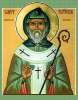
St Patrick is known for driving the snakes from Ireland. However, snakes were at that time a symbol of paganism, and it was really paganism he drove out. It is also said that, as a reward, Patrick was granted a request from Our Lord. Patrick asked that the Irish should keep the Christian faith for all time and that they should be spared the horrors of the Day of Judgement. From this comes the legend that Ireland will be drowned under a sea of water seven years before the Last Day originates.
After a long and fruitful life, St Patrick died on March 17th in the year 461. He is buried in a secret grave. Many believe this to be in Downpatrick.
St. Patrick became the Patron Saint of Ireland. There are no fewer than 60 churches and cathedrals named for him in Ireland alone. Perhaps the most famous of these is the giant St. Patrick's Cathedral in Dublin, the grounds of which bear the mark of the site on which St. Patrick baptized his converts.
The first American celebration of Saint Patrick's Day was in Boston, Massachusetts, in 1737. As the saying goes, on this day "everybody is Irish!" Many, many U.S. cities now hold Saint Patrick's Day parades, the largest held in New York City.
Claddagh
 Origin of the Claddagh Ring
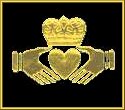
The emblem of the Claddagh (pronounced 'Cladda') has a design of a heart being encircled by a pair of delicate hands with a crown above the heart.
It is said to be the traditional symbol of the inhabitants of Claddagh, an Irish village to the southwest of Galway city. The Claddagh is said to be the oldest fishing village in Ireland.
The origins of the Claddagh Ring continues to remain a matter for conjecture.
Popular stories of its origins attribute it to the Joyce family of Galway City. It is generally accepted that the ring came from an area that includes the Aran Islands on the West, through all Connemara and Joyce Country to Galway, and then eastward and southward for about twelve miles in either direction. A region which surrounds Claddagh Village.
It has been difficult to trace the origin because huge numbers of Claddagh rings were melted down following the Great Famine of 1846-47, as there was nobody to redeem or purchase them. Interest in Claddagh rings has revived and it's popularity has spread, helped by the vast exodus from Ireland during the great Famine.
Symbolism of the Claddagh
By tradition the ring is taken to signify the wish that love and friendship should reign supreme. The hands signify friendship and faith, the crown loyalty and fidelity, and the heart love.
It is also said the Claddagh symbolises the Holy Trinity. The crown signifies The Father, the left hand The Son, and the right hand The Holy Ghost....all caring for the heart in the center which symbolises humanity. This explanation correlates to the Shamrock, one of the earliest symbols of the Holy Trinity among the Irish.
There was also a Dublin version of this ring that appeared some 100 years back with two hands and two Hearts but no Crown. Some call this version the Fenian Claddagh.
Some will say that the crown represents Beathauile. The left hand represents Anu who was the ancestral and universal mother of the Celts and who later changed her name Danu. The right hand represents Dagda Mor, the father of the gods who was so powerful he had the power to make the sun stand still. The heart represents the Hearts of all mankind and that which gives the everlasting music to the Gael.
In the 17th century the symbol was first depicted on a ring which became the fashionable exchange of friends or lovers. These rings were kept as heirlooms and, with great pride, were passed from mother to daughter on the daughter's wedding day.
Today, the ring is worn extensively across Ireland and elsewhere. Worn on the right hand with the heart turned outwards shows that the wearer is "fancy free". When the heart is turned inwards, it denotes that he or she is "spoken for". The symbolism of the Claddagh can also vary depending on which hand the ring is worn:
Worn on the right hand with the point if the heart turned outwards, the world will know that the heart has not yet been won.
Worn on the right hand with the point if the heart turned inwards, it shows that friendship and love is being considered.
Worn on the left hand with the point if the heart turned inwards, it means two loves have joined forever.
Throughout each varying symbolism, a single theme shines through, specifically that the ring symbolises the trinity of "Love, Loyalty, and Friendship".
Origin of the Claddagh Ring
The emblem of the Claddagh (pronounced 'Cladda') has a design of a heart being encircled by a pair of delicate hands with a crown above the heart.
It is said to be the traditional symbol of the inhabitants of Claddagh, an Irish village to the southwest of Galway city. The Claddagh is said to be the oldest fishing village in Ireland.
The origins of the Claddagh Ring continues to remain a matter for conjecture.
Popular stories of its origins attribute it to the Joyce family of Galway City. It is generally accepted that the ring came from an area that includes the Aran Islands on the West, through all Connemara and Joyce Country to Galway, and then eastward and southward for about twelve miles in either direction. A region which surrounds Claddagh Village.
It has been difficult to trace the origin because huge numbers of Claddagh rings were melted down following the Great Famine of 1846-47, as there was nobody to redeem or purchase them. Interest in Claddagh rings has revived and it's popularity has spread, helped by the vast exodus from Ireland during the great Famine.
Symbolism of the Claddagh
By tradition the ring is taken to signify the wish that love and friendship should reign supreme. The hands signify friendship and faith, the crown loyalty and fidelity, and the heart love.
It is also said the Claddagh symbolises the Holy Trinity. The crown signifies The Father, the left hand The Son, and the right hand The Holy Ghost....all caring for the heart in the center which symbolises humanity. This explanation correlates to the Shamrock, one of the earliest symbols of the Holy Trinity among the Irish.
There was also a Dublin version of this ring that appeared some 100 years back with two hands and two Hearts but no Crown. Some call this version the Fenian Claddagh.
Some will say that the crown represents Beathauile. The left hand represents Anu who was the ancestral and universal mother of the Celts and who later changed her name Danu. The right hand represents Dagda Mor, the father of the gods who was so powerful he had the power to make the sun stand still. The heart represents the Hearts of all mankind and that which gives the everlasting music to the Gael.
In the 17th century the symbol was first depicted on a ring which became the fashionable exchange of friends or lovers. These rings were kept as heirlooms and, with great pride, were passed from mother to daughter on the daughter's wedding day.
Today, the ring is worn extensively across Ireland and elsewhere. Worn on the right hand with the heart turned outwards shows that the wearer is "fancy free". When the heart is turned inwards, it denotes that he or she is "spoken for". The symbolism of the Claddagh can also vary depending on which hand the ring is worn:
Worn on the right hand with the point if the heart turned outwards, the world will know that the heart has not yet been won.
Worn on the right hand with the point if the heart turned inwards, it shows that friendship and love is being considered.
Worn on the left hand with the point if the heart turned inwards, it means two loves have joined forever.
Throughout each varying symbolism, a single theme shines through, specifically that the ring symbolises the trinity of "Love, Loyalty, and Friendship".