Massive protests disrupt trade talks Source:
AP | Published:
Wednesday December 1 1:55:17 PM
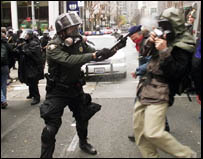
Seattle: The mayor of Seattle declared a state of emergency and imposed a dusk-to-dawn curfew as demonstrators opposed to a new world trade regime forced the cancellation of the opening ceremonies of the largest trade event ever staged in the United States. Mayor Paul Schell imposed the curfew from 7pm (Pacific Standard Time) to 7.30am PST, a period that will cover the scheduled arrival of President Clinton, who is flying here to address the World Trade Organisation on Wednesday. Washington Governor Gary Locke said at nightfall on Tuesday that he was calling up 200 unarmed National Guard personnel trained in crowd control for duty on Wednesday morning. The mayor's and governor's actions came as roving bands of protesters blocked major thoroughfares and continued random acts of violence, including breaking windows in downtown buildings. Parts of this normally laid-back Pacific Northwest city took on the look of a battle zone as police confronted protesters who chained their bodies together so that officials' motorcades couldn't get through. Clinton is scheduled to arrive in Seattle after midnight and will stay at a hotel in the curfew zone. Schell told reporters at city hall, "Do I wish things had turned out differently today? You bet, don't you?" Locke, appearing with Schell at the news conference, said he had decided to call in 200 unarmed members of the National Guard as a precaution. He said he expected them for the most part to serve in a backup role. "You may not even see them," the governor told reporters. Clinton, who had hoped to use the meetings of the 135-nation World Trade Organisation to showcase the benefits of free trade, told reporters in Washington before the violence erupted that he was "very sympathetic" with the concerns being expressed by labor unions and environmental groups.< "I think we should strengthen the role and the interest of labor and environment in our trade negotiations," said Clinton, who is scheduled to address the WTO ministers on Wednesday. Clinton, however, spoke before the confrontations in the streets of Seattle. The White House gave no indication of any alternation in plans for Clinton to address the delegates. However, disappointed WTO officials said that the Geneva-based trade organisation had decided to scrap plans for UN Secretary General Kofi Annan and Secretary of State Madeleine Albright to address an opening session, which was to be held in the ornate Paramount Theatre. Instead, the WTO went straight into the first of a series of plenary sessions, where trade ministers from different countries are allowed to address the meetings. A disappointed WTO Director General Mike Moore vowed that, despite the rocky start, the assembled nations would succeed in launching a new round of multinational trade negotiations to lower tariffs and other barriers on agriculture products, manufactured goods and service industries such as banking and insurance. "This conference will be a success. The issues are far too important to be ignored," Moore said. Police Chief Norm Stamper defended the way the Seattle force had handled the protests. He said the small number of people arrested showed "remarkable restraint" by the police. By late Tuesday, police were confirming 22 arrests. Moore said official delegations at two downtown hotels had been advised that the police "were not able to guarantee a safe passage" to the theatre where the opening ceremonies were to be held and UN spokesman Fred Eckhard said in New York that Annan hadn't been able to get out of his hotel room to deliver his speech because of the protests. After a three-hour delay in the morning opening, WTO officials finally gave up and said they would break for lunch. They reassembled in the more-secure but less ornate convention centre for the afternoon talks. Only a handful of the hundreds of official delegates had managed to get through the protesters and stinging gas clouds to the theatre. During the afternoon session, US Trade Representative Charlene Barshefsky told the delegates: "We regret any inconvenince that you may have experienced. ... It is unfortunate that some of the protesters did become unruly, but that does not reflect the views of the people of Seattle or the United States." But Pascal Lamy, the top trade negotiator for the European Union, said, "The reason why a number of protesters are here is because they believe that trade liberalisation is working against a number of value they care about." The Clinton administration had picked Washington state, home to exporting giants Boeing and Microsoft, to highlight the importance of trade for the US economy. One of every three jobs here are tied to international trade, the most of any state. But the Pacific Northwest also has strong ties to trade unions and environmental activists, and they showed up in large numbers to voice their grievances. In the view of protesters, the World Trade Organisation puts profits for multinational corporations over other concerns, forcing nations to engage in a "race to the bottom" to compete in the global economy with low wages and lax environmental standards. "We're going to change WTO or we're going to get rid of WTO," Teamsters union president James Hoffa Jun told a union crowd that swelled during their afternoon march to as many as 50,000 persons by some estimates. That march, sponsored by the AFL-CIO, did not begin until after a morning of sporadic violence from protest groups who defied police orders to stay clear of the giant convention centre and downtown theater where the WTO meetings were being held. The union throngs stayed to their designated parade route and returned to the staging without incidient. During the morning demonstrations, protesters broke windows at several downtown businesses and vented their rage at unoccupied police patrol cars, spray painting them, kicking in doors and slashing their tires. "We are winning, don't forget," someone sprayed on one downtown building. Police said they fired tear gas and red pepper spray into groups of demonstrators who had chained themselves together and were lying in the streets in an attempt to prevent delegates from making it to the opening sessions. Third World countries are strongly opposed to demands that the WTO take into account labour and environmental standards in its trade negotiations. They see this as a veiled effort at protectionism by rich nations seeking to take away the competitive advantages of lower wage scales and more lax environmental regulations. Dockworkers up and down the West Coast shut down some cargo movement on Tuesday in solidarity with the anti-WTO protest. About 9,600 workers of the International Longshore and Warehouse Union were expected to take part in the action at about three dozen West Coast ports, including the nation's largest, Long Beach and Los Angeles Copyright © 1999 John Fairfax Holdings Ltd. All rights reserved. |