

President Clinton arrives in troubled Seattle
State of emergency declared after turbulent protests
December 1, 1999Web posted at: 8:29 a.m. EST (1329 GMT)
SEATTLE (CNN) -- President Clinton arrived early Wednesday in Seattle, where downtown storefronts have been smashed and others are boarded up, and a state of civil emergency is in effect following turbulent protests against the World Trade Organization.
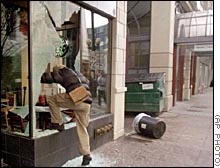
Police used tear gas and pepper spray to disperse demonstrators, and through the night, despite a dusk-to-dawn curfew, angry bands of protesters roamed the streets, smashing windows at NikeTown, a Planet Hollywood restaurant, Nordstrom, a McDonald's, a toy store, a Starbucks coffee house and other businesses. In some areas, streets were littered with glass.
Police cars were vandalized, some restaurants were looted, and King County Executive Ron Sims said several transit buses were boarded by angry protesters who assaulted drivers, slashed tires and removed batteries to disable the vehicles.
Police arrested about 60 people. Another 30 people were injured in the melee. A number of delegates to the WTO conference checked themselves into area hospitals after they were exposed to pepper spray or teargas, CNN's Greg Lefevre reported.
President Clinton plans to speak to the WTO delegates, and has indicated he may meet privately with some of those opposed to the organization, in an effort to get them to participate more constructively in the dialogue on trade issues.
Clinton has said some of the protesters have "legitimate concerns" but deplored the violence which erupted. The president will try to satisfy three very different groups: U.S. farmers, international trade ministers and a host of protesters opposed to globalization.
Anti-free trade activists took their criticism to the streets on Tuesday,
clashing with police. In scenes reminiscent of U.S. civil rights and anti-war
protests of the 1960s, police in riot gear sprayed tear gas and shot rubber
pellets called "stingers" to clear the protesters, who had clogged streets
and blocked access to the convention center, where the WTO sessions are
being held.
Hotel guests sent to their rooms
At the posh Westin Hotel, where U.S. Trade Representative Charlene Barshefsky and her Japanese counterparts were staying, guests were told to go to their rooms for fear demonstrators would storm the building.Undeterred by the protests, trade ministers representing the 135 WTO members went ahead and delivered dry speeches about their vision for the global trading system.
Barshefsky said negotiators had already made progress toward narrowing their differences over agriculture and electronic commerce. "We're very much on track," she said. Other diplomats were skeptical a breakthrough was at hand.
By nightfall, the demonstrations had largely subsided. But they cast a a pall over the conference, which aims to launch a new round of negotiations to free up global trade in goods and services.
Many U.S. labor leaders reacted angrily after the looting and clashes
in Seattle, saying the violence itself -- not the issues -- would take
center stage.
Downtown under curfew
Seattle Mayor Paul Schell declared a civil emergency and placed most of downtown under curfew. Washington Gov. Gary Locke ordered as many as 200 National Guard personnel and up to 300 state troopers to help patrol Seattle's streets.Locke said the National Guard members would be unarmed and "You may not even see them, but they will be there."
"This is the last thing I wanted to do -- be a mayor of a city where I had to call in the National Guard, where I had to see tear gas in the streets. It makes me sick. At the same time, we have a city that needs to be protected," Schell said.
As the 7 p.m. curfew approached, Seattle police in body armor and riot gear fired tear gas into crowds and charged demonstrators who refused to leave the downtown area, backing them further away from the downtown area.
Police warned curfew violators: "You're going to jail."
The street protests forced the cancellation of the planned opening ceremonies of the trade conference.
Officials said police from other cities in Washington state were en
route to help.
Frightening moments for Iowa governor
|
||||
Schell apologized to the ministers "for the inconvenience" created by the protests and issued a plea to the protesters:
"If we really want to see change, those of you who are asking for it, we need to give them a chance to work on it."
Sections of downtown were rendered impenetrable hours after the scheduled start of the international trade conference. The conference attracted 6,000 delegates from 135 countries.
The protesters -- environmental activists and other more radical demonstrators who are demanding the abolition of the WTO -- tried to prevent delegates from leaving their hotels, blocked access to conference facilities and spray-painted walls and police cars with anti-WTO graffiti.
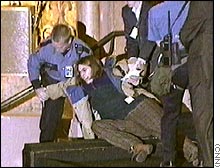
Iowa Gov. Tom Vilsack, trapped in a screaming mob as he headed to a WTO meeting, was dragged to safety by bodyguards as protesters pummeled a state trooper bending over Vilsack to protect him.
"It was a little bit more frightening than the earthquake I was in," Vilsack said. "You could see the faces of people screaming at you."
The governor said neither he nor security aides were injured, but he
was shaken by the events.
Thousands participate in rallies
|
||||
U.N. Secretary-General Kofi Annan, a scheduled speaker at the opening ceremonies, was among those who was prevented for hours from leaving his hotel. The ceremony was postponed indefinitely.
The plenary session at the main convention center was delayed, but did take place. And WTO officials said negotiations were being conducted despite the unrest.
The disturbances, which covered a several-block area near the main convention hall, started hours before a march sponsored by the AFL-CIO saw 20,000 labor activists walk from Memorial Stadium to the downtown area.
About 5,000 to 6,000 people participated in morning street rallies before the violence broke out, police said. Mayor Schell said most demonstrations were non-violent.
"But once people crossed the line and started disrupting the peaceful demonstrations, they harmed not only the city, but the people making those protests.
"Do I wish things turned out differently today? You bet," he said.
Some demonstrators turn on one another
Tensions escalated as police used pepper spray and tear gas to disperse crowds that had stalled the meeting's opening ceremonies. In one clash, witnesses said demonstrators turned against one another.Protesters smashed downtown windows at a McDonald's, an FAO Schwartz toy store, a Joan and David shoe store and a bank. "Barbie Kills" was sprayed on a toy-store window full of Barbie dolls.
Protesters carried placards inscribed, "WTO Hell No," "America Repent," "Trust Jesus" and "Green Backs Unite."
Many protesters wore gas masks or scarves over their faces to help them
breathe after police began spraying.
Police use fire extinguishers, billy clubs
Police at first said only pepper spray was used against the protesters, but Chief Norm Stamper later confirmed tear gas also had been fired into their ranks."Warnings were administered," Stamper said. "This gas is more than inconvenient. It really hurts, it stings, and it's intended to drive people away in a potentially violent situation."
Later, he said, "We are using a variety of non-lethal tactics ... But the kinds of weapons we are talking about are not to be taken lightly."
As officers sprayed the protesters with fire extinguishers and fired tear gas canisters, protesters picked up still-smoking canisters and threw them back at police. In one violent exchange, police hit protesters with billy clubs.
Correspondents Greg Lefevre, Rusty Dornin and John King, and The Associated Press contributed to this report.