
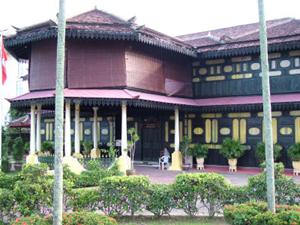
Many historians claimed yhat Kelantan has been in
existence between 8000 and 3000 B.C. According to
Chinese historical documents, Kelantan referred to as
'Ho-lo-tan', 'Chih-Tu' and 'Tan-Tan' in these records
had maintained links with China. In the 18th Century.
Royal house of Kelantan. Kelantan came under Thai and British influence before becoming part of the
Federation of Malaya in 1957 and Malaysia in 1963.
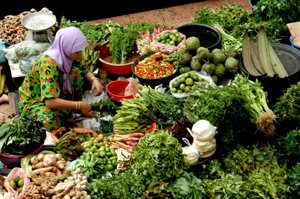
Kelantan's economy relies mostly on agriculture
especially paddy, rubber and tobacco produce.
Fishing along its 96-kilometre coastline and livestock
rearing are also two important economic activities.
songket (cloth with gold or silver embroidery) weaving are evident. In recent years, the tourism industry has
also become a major money-spinner
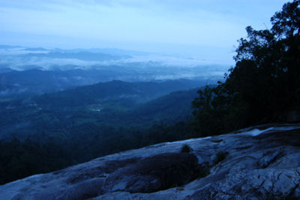
Kelantan is the north eastern most State in the
Penisular Malaysia. The state is bounded on the
north by Thailand, on the east by Terengganu, on the
west by Perak and on the south by Pahang. Covering
an area of about 14,922 sq km, Kelantan is richly
endowed with forests.
Climate
On the whole, Kelantan's climate is tropical monsoon. The temperature
is relatively uniform within the
range of 21A°C to 32A°C throughout the year. During the months
of January to April the weather is
generally dry and warm. Humidity is consistently high on the lowlands
ranging between 82% to 86% per
annum. The avarage rainfall per year is 2,032 mm to 2540 mm and the wettest
months are from November
to January.