Under
Sindbad’s
Shadow
in Muscat
This Arab city is fast becoming an Asian business and tourist hub for the 21st century.
With additions by Sheila Sivanand
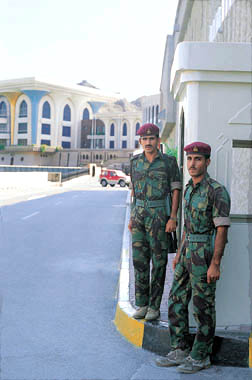
I'M STROLLING about Sultan Qaboos bin Said al Said's royal precincts, in front of his imposing blue-and-gold palace. Armed guards, the only other people in sight, ignore me. Yet I'm jittery. Am I trespassing? Will they take my camera away? I walk up to a guard and ask if I may take pictures.
"No problem," he smiles. "You're welcome to Muscat."
Typical Omani behaviour — the society is friendly and, for this neck of the woods, remarkably free. In some neighbouring capitals, you could land in jail for photographing a royal residence.
I'd imagined Persian Gulf cities to be stark concrete jungles. However, Muscat changed my mind. Here, the desert has bloomed — hard work and good leadership have brought prosperity, and this port city is fast becoming an Asian business and tourist hub for the 21st century.
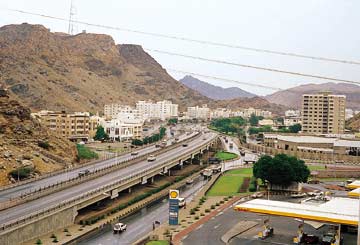
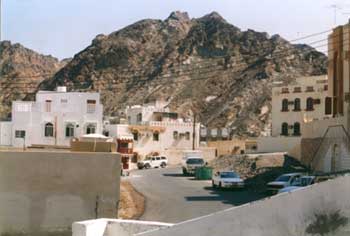
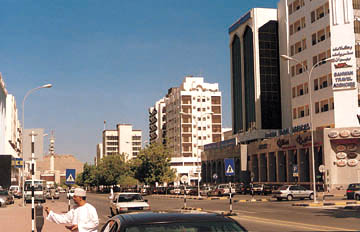
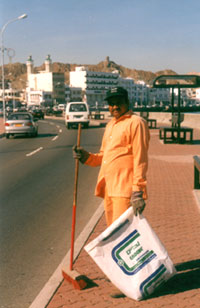
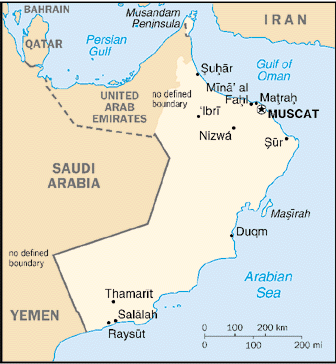
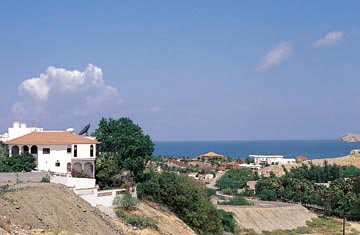
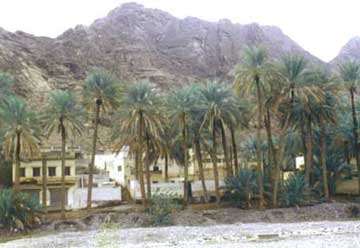
As you fly into Muscat's Seeb Airport, less than two hours across the sea from my home in Bombay, you notice fold upon fold of mountains. It's the spectacular Al-Hajar range with its many hues, said to result from the wealth of minerals — copper, aventurine, jasper, quartz — present in the rocks. Driving out from Seeb, a slick highway that slices through the hills is flanked by acacia trees and date and coconut palms. With an emerald bay, it's a dramatic landscape — Muscat (population: 622,500) is a mix of traditional and ultra-modern. New buildings harmonize with old structures — arched, latticed windows and sparkling white exteriors characterize all residential blocks, churches, mosques, even the city's two Hindu temples. Few high-rises exist outside the central business district of Ruwi. Folks here like to say how Muscat rivals Singapore for the title of Asia's cleanest city. "And mind you," remarked my brother Sunil, a longtime Muscat resident, "nobody here gets spanked for littering." Folks here will also tell you that their Sultan takes a personal interest in the city's décor. I could never verify this, but there's talk of Sultan Qaboos driving around incognito to ensure that everything's ship-shape.
Described as the Persian Gulf's best-kept secret, most of the desert land that surrounds Muscat — the Rub-al-Khali or Empty Quarter— was uncharted territory until the 1950s, and less known than even Tibet, until Sir Wilfred Thesiger, an Oxford scholar, lived among the Bedouin tribes here and wrote his Arabian Sands. "No man can live this life and emerge unchanged," Thesiger observed, "… for this cruel land can cast a spell which no temperate clime can match."
Just 25 years ago, Muscat had no newspaper and no radio station, and barely 10 kms of paved road. But all that was to change from 1970 after power transferred to the western-educated Sultan Qaboos. Both locals and expatriates often describe the Sultan in one short word: wise.
Because of the rapid changes, the past decade on is referred to here as The Renaissance. "I've seen Muscat transform," says Kuttan Sateshan, an Indian construction businessman who's lived here since the 1970s, whom I met in his ritzy Muscat villa. "It seems to me that just the other day this place had nothing. Today it has everything."
They call it their Renaissance also because Muscat once enjoyed a glorious past until rulers before Qaboos bin Said shut themselves off from much of the rest of the world. Muscat controlled several outposts along India's west coast and colonized Zanzibar. In the desert sands west of Muscat lie the ruins of Ubar, a fabled lost city of biblical times, rediscovered in 1992 using satellite imaging. And they'll tell you that Sindbad the Sailor was a compatriot. His birthplace: the coastal Omani town of Sohar.
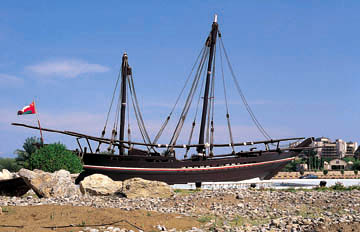
Huh? I'd always thought this 9th century hero, whose seven voyages provide the most daring tales in The Arabian Nights, hobnobbed with the Caliph of Baghdad and belonged there. Anyway, I wasn't getting into any foolish argument, partly because I'd read The Arabian Nights back in primary school. And partly because of Ali, a Muscat cab driver, who offered to show me proof. Ali drove me and my wife Sheila close to the city's plush seaside Al-Bustan Hotel and stopped by Sindbad's sailboat, also named Sohar, displayed on a roundabout, now proudly retired from her voyages.
"No," we said to Ali, "this couldn't be the real one!" Common sense told us that nothing so ancient could just sit there like that. Ali smiled. "I never said it was Sindbad's real boat."
We then learnt about how in 1980, for the 10th anniversary of his rule, the Sultan sponsored a voyage led by British adventurer Tim Severin and his part-Omani crew to retrace a Sindbad voyage. They sailed from Muscat to Canton, China, the old-fashioned way, even navigating by the stars. Sohar, Ali revealed, is Severin's replica of Sindbad's boat.
In Sindbad's day, Sohar was Oman's capital, a most magnificent city, until it was sacked by the Persians in 971 AD, never to recover its former splendour. Anyhow, a long drive to Sohar, now developing into an important industrial site, offered me no tangible proof to show that Sindbad was an Omani, or that he even existed. However, the legend of Sindbad is so entrenched in modern Muscat lore that his name crops up everywhere: from amusement park and restaurant names to magazine ads. A local book about the country, published in English, refers to modern Omanis as the "Sons of Sindbad."
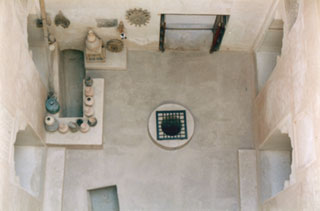
Be it fact or fiction, I decided to rest Sindbad's case awhile. Why, almost everything else that's historical here was believable, and there's a good deal to explore in and around Muscat. The old merchant houses along the Corniche, or the sea-front, are graceful with intricately worked windows and balconies. One of Muscat's best old-world private homes to explore is the Baith Fransa — baith means house in Arabic — the 19th-century home of the French consul-general. Inside it, I was transported back into the past as I pushed open carved doors, and stumbled upon lovely things like old tools, maps, and official almanacs, all left openly on display.
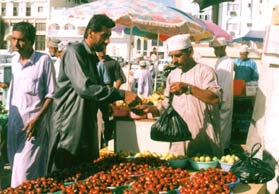
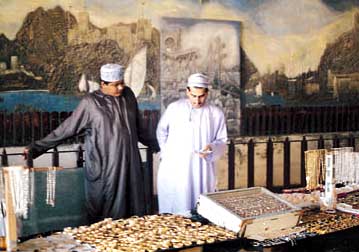
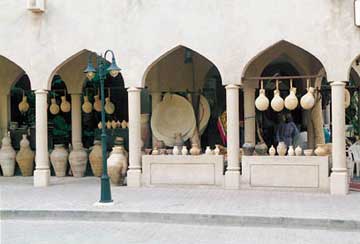
The bustling maze that is Muscat's Muttrah souk is also worth exploring for souvenirs. The Gulf's oldest surviving souk, it's far more exciting than the city's sparkling new shopping malls. At the souk I pick out a beautifully worked incense burner and a charming replica of Aladdin's lamp.
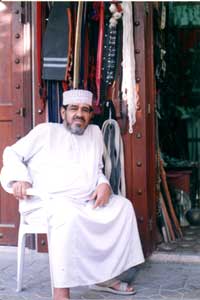
"Was Aladdin an Omani?" I ask the turbaned curio merchant as he carefully polishes my lamp.
"Of course," he replies, in his gruff genie-like voice, "just like Sindbad."
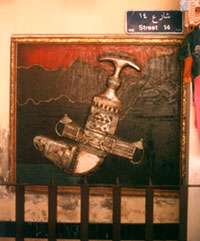
My doubts about Sindbad now get even graver because, in The Arabian Nights, Aladdin is as Chinese as dim-sum. I quietly pay for the lamp and move on to explore the elaborate silver the souk offers. They include bent daggers or khanjars worn ceremonially by Muscat's men, and Maria Theresia thalers — Austrian coins that were legal tender here until 1950, and which now adorn all kinds of chunky Omani necklaces. Most exquisite are tiny silver pendants shaped like Arab coffee pots, even khanjars. While at the souks, remember that asking prices for visitors are inflated. And most merchants speak enough English for visitors tohaggle comfortably.
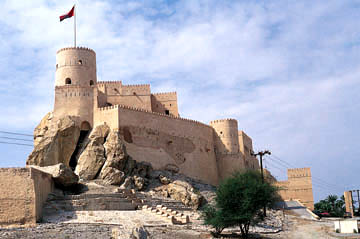
Muscat's past is best
explored in the many ancient forts that dot the city and its surroundings.
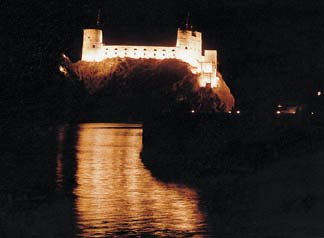
I returned to the royal precincts again after dark when the two ancient
forts Jalali and Mirani (built by the Portuguese who for a while occupied
Muscat on their route to India) off the bay there are softly lit and looking
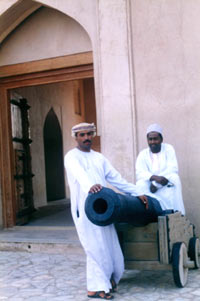
picturesque. A few drives into the interior also got me to the forts of
Nizwa, Nakhl and Jabrin, all about as old as ....
Click
Go for the rest
of this article.