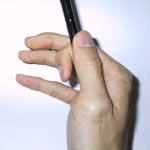
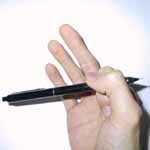
Pencil
Spinning 101
What?
Pencil
spinning?
Pencil spinning is the act of spinning your pencil in your hand. Although called
Pencil Spinning, pencils are not the only writing instrument that can be spun.
Pens, Erasers, Glue sticks, remotes, chocolate bars, and much anything that has
a certain length and thickness (totally depending upon the size of your hand)
can be spun.
Why?
I don't know why I'm writing this section, but this is something I'd like to
share. I started spinning my pencil in grade 8 during math class and eventually
all my classes. It became a 'hobby' I guess you can call it and has become
something I do involuntarily to pass the time and keep my brain thinking. No
matter what reason you have for wanting to learn how to spin your pencil (be it
to pass the time, show off for your friends, impress no-names on the public
transit, or just to distract your mind when you find out you just don't know the
answer on a really hard final exam) it's still something to do. I don't think
I'm an expert at this, as I still am learning how to do more and more spins, but
I feel that I have something to say about this.
Who this is for:
This article was written with the intention of informing people who want to
learn how to spin a pencil in their hand. Readers who already know how to Pencil
Spin may also want to read further on to find out more ways and tricks to spin
pencils. Perhaps there is a spin that you haven't seen, have trouble performing,
or don't know how to do. All in all, anybody who has nothing better to do other
than read boring articles on mundane topics may want to spend their time here as
well. At least it's more fun than trying not to think about llamas.
Instruments of Spinnage
What do I
need?
To perform basic pencil spinning, the only instruments needed are a hand
(hopefully your own), and a pencil. Other instruments may be used (though your
hand is usually one of the set requirements). The pencil you choose to spin
usually depends on personal taste, how comfortable you feel holding the pencil,
the weight of the pencil, the length, and whether there's any gum stuck on it.
Try to choose a pencil that isn't too thick, nor too short. Longer pencils are
easier to spin than shorter ones and heavier well balanced pencils better than
feather light end weighted ones. If you don't have a pencil, here are some
possible substitutions:
|
Pen |
Any pen
will do basically. The easier ones include Bic blue/black/red clear barrel
pens, and the slightly thinner Bic blue plastic pens. |
|
Eraser |
The
pencil length types are the easiest of the erasers to be spun, although,
with practice, spinning regular rectangular prism shaped plastic erasers
can be accomplished. |
|
Glue
Stick |
Difficult
due to its thickness, I'd suggest using these only when there is no
alternative. |
|
Wooden
stick off the forest floor |
The
quality of the stick for our purpose depends on the thickness, weight, and
how straight it is. Basically the same qualities you want in a pencil go
for the stick, except the sticks are usually easier due to their length.
Hint: Dry sticks with no bugs crawling on them are usually more
entertaining (for you, maybe not those watching) than running away
screaming when you find out you didn't pick up a stick from the forest
floor. |
|
Meter
(Yard) stick |
These
long sticks are ideal for strengthening your fingers into rhythmic motion.
The long length and possible the weight means that the stick will have a
lot more inertia and will try to spin in a smooth motion. Try to watch it
though when the stick swings by your head as serious eye/ear injuries can
occur. You might want to stay away from glass and delicate crystals at the
same time. |
|
Baton |
The
original spinning stick. These are just as good as the Wooden sticks at
training your fingers. |
|
Chocolate
bars |
Hopefully
covered in tin foil, these bars are good for spinning in cold climates
where they won't melt while you spin them. Rolo's are the best for this,
and you can have a good snack after you're done too. |
|
Chopsticks |
Chopsticks
are great to spin. Wooden, plastic, or ivory are all the same, although it
is better to stick with the cheaper ones before moving to fine ivory
chopsticks. It is best to spin them when there aren't any bits of food
stuck to them as flying food usually results in chopsticks getting shoved
into curiously important cavities in the human body. |
Things I advise against using for Pencil Spinning:
|
Remote
controls |
Although
many seasoned veterans of pencil spinning can spin their remote controls
for their TV in many fastidious fashions, the average beginner will likely
drop the remote enough times to cause serious damage, or at least case the
batteries to fall out resulting in a frustrating search on the floor and
under objects, and an equally frustrating difficulty in trying to put the
batteries back in the proper direction. (Remote controls are already
fragile and receive too many bumps and bruises from regular use. I advice
you not to spin these unless you have a plenitude of universal remotes in
your house). |
|
Animals |
Some
animals don't respond well to being grabbed and spun in furious manner. It
is usually safer to go look for something else to spin than to pick up an
animal and attempt to make it nauseous. If you HAVE to spin an animal, try
to find a stick insect rather than a squirmy snake or caterpillar. |
|
Crystal
or anything else that can be easily broken when dropped |
This is
kind of a rule of thumb, although if you have the money and the guts, go
right ahead. |
In any case, try to use your own judgment in whether or not you will be able to
safely spin an object before you do. Safety of yourself (above all), others
around you (above all but your own safety), and the safety of physical objects
around you (above the rest not listed here) should be your primary concerns.
Don't say I didn't warn you, because I did.
Setup
Location:
It is best to learn how to spin your pencil when you don't have anything else to
think about. Distractions such as (but not limited to) your boss at work,
professors, parents, sexy people of the opposite sex, large carnivorous animals,
cars or any other vehicles coming straight at you, raving lunatics wielding
flaming chain saws, dangerous limb chopping machinery, flammable or corrosive
chemical spills, and pesky insects should be kept away from. Again, use your own
good judgment as to whether the environments is a calm one where you can
concentrate on spinning your pencil or not. Good environments include in bed
(depending on how clean the object is that you're spinning), while watching TV,
in class when the teacher doesn't care what you're doing, or isn't there,
outside on a sunny day, and/or while in public transit (although when/if you
drop your pencil it'll be difficult to retrieve it without big movements).
State of mind:
The first thing to do (after you've acquired your instrument of spinnage) is to
put yourself into a state of mind. Nobody ever saw a person spin their pencil
while shouting "I can't do this! I can't do this!". It is best to
learn how to spin your pencil when you are in a calm state of mind. Small things
such as music or TV may be nice to have at the same time for 2 reasons: When
you're fingers get tired of spinning your pencil, you can rest and catch a show
or something, and 2, when people see you sitting there, they'll think you're
watching TV or listening to music, and not think that you're an idiot for
practicing such ludicrous actions (not that it's ludicrous to do so).
The old saying "I think I can I think I can" works well with this,
although you might come up with your own. Various mentalities have been
witnessed, such as "Jean can do this! So why can't I?!?!" (replace
Jean with any other name) or "I can't be respected if I don't spin this
pencil!!!". Whatever mentality you come up with to try to conquer pencil
spinning, make sure it's a good one.
Which hand to use?
Hopefully you have two hands. My regrets to those out there who have one or none
as I wish you weren't/hadn't been struck with this tragic impediment. For those
of us who have 3 or more hands, WHAT THE HECK IS WRONG WITH YOU!?!?
Usually it is best to try to learn how to spin your pencil with your writing
hand. As that hand has had more practice at being controlled precisely than your
other hand. Later on, if you want, you can try to conquer the savage that is
your other hand, and train it to be more useful. For me, I learnt to spin on my
pencil with my right hand (as I am right handed), and now I'm trying to learn
with my left.
Where to
Start
Where to
Start:
Of all the people that I've spin to about pencil spinning, no particular spin
has become apparent as the best beginner's spin. However, certain spins are
obviously more complicated than otherse. Because of this, I cannot tell you
which spin is best to learn first and so on, but here are some suggestions
anyway.
The three main spins that seem to be the most popular starters are the Simple
Thumb Spin, the Four Finger Loop, and the Gyrating Twirl. These three spins are
usually the starters due to their simplicity, not only in balance, but in speed.
The faster your fingers have to move to perform a spin, the more difficult it is
to learn/master that spin (I was going to say something here but I forgot what).
The balance, on the other hand (no not 'your' hand) depends on multiple factors.
Each and every pencil spin relies on the balance of the pencil, but different
spins require more or less precision where you hold or touch the pencil to
maintain that balance. Some spins such as the Simple Thumb Spin allow you to
hold the pencil almost anywhere in a range close to half the pencil, while
others like the Infinity Loop require that you hold the pencil withing 1
centimeter of the tip.
Order?
For order's sake, I'm going to go through the spins in the order that I learnt
them in. The order is just a suggestion but if you feel that the spin is too
difficult, try another one and maybe it'll be easier for you. Then again, maybe
it won't and you'll end up missing an eye, but who's to say eh?
Note: I'm giving the spins names because I have to be able to refer to
them somehow. In fact, I have never heard of a pencil spin being named at all so
this could be a first hehe.
The Four Finger Loop
Description:
This loop involves using your index, middle, fourth, and pinkie fingers. The
thumb can be used to help start eh spin and later on to maintain a steady rate,
but usually after learning this spin well enough, the use of the thumb becomes
minimal at most.
Uses:
This spin can be used to strengthen the control of your four fingers. Usually
the pinkie is the weakest and the fourth finger has little to no precise
control. This spin can help you gain control for future spins (as you will
surely need it). It's also quite simple and a good place to start.
Crowd effect:
With practice, this spin (with the use of a shiny pencil) can yield dazzling
shiny reflecting whir’s of light around your fingers with minimal effort. Hey,
they even used a 3 finger variant of this spin in James Bond: Goldeneye
(remember the computer guy who spun the exploding pencil?).
Note: The three finger variant of this spin yields less effect and
results in the place where you hold your pencil to move upwards or downwards on
along the shaft of the pencil until you run out of pencil (eek!). Not good for
long continuos spins. No. Not good at all.
How:
To start the spin, put the pencil (doesn't really matter which end for this
spin) in between your thumb and your semi-curled up index finger so that the
thumb is pointed along the shaft of the pencil and the index finger's middle
bone is supplying the support on the other side. The other three fingers (middle
finger, fourth, and pinkie) should be extended because shortly after the start
of the spin you'll be needing these.
Slowly allow your index finger to curl a bit more towards the palm of your hand
and your thumb to push the pencil so that it wraps around the index finger. The
longer end of the pencil should be pointed towards the bottom of your hand by
now.
At this moment, use your middle finger to wrap around the pencil. Your thumb
should let go of the pencil causing the pencil to arrive in a state between the
index and middle fingers.
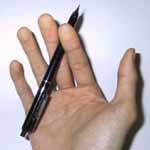
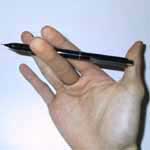
Your index finger should now start to extend while your middle finger still
curls up causing the pencil to rotate with its center of rotation being a point
in between the index and middle fingers.
The pencil should now be in a position where it's resting on the top of your
middle finger. Your fourth finger should now curl up wrapping over the pencil
causing it to wrap around the middle finger and become pinned between your
middle and fourth fingers (the pencil, not your finger). Meanwhile, your index
finger should extend (allowing the pencil to move) and then slightly curl up
into the palm of your hand (not too much). The reason for this will become
apparent after the next part.
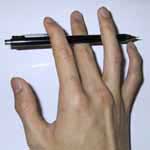
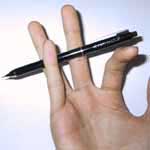
For some, this next part will be the most difficult of this spin because of the
general weakness of your pinkie finger. The pinkie finger should now curl over
the pencil while your middle finger lets go, causing the pencil to wrap around
your fourth finger and become pinned between your fourth and pinkie fingers.
Without stopping, your pinkie finger should curl and move slightly towards your
thumb while your fourth finger rises above the pinkie finger and moves
downwards. This will cause the pencil to wrap around the fourth finger and stick
upwards in the palm of your hand.
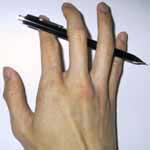 Your index finger (which should now be under
the pencil because you curled it up before) should now extend locking the pencil
in a position with the index an pinkie fingers under, and the middle and fourth
fingers on top. This part of the spin is usually the longest (in time) to
perform because the pinkie usually doesn't have enough power to move the pencil
in a large swoop at a fast enough speed.
Your index finger (which should now be under
the pencil because you curled it up before) should now extend locking the pencil
in a position with the index an pinkie fingers under, and the middle and fourth
fingers on top. This part of the spin is usually the longest (in time) to
perform because the pinkie usually doesn't have enough power to move the pencil
in a large swoop at a fast enough speed.
The pinkie should now curl all the way while the index finger extends outwards
causing the pencil to spin and become locked between the index and middle
fingers (back where we started after the thumb thing).
At this moment, the entire loop can be started all over again. Some tricks to
keep in mind are that not all fingers are made the same. As such, try to find
the best place on your fingers where you can control the pencil and it won't fly
out of your hand. Most people who find this trick difficult hold the pencil a
bit too close to the inside of their hand, or too far out (near the tips of
their fingers). Try to keep the pencil just under the last knuckle of your
finger.
Variations:
There aren't any variations really to this spin other than doing it backwards
(rolling on top of your fingers from the pinkie to the index).
The
Simple Thumb Spin
Description:
This spin involves using the thumb as a pivot for the pencil to wrap around 360
degrees and arrive in between your thumb and your index finger. In all cases,
the thumb must be used as the pivot while any other finger can be used to
initiate the spin and or catch the pencil. Most people use the index finger with
the third finger to initiate the spin, and then catch the pencil with the thumb
and the index finger. Many variations are available and will be discussed later.
Uses:
This spin is the first part of the Back Forth Thumb Spin and is also a very easy
spin to learn to get used to balance and timing. This spin is also very easy to
incorporate into combinations of spins as the pencil starts and stops in a
simple position.
Crowd effect:
This spin being quite possibly the most common of them all usually generates
very little effect. As it isn't continuos and most everybody with little
practice can get this spin to work for them. Later on, however, when this spin
is incorporated into the Back Forth Thumb Spin, the effect it has (that spin
being a continuos one) becomes more apparent. Complexity isn't very high for
this one.
How:
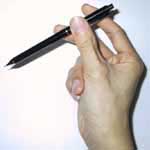 To start the spin, hold the pencil with your
thumb on one side, and your index and middle fingers on the other. Use the tips
of your fingers to hold the pencil. This spin is more dependent on the weight of
the pencil than the last spin as you need the heavier end of the pencil to pull
the rest of the pencil around your thumb. For most pencils, hold the pencil
about 1/4th of the way down from the top. With the longer end pointing down your
hand.
To start the spin, hold the pencil with your
thumb on one side, and your index and middle fingers on the other. Use the tips
of your fingers to hold the pencil. This spin is more dependent on the weight of
the pencil than the last spin as you need the heavier end of the pencil to pull
the rest of the pencil around your thumb. For most pencils, hold the pencil
about 1/4th of the way down from the top. With the longer end pointing down your
hand.
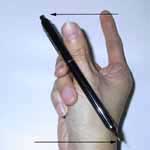 Using your middle finger, push the pencil
towards you while extending your index finger. The motion for the middle finger
is almost exactly the same as that for snapping your fingers, except that your
middle finger should stop moving once the tip of the finger reaches the middle
joint of your thumb. There it should stop as it makes catching the pencil easier
see.
Using your middle finger, push the pencil
towards you while extending your index finger. The motion for the middle finger
is almost exactly the same as that for snapping your fingers, except that your
middle finger should stop moving once the tip of the finger reaches the middle
joint of your thumb. There it should stop as it makes catching the pencil easier
see.
It is important that you do not move your thumb as doing so in a frantic manner
could send your pencil (or whatever you're spinning) into the air and possibly
poke an eye out). The speed that you spin the pencil at doesn't really make a
difference other than the fact that it looks a bit better when faster. People
learning this spin should start out slowly (just not too slow that the pencil
falls before it wraps around your thumb). Also, the index finger doesn't have to
be used to create the velocity in the pencil. The middle finger should be able
to give it the speed needed by itself.
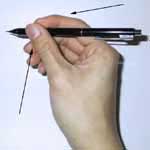 The longer part of the pencil should have
enough velocity to keep turning around your thumb. At this moment, timing is
quite important as your index finger, which should be fully extended should come
back and connect with the thumb (the tips of your thumb and index finger should
touch). The timing should be so that the pencil will have enough time to make a
turn around the thumb and rest on your middle finger (which becomes a small
temporary support for the penci) just as the the index and thumb connect
together to hold the pencil in place.
The longer part of the pencil should have
enough velocity to keep turning around your thumb. At this moment, timing is
quite important as your index finger, which should be fully extended should come
back and connect with the thumb (the tips of your thumb and index finger should
touch). The timing should be so that the pencil will have enough time to make a
turn around the thumb and rest on your middle finger (which becomes a small
temporary support for the penci) just as the the index and thumb connect
together to hold the pencil in place.
Tips and tricks to make this spin a bit easier:
Finding a well balanced pencil will make your life a lot easier. A long stick is
also very good for learning as it will spin slower and allow you to position
your fingers and thumb a lot easier. As stated earlier, the main focus of your
thumb is to act as the pivot. Very little movement on the part of the thumb is
needed. The index finger should be used only to hold the pencil in place at the
beginning and to catch the pencil after the spin. Basically the ONLY moving
parts in the spin are the middle and index fingers. Moving your hand (in an
attempt to make the pencil move better) will just cause the pencil to fall.
Variations:
Many variations to this spin exist. Here are some and their descriptions:
·
Single Finger Thumb Spin: This spin uses only one finger (index, middle,
fourth, or pinky), along with the thumb, to hold the pencil in place in the
beginning. To catch the pencil, the same finger (and only that finger) that held
it in place is used again along with the thumb. The easiest finger to use for
this trick is the index finger.
·
Thumb Spins with more than one turn: Many people claim to be able to spin
the pencil so that it will turn multiple times before being caught with the
index and thumb. These spins reduce control and accuracy for speed in the hope
for the pencil to spin more than once and land in the same place. In the end,
these variations lose so much control that the ability to perform it reliably
and on cue becomes close to null. Many an eye have been lost to this one folks.
The Three-Two Jump
Description:
This is probably one of the most satisfying spin to conquer. The control needed
for this spin incorporates a great deal of balance, position, and timing. The
pencil starts out in between the middle and fourth fingers, and then spins
around the middle finger to land in between the middle and index fingers.
Uses:
Other than increasing balance, control, and timing, this spin only serves to
allow the creation of many combinations as it virtually is the opposite of the
Four Finger Loop (This one makes the pencil go up over the fingers while the
Four Finger Loop makes the pencil go down over the fingers).
Crowd effect:
This spin is easily the spin with the most effect as it also is probably the
second hardest spin to master. The spin is easy to set up (once you're used to
it), and easy to recover from to make another go at it (after you're done)
making multiple repetitions not that difficult to accomplish. Later on, I'll
show you how to incorporate it with other spins to get rid of the setup/recovery
delay.
How:
Start out with the pencil resting between the middle bones of the third and
fourth fingers pinned just a bit below the middle of the pencil with the
slightly longer end sticking up out of the top of your hand (resting on the
flesh in between your thumb and index fingers. The third fourth (and fifth?)
fingers should be curled slightly to bring the pencil a bit closer to your palm
and it also gives a bit more control/space to move around.
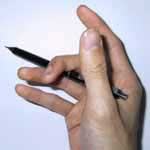
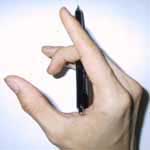
It is best to leave your index finger a bit straight as it will also direct the
pencil in the first half of the spin and make it easier to catch the pencil at
the end of the spin.
Slowly, extend and move your fourth finger above the third finger. The pencil
should move from it's resting position in between the thumb and index, and the
tip of the pencil should wrap around the middle finger and up to where it should
hit your index finger, causing the direction of rotation to shift 90 degrees to
be parallel with the face of your hand. The tip of the pencil should hit the
index which was slightly raised, and follow the index down towards your knuckle.
At the same time, the other end of the pencil should be above the middle finger
by now and it should all rotate with a pivot above the middle joint of the
middle finger.
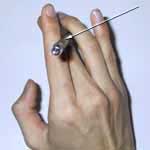
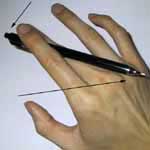
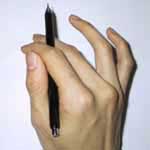
The pencil should keep on spinning and the top of the pencil should come into
place where your index finger rises above the middle finger as was described in
figure 7.2. Your index finger should come down locking the pencil in place in
its final position.
This entire spin basically relies on how well you set it up and start it going.
Once moving, the pencil should guide itself to be caught by your index finger.
Variations:
·
The Four-Three Jump: The spin, with practice, can also be successfully
performed from between the pinkie and fourth fingers, jumping up to the position
between the fourth and third fingers. This variation is a bit harder as usually
the pencil isn't long enough to reach up to rest on the base of the thumb so the
entire pencil must be held by the fourth and pinky fingers. Interestingly
enough, the final position of the pencil is also the initial position for the
Three-Two Jump making a Four-Three to Three-Two Jump Combination easy.
·
The Two-Thumb Jump: This spin is probably the most difficult variation of
the Three-Two Jump as the only finger left to catch the pencil at the end is the
thumb which usually doesn't have enough leverage to catch it. The pencil usually
ends up resting in the well of your hand supported by the side of your thumb and
the side of your index finger. The most difficult aspect of this variation is
the fact that the pencil's speed must be kept at a certain level or the pencil
will pop out of your hand/control.
The Thumb
Snap
Description:
This spin causes the pencil to be snapped into the air straight up, and then
land on your unmoved hand in the same place as where it started. This is
probably the most difficult spin to master/accomplish as it relies heavily on
where you apply pressure, how much you apply this pressure, and on the type/make
of pencil you are using. Wooden pencils (pencil crayons and regular wood
barreled pencils) make for the best control as they have a high flexibility and
won't spin as fast as would a plastic or metal pencil.
Warning:
This trick should be performed only with full one piece bodied pencils. Pencils
made from two pieces (plastic or otherwise) joined in the middle should be
avoided at all times. I have lost two Staedler Retro 1st Gen Retractable Tip
Mechanical pencils (one 0.7 mm the other 0.5mm), 1 Fisher Metal Barreled Twist
Top Pen, and a Generic Plastic Multicolor Pen to this trick. If your pencil
doesn't seem sturdy, then don't use it.
Uses:
None really. This trick at most is only a practice exercise at thumb control in
applying pressure and position. The limitation on the types of pencils that you
can use for this trick also makes it difficult to perform this trick most of the
time.
Crowd effect:
This trick is up there on the list of spins generating the most effect as people
usually don't expect a pencil to pop in the air a few feet while rotating, and
then land straight back in your hand in the initial (or quite possibly reversed)
direction. I guess it generates big effect also due to its difficulty to
perform.
How:
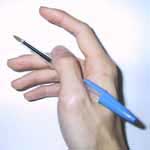 Place the pencil so that the tip of the pencil
rests on the side of your middle finger, and the other end on the well of your
hand. Your second finger should be extended (as this will facilitate the
catching of the pencil), and your thumb on top of the pencil pinning it in
place. This position is also usually very comfortable in holding the pencil as
it is very close to the same way you hold a pencil to write (well not really but
it's close to how -I- write hehe).
Place the pencil so that the tip of the pencil
rests on the side of your middle finger, and the other end on the well of your
hand. Your second finger should be extended (as this will facilitate the
catching of the pencil), and your thumb on top of the pencil pinning it in
place. This position is also usually very comfortable in holding the pencil as
it is very close to the same way you hold a pencil to write (well not really but
it's close to how -I- write hehe).
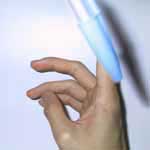 With the utmost of care, apply pressure on the
top of the pencil with your thumb. DON'T CRACK THE PENCIL as that would be bad
(since you not only lose a pencil, but look stupid). If you think you're going
to break the pencil, let go and try again in a different place. Experimentation
should be used to figure out how much pressure you want to apply to that type of
pencil. (Quick hops by apply a little pressure with your thumb and then rolling
it off the pencil are a great way to find out how much pressure you want to
apply for the real trick). When you're ready, roll your thumb off the pencil to
the side so that nothing is holding the pencil down anymore.
With the utmost of care, apply pressure on the
top of the pencil with your thumb. DON'T CRACK THE PENCIL as that would be bad
(since you not only lose a pencil, but look stupid). If you think you're going
to break the pencil, let go and try again in a different place. Experimentation
should be used to figure out how much pressure you want to apply to that type of
pencil. (Quick hops by apply a little pressure with your thumb and then rolling
it off the pencil are a great way to find out how much pressure you want to
apply for the real trick). When you're ready, roll your thumb off the pencil to
the side so that nothing is holding the pencil down anymore.
Your middle finger should have remained stiff during all of this, and the pencil
should now pop up into the air (spinning of course). The amount of pressure you
applied determines the height at which the pencil will achieve and how many
times it will spin before landing back in your hand.
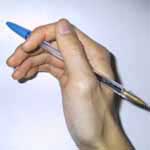 Your hand should remain in the same position
(with the well of your hand on top) and the pencil SHOULD come down straight
into it. With practice, this could happen, but usually a little adjustment in
the whereabouts of your hand will have to be made to make sure the pencil
doesn't miss the landing pad and hit the ground.
Your hand should remain in the same position
(with the well of your hand on top) and the pencil SHOULD come down straight
into it. With practice, this could happen, but usually a little adjustment in
the whereabouts of your hand will have to be made to make sure the pencil
doesn't miss the landing pad and hit the ground.
Variations:
None really. The only variations that you can do on this trick are usually how
high and how many spins you can do in the air while maintaining 100% control
(yes it can be done). I've seen this trick be performed with the pencil flying
several feet into the air without any hand adjustments.
The Reverse Thumb Spin
Description:
As the name implies, this trick is basically the reverse of the Simple Thumb
Spin causing the pencil to spin around the thumb again to be caught by the
second and third fingers. This spin however is a bit more difficult as the catch
isn't done by a finger wrapping around the top of the pencil but by a finger
positioned to let the pencil rest on it. It's also a bit more difficult to get
the pencil to wrap around the thumb this way because the force applied to the
pencil doesn't naturally make the pencil wrap around the pencil unless you do it
in a certain way.
Uses:
This trick is useful for making a combination with the Simple Thumb Spin. Doing
so allows you to get rid of the setup/recovery time for both spins.
Crowd effect:
This spin alone creates little effect but added with the Simple Thumb Spin, this
spin can create a nice continuous movement which will impress viewers with its
seemingly impossible movement (wrapping around the thumb by itself).
How:
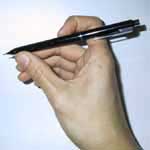 Position your hand such that the middle,
fourth, and pinkie finger tips touch each other, along with the tip of your
thumb on top of the middle finger. You should have a sort of circle now. Curl
your index finger such that the tip of your finger rests on top of the middle
knuckle of your middle finger. Make sure your thumb is pretty much straight (as
a crooked thumb makes for more difficult spinning). Place the pencil such that
the tip of the pencil is 1 centimeter down from the tip of your thumb and the
body rests against the tip of your index and on top of the first bone of your
index. A little adjustment on your part must be made so that the pencil fits
nicely and correctly as balance will play a part in this spin.
Position your hand such that the middle,
fourth, and pinkie finger tips touch each other, along with the tip of your
thumb on top of the middle finger. You should have a sort of circle now. Curl
your index finger such that the tip of your finger rests on top of the middle
knuckle of your middle finger. Make sure your thumb is pretty much straight (as
a crooked thumb makes for more difficult spinning). Place the pencil such that
the tip of the pencil is 1 centimeter down from the tip of your thumb and the
body rests against the tip of your index and on top of the first bone of your
index. A little adjustment on your part must be made so that the pencil fits
nicely and correctly as balance will play a part in this spin.
This part can be done in two ways (as there are two ways to do it). The first
way (and the way I usually do it) is to push the pencil by moving the index
finger so that the tip moves perpendicular to the pencil. The second way, is to
sort of scratch the pencil with your index finger. This is done by curling your
index finger even more (more so than it is now) and allowing the tip of your
finger to move along the pencil pushing it away from the resting position on
your index finger's first bone.
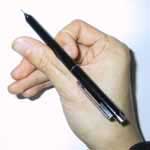
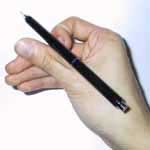
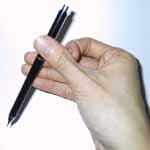 The pencil SHOULD wrap around the thumb
(considering that your thumb was positioned correctly). To catch the pencil,
your three fingers (middle, fourth, and pinkie) should extend slightly (rise to
the occasion) and then as the pencil hits them, give way a bit (absorb the force
of the pencil being stopped). You can get away with not absorbing the force if
you want to but doing so gives you more control in stopping the pencil.
The pencil SHOULD wrap around the thumb
(considering that your thumb was positioned correctly). To catch the pencil,
your three fingers (middle, fourth, and pinkie) should extend slightly (rise to
the occasion) and then as the pencil hits them, give way a bit (absorb the force
of the pencil being stopped). You can get away with not absorbing the force if
you want to but doing so gives you more control in stopping the pencil.
Your pinkie actually doesn’t really give any support to the pencil (unless the
pencil is moving slow enough that it's going to fall) but gives support to the
fourth finger. In fact, you can perform this trick successfully using only the
thumb, index, and middle finger, but more fingers isn't necessarily bad :-).
The pencil should now be in the resting spot, held there by the thumb, middle
finger, and gravity. Because of this gravity bit, you can't really perform this
trick upside down :-).
Variations:
There are no variations to this spin. Only combo's but they will be described in
the combo section.
The Half
Spin
Description:
This spin uses the thumb as the pivot for rotation, but, unlike the Simple Thumb
Spin, it doesn't rotate around the thumb, but on top of the joint. Difficult for
some, easy for others.
Uses:
Not really useful at all unless you're using a regular wooden pencil and want to
erase something (then it becomes really useful because the starting and ending
positions are the same, and very close to the position where you hold your
pencil.
Crowd effect:
You won't really impress the masses with this spin. It looks kind of weak
against the full Simple Thumb Spin, but it IS pretty funny to watch. Don't
expect a standing ovation for pulling this one off in the bus though :-).
How:
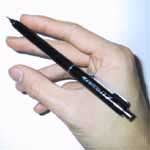 Start out by holding the pencil with one end
resting on the side just above the last joint of your middle finger and
the
other end on the well of your hand. This position is much like that from the
Thumb Snap (if you read that part first).
Start out by holding the pencil with one end
resting on the side just above the last joint of your middle finger and
the
other end on the well of your hand. This position is much like that from the
Thumb Snap (if you read that part first).
Lower your thumb so that the top of your thumb is a bit lower than half of the
pencil. Using your index finger, push the tip of the pencil (the part resting on
the middle finger towards you. The pencil SHOULD go onto the thumb and then spin
around, eventually landing in the well again (just half turned). Speed isn't
everything in this spin as you can do it slowly if you wanted. Also, the shape
of your thumb may affect your ability to spin the pencil in this way.
Experimentation again plays a big part in finding out what the best way for you
to spin your pencil is.
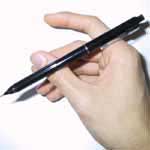 While the pencil is spinning, it is safer to
widen the gap between your index finger and thumb. This will give more stability
to the pencil and as you close the gap after the pencil is perpendicular to your
arm, the pencil will fall back into place more naturally.
While the pencil is spinning, it is safer to
widen the gap between your index finger and thumb. This will give more stability
to the pencil and as you close the gap after the pencil is perpendicular to your
arm, the pencil will fall back into place more naturally.
Variations:
There aren't many variations for this spin actually... in fact.. I don't think
there are any. Hmm... ok... well uhh I guess that's it for this one... (kind of
a let down isn't it?)
The Straight Up Flip
Description:
This spin looks somewhat like the Three-Two jump but is performed differently. I
think this one is actually harder to do really (your mileage may vary). This is
due to the lack of space available in the palm of your hand. Pencils that are
too large won't have enough room to flip, while pencils that are too small won't
have enough contact with your hand to flip correclty (and could wind up spinning
madly out of control into the air a few feet in front of you).
Uses:
None really unless you find yourself in the position of holding your pencil in
between your third and fourth fingers and want to move it to between your third
and second fingers.
Crowd effect:
This trick generates a bit less crowd effect than the Three-Two Jump but mostly
because the Three-Two jump moves a bit more than this one and generates more of
a blur.
How:
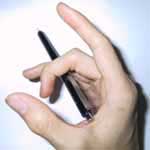 Start out holding your pencil such that the
tip is pointed down wards and is held in place between your third and fourth
fingers on the middle bone. The third and fourth fingers should be curled up so
that their middle bones are perpendicular to the pencil shaft. Your index finger
should be extended straight out (well not REALLY straight, just pretty straight)
so as not to accidently touch the pencil in mid flight (did I say flight? I
meant flip...) The other end (eraser side) should be resting on the well of your
hand.
Start out holding your pencil such that the
tip is pointed down wards and is held in place between your third and fourth
fingers on the middle bone. The third and fourth fingers should be curled up so
that their middle bones are perpendicular to the pencil shaft. Your index finger
should be extended straight out (well not REALLY straight, just pretty straight)
so as not to accidently touch the pencil in mid flight (did I say flight? I
meant flip...) The other end (eraser side) should be resting on the well of your
hand.
Pull your third finger towards you (curl it up more), and extend your fourth
finger. The end of the pencil with the tip should come up over your third finger
pulling the end with it. The tip should miss hitting your hand (at all) and as
the end comes up over your middle finger, your index and thumb should catch it.
Timing isn't THAT important (it still is) for the catch as you can catch the
pencil in two different positions (kind of lenient isn't it?). The first being
with the thumb and the index catching the end of the pencil by closing up. This
catch happens if you catch the pencil quickly (well quicker than the second
option). The second option (and sometimes a lot easier) is to catch the pencil
as it hits the well of your hand. You just have to move your thumb to make the
well of your hand close up. However, sometimes the pencil doesn't make it to the
well and you MUST catch it with your thumb and index, so basically try and hope
either case works :-).
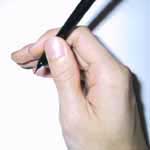
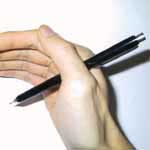
Variations:
The only working variant that I have been exposed to is flipping the pencil up
from between the second and third finger. This flip is quite a bit more
challenging for two reasons; The natural tendency for the pencil to NOT flip
straight over your index finger (as your index finger doesn't line up with your
middle due to its length), and the inability to use your index finger to help
catch the pencil (you have to use the well of your hand and your thumb). I'm not
saying it's impossible (because I've seen it done and can do it myself) but it
is difficult. Flipping from between the fourth and pinkie is usually too
difficult to perform as the pinkie doesn't have the strength and leverage to
actually apply the force correctly and efficiently to the pencil resulting the
inability to control the spin. As with all cases, use caution when experimenting
or trying new tricks out.
The Infinity Loop
Origin:
Description:
This spin requires a more tactile approach to spinning. It doesn't rely on speed
(as you can do it fast or slow) and it doesn't rely on the pencil shape (as you
can do it with almost anything that doesn't weigh too much). It's quite fun to
do too as it's simple and yet elegant.
Uses:
Very little to None... minus very little. I can't think of anything that this
spin could be used for except for the shear joy of watching a pencil move in an
extremely smooth double-circular motion. Quite calming actually.
Crowd effect:
Since this spin isn't very spectacular in terms of speed or flashiness, it won't
generate a huge response. It does, however, offer you a calm continuos spin (as
opposed to the mad rush the Four Finger Loop gives you). I use it when my hands
are cold and unable to move much as it doesn't require very much movement to get
it going.
How:
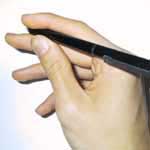 Begin by holding ONLY the pencil tip using
your thumb and index finger. The rest of the pencil should be resting on the
well of your hand but not pinned down. The tip of your index finger should be
slightly above the pencil (you'll need the added leverage to help spin the
pencil). Your middle finger should be giving support from the bottom (the pencil
tip should be resting on the last joint). This added support also makes it so
that the middle finger will be in position when needed.
Begin by holding ONLY the pencil tip using
your thumb and index finger. The rest of the pencil should be resting on the
well of your hand but not pinned down. The tip of your index finger should be
slightly above the pencil (you'll need the added leverage to help spin the
pencil). Your middle finger should be giving support from the bottom (the pencil
tip should be resting on the last joint). This added support also makes it so
that the middle finger will be in position when needed.
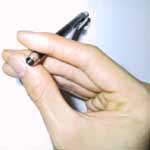 Start the pencil moving by pushing down with
your index finger. The pencil should pivot in between where your index and thumb
are holding it (causing the end resting on the well of your hand to come up and
over the rest of the pencil). When the entire pencil seems to have turned over
and the eraser end is falling down over the outside of your fingers, slightly
extend your middle finger to apply pressure just under where your thumb is
holding the pencil. Make note not to apply TOO much pressure (you still want the
pencil to be able to turn). This is where the difficulty comes in, keeping a
tactile grip on the pencil allowing it to pivot, while making sure it won't fall
to the ground.
Start the pencil moving by pushing down with
your index finger. The pencil should pivot in between where your index and thumb
are holding it (causing the end resting on the well of your hand to come up and
over the rest of the pencil). When the entire pencil seems to have turned over
and the eraser end is falling down over the outside of your fingers, slightly
extend your middle finger to apply pressure just under where your thumb is
holding the pencil. Make note not to apply TOO much pressure (you still want the
pencil to be able to turn). This is where the difficulty comes in, keeping a
tactile grip on the pencil allowing it to pivot, while making sure it won't fall
to the ground.
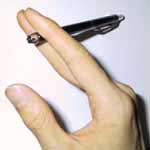 Once the middle finger has applied enough
pressure, it can take over for your thumb and you can release your thumb. The
pencil should now be pinned between your middle and index fingers see. At this
point, your want to slightly turn your hand inwards (your thumb moving down
towards you) while keeping your index and middle fingers almost stiff. Make sure
your thumb is lower than your third finger (almost touching the tip of your
fourth finger would help) because you'll need it to be there later. This will
cause the eraser end of the pencil to rise up (and as gravity would have it)
start to fall down by pivoting on itself where you're holding it in between your
middle and index fingers.
Once the middle finger has applied enough
pressure, it can take over for your thumb and you can release your thumb. The
pencil should now be pinned between your middle and index fingers see. At this
point, your want to slightly turn your hand inwards (your thumb moving down
towards you) while keeping your index and middle fingers almost stiff. Make sure
your thumb is lower than your third finger (almost touching the tip of your
fourth finger would help) because you'll need it to be there later. This will
cause the eraser end of the pencil to rise up (and as gravity would have it)
start to fall down by pivoting on itself where you're holding it in between your
middle and index fingers.
You should allow the pencil to make a 180 degree pivot, or just about. After
doing so, the barrel of the pencil should be just above the side of your thumb.
Raise your thumb and apply pressure to the bottom of the pencil it
(taking over from your middle finger). Once you've moved your thumb up
against the pencil enough, the pencil should have moved sideways and be almost
straight up being held (still at the tip) by your thumb and index finger.
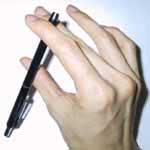
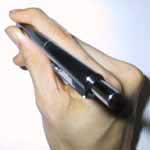
We're now at the starting position for the loop again (assuming you did it
right). Simplistically, the steps are: 1) Thumb and index 2) turn 3) pencil end
falls down 4) Middle and index 5) turn 6) pencil end falls down. And it repeats.
Once you've gotten the basic spin done, you can refine the spin so that the
pencil seems to move extremely smoothly and not just "down, side, down,
side... etc.".
Variations:
·
You can do this trick with the thumb, fourth, and middle finger replacing
the index. It's a bit more tricky as your thumb has to reach down lower to get
the pencil, but if you can do that a combo can be made using just variants of
this trick. Combo's will be discussed later.
·
Again, if your pinkie is long/strong/controllable enough, you can use
that too with the fourth and thumb to add yet another variant. In my best
judgment, however, the pinkie is lacking in enough control to hold the pencil
with just the right amount of force, making it extremely difficult to pull that
variant off.
The Gyrating Twirl
Description:
This trick has the pencil being pinned in between the second and third fingers
at the center of the barrel. By applying pressure to the pencil at certain times
one side at a time, the ends of the pencil will then start tracing circles in
the air. Doing the spin fast enough will make it look like the pencil is two
cones sticking out of your hand (ok I'm exaggerating but that's what you can
imagine it to be hehe). Anyway, this spin is less technical (meaning I have less
to say about it) as it seems to be different slightly for everybody.
Experimentation on how to get it to work for you (especially timing) is vital.
Uses:
None really but it's quite fun to do when you're bored. The pencil just moves
continuously with very little effort (leaving those valuable brain cycles free
to do actual work like playing free cell).
Crowd effect:
This spin generates an average amount of interest. I think it isn't as flashy
because it's seemingly simple for the amount of timing and control you have to
put it in. Also, a lot of people can do this spin with no problem so it doesn't
seem very great, but to me it's still special.
How:
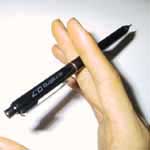 Start with the pencil pinned in between your
index and middle finger in the middle. It should be resting between the middle
bones of your fingers, pinned in the middle of the pencil (or near there).
Start with the pencil pinned in between your
index and middle finger in the middle. It should be resting between the middle
bones of your fingers, pinned in the middle of the pencil (or near there).
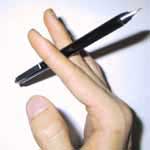
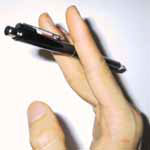
Start the spin by moving your index finger inwards slightly pushing down on the
pencil. The pencil end should start rotating downwards (the end on the inside of
your hand). When it reaches the bottom, start to move your index finger outwards
(pushing down on the other side of the pencil). The inner pencil end (i.e. the
end of the pencil on the inside of your hand) should rotate upwards while the
other end rotates downwards. Again, when the other end is at the bottom, move
your index finger inwards again (hence the gyration).
Variations:
This trick seems to be able to be done in between all four of your fingers as
long as you have the control and timing. Many people seem to find a preference
in which fingers to use to do this trick and stick to it.
Spinning Up Combos
If you've
mastered a few of the tricks described in this article, and want to get into the
really neat stuff, then this page is for you. Performing a trick well is surely
a great way to spend your time, but like all things, it gets boring. Solution?
Combine different spins together to make long combinations of tricks. Since
there are an infinite number of combo's that can be performed, and surely I
don't know ALL of them, I'll describe some of my favorite ones.
These ones have no names and are only described by how many different spins are
required.
4 Spin Combo
Spins needed: Three-Two Jump, Simple Thumb Spin (Index Finger Only
Variation), The Four Finger Loop, Simple Thumb Spin (Middle Finger Only
Variation with Middle Finger Catch)
Description: Start with the Three-Two Jump, then just as you catch it
with your thumb and index finger, go into the Simple Thumb Spin (Index Only
Variation) to set the pencil into position for the Four Finger Loop. When you're
bringing the pencil back up from the Four Finger Loop, instead of pinning the
pencil with your pinkie and index finger, use the pinkie and thumb so that you
can use your middle finger to start the Simple Thumb Spin (Middle Finger Only
Variation). Catch the pencil between your middle and fourth fingers instead and
you'll be in position to restart the combo.
2 Spin Combo
Spins needed: Simple Thumb Spin, Reverse Thumb Spin
Description: This combo is very simple in that one spin is the reverse of
the other. Just start with the Simple Thumb Spin and then catch the pencil in
the position needed to start the Reverse Thumb Spin. When you catch the pencil
for the Reverse Thumb Spin, use your middle finger and just do the Simple Thumb
Spin (Middle Finger Only Variation) again. This combo loops VERY easily.
3 Spin Combo
Spins needed: The Four Finger Loop, Four-Three Jump (Three-Two Jump
Variant), Three-Two Jump
Description: It doesn't matter really which spin you start out with but I
usually like to start out at the bottom with the Four-Three Jump. When you catch
the pencil from the Four-Three Jump, do the Three-Two Jump right away (bringing
the pencil up to between your middle and index fingers. Once there, you can
start the Four Finger Loop to bring the pencil back to down between your fourth
and pinkie fingers. Once there, you're ready to begin the combo again.
5 Spin Combo
Spins needed: Gyrating Twirl (all three variations), Four-Three Jump
(Three-Two Jump variant), Three-Two Jump
Description: Start with the Gyrating Twirl between your pinky and fourth
fingers. You can do it for however long you want, but when you're ready, put the
Five-Four Jump in there and get the pencil up to between the third and fourth
fingers. Once there, keep the momentum going in the pencil by doing the Gyrating
Twirl again between the third and fourth fingers. When you're ready, do the
Three-Two Jump to get the pencil up to between the Third and Index fingers.
Continue the momentum with the Gyrating Twirl again. This combo is limited by
the fact that it isn't continuos, but it can be extended to take a long time
:-).
2 Spin Combo
Spins needed: Four-Three Jump, The Straight Up Flip
Description: This spin is a really flashy combo that doesn't do much. You
start out with the Four-Three Jump and go right into the Straight Up Flip with
no pause. It makes the pencil jump up twice quickly while changing directions as
well.
Here is list of which spins can be performed after a certain spin:
|
Four
Finger Loop |
Simple
Thumb Spin, Three Two Jump, Thumb Snap, Straight Up Flip |
|
Simple
Thumb Spin |
Four
Finger Loop, Three-Two Jump, Thumb Snap, Reverse Thumb Spin, Half Spin,
Straight Up Flip, Infinity Loop |
|
Three-Two
Jump |
Four
Finger Loop, Simple Thumb Spin, Three-Two Jump, Thumb Snap, The Half Spin,
The Straight Up Flip, Gyrating Twirl |
|
The
Thumb Snap |
Four
Finger Loop, Thumb Snap, Half Spin |
|
Reverse
Thumb Spin |
Simple
Thumb Spin, Three-Two Jump, The Straight Up Flip |
|
The
Half Spin |
Four
Finger Loop, Simple Thumb Spin, Thumb Snap, Reverse Thumb Spin (sort of),
Half Spin |
|
Straight
Up Flip |
Four
Finger Loop, Simple Thumb Spin, Three-Two Jump, Gyrating Twirl |
|
Infinity
Loop |
Four
finger Loop |
|
Gyrating
Twirl |
Three-Two
Jump |
I'm not sure whether the list has all the possibilities but those are some of
the more common ones.
Appendix A: Hand Reference
Here are some
pictures describing what I refer to. Nothing much, just in case.
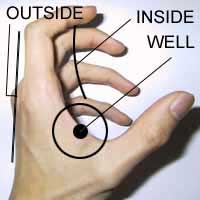
Description of what I mean by "The Outside" of the hand, and
"The Inside" of the hand. Also where I call "The Well" of
the hand.
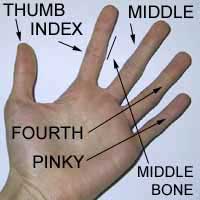
Names of the fingers and where the "Middle Bone" is.
That's about it for now. I think that should be sufficient if at all needed.