Raid on The Yosserburg Creek

|
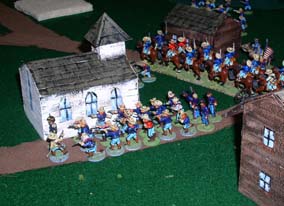 Within a few days of the American declaration of war on its Southern counterpart due to the latter's
purchase of the Mexican provinces of Chihuahua and Sonora, both nations started to raid the Shenendoah Valley.
The Confederates had already shown some success at Winchester under the command of General Thomas "Stonewall"
Jackson. Although the Union thereafter pushed mainly through Louisville, Kentucky, they never forgot the importance
that the Shenendoah held. Within a few days of the American declaration of war on its Southern counterpart due to the latter's
purchase of the Mexican provinces of Chihuahua and Sonora, both nations started to raid the Shenendoah Valley.
The Confederates had already shown some success at Winchester under the command of General Thomas "Stonewall"
Jackson. Although the Union thereafter pushed mainly through Louisville, Kentucky, they never forgot the importance
that the Shenendoah held.
It was around noon when, among the ringing of the parish bells, Union
troops came marching in columns through Yosserburg. People didn't know wheiter to go outside and cheer, or
stay inside and lock up.
|
|
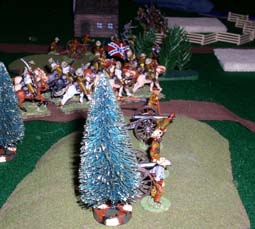 Major R.L. McCoy, of the Confederate persuation, had positionned his
guns accross the Yosserburg creek on McLund Hill. Farmer McLund was watching nearby with his missus and their
six offsprings, nervously juggling the cold hard money the Georgian had handed him. The Battery were happily
adjusting the sight of their breach loaders, being in a position every artilleryman dreams about. Major R.L. McCoy, of the Confederate persuation, had positionned his
guns accross the Yosserburg creek on McLund Hill. Farmer McLund was watching nearby with his missus and their
six offsprings, nervously juggling the cold hard money the Georgian had handed him. The Battery were happily
adjusting the sight of their breach loaders, being in a position every artilleryman dreams about.
As the infantry marched down the roads in butternut columns, Captain Ian Veer Dranke was leading his cavalry
squadron from the rear, as usual. It was possible that he had had just a bit too much of the fine virginian
wine with him, and was apparently not too keen on sharing. In spite of his condition, Major McCoy let him keep his
command, since Captain Veer Dranke would have never been able to ride his horse had he been sober. |
|
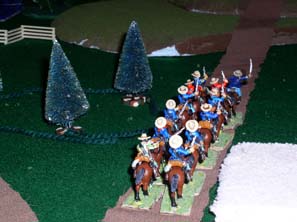 Meanwhile, the American cavalry sped accross the fields to try to reach
the Yosser's Bump, a small elevation just accross the Yosserburg creek from the McLund Farm. From there, if the
artillery could get there, one could control who could cross the bridges. The creek, while in reality was only
waist deep, was deemed too risky to cross. Meanwhile, the American cavalry sped accross the fields to try to reach
the Yosser's Bump, a small elevation just accross the Yosserburg creek from the McLund Farm. From there, if the
artillery could get there, one could control who could cross the bridges. The creek, while in reality was only
waist deep, was deemed too risky to cross.
(In fact, both Farmer McLund and Hiram Mout, who owned the land on the other side of the Yosserburg, had shared
a long feud that spanned from the time of the revolution. Both families had tried to limit contact between them by
installing spikes in the creek.) |
|
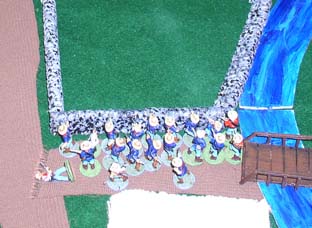 Captain Veer Drunke, not one to finish last in a race, waved his sabre and
followed his men down McLund Hill towards the eastern bridge. Riding out two by two, he was sure that his squadron
could impress the Damnyankees so much, they might actually leave him alone with his wine. Captain Veer Drunke, not one to finish last in a race, waved his sabre and
followed his men down McLund Hill towards the eastern bridge. Riding out two by two, he was sure that his squadron
could impress the Damnyankees so much, they might actually leave him alone with his wine.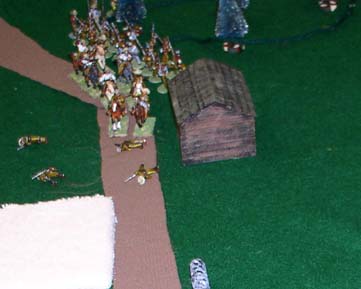
Damnyankees, there were, since an infantry platoon had been ordered to seize that particular bridge. And to Veer
Drunke's dismay, they got accross before him and took shelter behind a stone wall. Had he half a mind, he would have
sped up his pace to cut them off, and he did. But he also was half a drink away, and with this delay, his charge turned
into a mess. The Union troops fired into the first men that appeared, and managed to shoot down four before all the wild
horsemen were ordered to "disperse into disorder" (true statement).
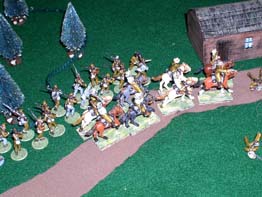 Capatin Veer Dranke, not realising he could have done something smarter, called his men
to charge away... into a confederate infantry column. Taking no notice, Veer Dranke took out his sabre and waved it again,
cheering for his men to keep charging away. One infantryman was not impressed and called the Captain a craven. To this,
the drunkard redoubled his efforts and started sprouting verses of Byron's Charge of The Light Brigade. Capatin Veer Dranke, not realising he could have done something smarter, called his men
to charge away... into a confederate infantry column. Taking no notice, Veer Dranke took out his sabre and waved it again,
cheering for his men to keep charging away. One infantryman was not impressed and called the Captain a craven. To this,
the drunkard redoubled his efforts and started sprouting verses of Byron's Charge of The Light Brigade.
|
|
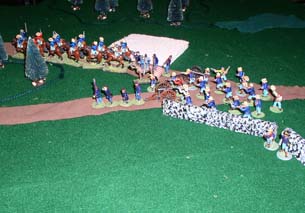 On the Western flank, the Confederate infantry was advancing and retreating
into cover, aparently not finding a convienient place to snipe away from. The Americans took advantage of this and tried
to advance to the river. They marched as quick as they could, but ended up slogging through the dirt. The cavalry managed
to take a few potshots at the Rebs from behind a wooden fence, so as to distract them from the advancing troops. The
second gun had found out that even towing a huge Krupp gun, they could skip ahead of the infantry (btw, this is not a good
idea). On the Western flank, the Confederate infantry was advancing and retreating
into cover, aparently not finding a convienient place to snipe away from. The Americans took advantage of this and tried
to advance to the river. They marched as quick as they could, but ended up slogging through the dirt. The cavalry managed
to take a few potshots at the Rebs from behind a wooden fence, so as to distract them from the advancing troops. The
second gun had found out that even towing a huge Krupp gun, they could skip ahead of the infantry (btw, this is not a good
idea).
|
|
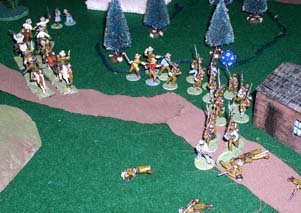 Veer Dranke kept on with his shahanigans, and kept stumbling his troops in this
so called disordered way (the men were wondering why they were doing it, since the Captain still hadn't given them even
a sip), yet managed to convince the nearby infantry to dislodge the Damnyankees and make 'em skidaddle. Veer Dranke kept on with his shahanigans, and kept stumbling his troops in this
so called disordered way (the men were wondering why they were doing it, since the Captain still hadn't given them even
a sip), yet managed to convince the nearby infantry to dislodge the Damnyankees and make 'em skidaddle.
|
|
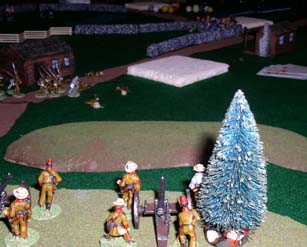 Back on McLund Hill, the Confederate artillery was trying to blast those pesky
Yankees from that stone wall, and by Golly, they were doing it. The Americans were being shelled by shrapnel, bullet,
rock, dirt, and other Americans. Back on McLund Hill, the Confederate artillery was trying to blast those pesky
Yankees from that stone wall, and by Golly, they were doing it. The Americans were being shelled by shrapnel, bullet,
rock, dirt, and other Americans.
"Stay put, said the Lieutenant, We've got reinforcements coming up this minute. Look behind you, here's the artillery
to support us. And look at those Rebs coming through the fields. Wouldn't you just want to send them skedadling like
they ought to?" |
|
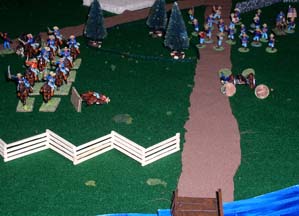 The second gun had found an idyllic place to fire at Rebs, unfortunatly it meant that they ended up wide out in the open and got turned into music sheets by the Confederate breech-loading rifles. And they suddently stopped playing any tune whatsoever. The second gun had found an idyllic place to fire at Rebs, unfortunatly it meant that they ended up wide out in the open and got turned into music sheets by the Confederate breech-loading rifles. And they suddently stopped playing any tune whatsoever.
The cavalry, still trying to potshot the entrenched Rebs, realised how bad their situation was when the men started
dropping like flies. The unit quickly rallied and charged back towards Yosserburg, but still they could not dodge the hail
of bullets.
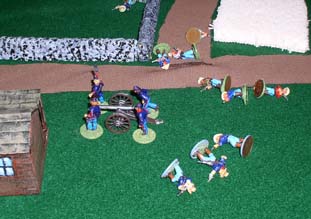 Even as the battery on top of McLund Hill was shredding the brave men that had
managed to cross the eastern bridge, the American artillery piece that had managed to get accross set up and waited for
the Confederates to charge through the open fields. And charge they did in one big line, only to be struck by cannister.
The skedaddling Rebel riflemen ran towards McLund Hill and hid like rabbits in a gulley. Captain Van Dranke, the highest
in command on that flank was nowhere to be seen, since he had decided in his drunkeness to join those on the other side
of the hill. And no, he still didn't want to share. Even as the battery on top of McLund Hill was shredding the brave men that had
managed to cross the eastern bridge, the American artillery piece that had managed to get accross set up and waited for
the Confederates to charge through the open fields. And charge they did in one big line, only to be struck by cannister.
The skedaddling Rebel riflemen ran towards McLund Hill and hid like rabbits in a gulley. Captain Van Dranke, the highest
in command on that flank was nowhere to be seen, since he had decided in his drunkeness to join those on the other side
of the hill. And no, he still didn't want to share.
|
|
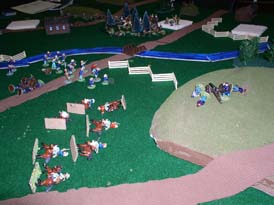 On the west flank, the last artillery crew had found a perfect spot on top of Yosser's Bump, and started immediatly to pester the Confederate Battery on McLund Hill. The American infantry also took the oppertunity to try and rush towards the creek and the troops entrenched in the forest behind it. The Confederates took
notice of this, and made sure that every shot counted. Thus, every cavalryman lay spewed with lead, the Krupp on Yosser's
Bump fell silent, and the infantrymen lost many a friend that instant. The attack was stopped, and the troops were spent. On the west flank, the last artillery crew had found a perfect spot on top of Yosser's Bump, and started immediatly to pester the Confederate Battery on McLund Hill. The American infantry also took the oppertunity to try and rush towards the creek and the troops entrenched in the forest behind it. The Confederates took
notice of this, and made sure that every shot counted. Thus, every cavalryman lay spewed with lead, the Krupp on Yosser's
Bump fell silent, and the infantrymen lost many a friend that instant. The attack was stopped, and the troops were spent.
|
This was a disaster of a game, especially as the end results clearly diverged from the intentions. The expectations
of John (who was running the game) were too high and his scenario objectives too basic (each side had to take control of
the two bridges and make the other side skeddadle, but that never happened), and the game took the substance of a trench
warfare game. The sides were also exactly the same (both had two infantry platoons, a cavalry squad and three guns), and
the layout favoured shelling over charging. The players were great, even if the gameplay was longer than the DBx game right beside, since one player had completly forgotten the basics of TSATF.
Obviously, having an artillery position on one side of the board clearly was to the advantage of the Confederates who
simply needed to wait.
This game was played in September at the Canadian War Museum using The Sword and The Flame as a quick plug in the
schedule.
Click here to return to the 2nd Mexican War campaign
|
 The
US Mogdonazian colonization plan
The
US Mogdonazian colonization plan