The
US Mogdonazian colonization plan The
US Mogdonazian colonization plan
|
|
The
US Mogdonazian colonization plan
|
 |
Wherever people go, they will build. The nature of humanity garanties that humans need shelters of some kind to survive anywhere for any period of time, be it from the weather, predators, or other humans. It is taken for granted that conditions are not the same all over the world, and so people adapt to their environment. Thus, different types of buildings are useful in different climates. For example, an adobe hut is much more suited for arid climes than a timber house. |
|
How to build Buildings For detailed instructions and basic gaming philosophy, click here for the Major General's views. Our ideas are similar enough that you can just look there. |
|
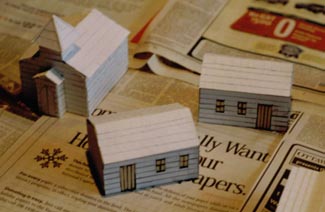 |
Here we're going to show you one way of painting 19th century European or North American style buildings. The buildings are made pretty much the same way as adobe buildings, but they all have peaked roofs and have details like chimenies, wooden planks, roof tiles, glass windows, and such forth. |
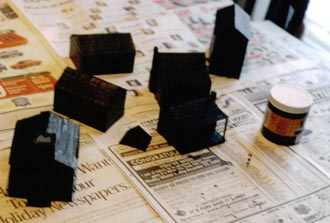 |
To be able to paint the buildings and make the details pop out, we've primed them all in black. That way the colours on top have much more contrast with all the little cracks, slits, etc. |
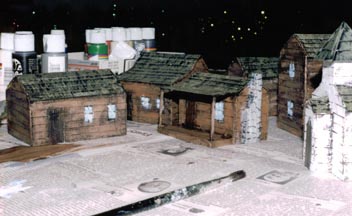 |
We've gone with natural wooden colours for the walls and roof tiles. As you can see, the black used for priming still shows here and there and gives more shades to the colours. Most of the building was drybrushed, which will give that effect. The windows were painted blue with dabs of white in one corner to simulate natural reflection. Of course, in real life what the windows reflects is entirely dependent on the angle it is seen from, but for wargaming, that usually isn't necessary. |
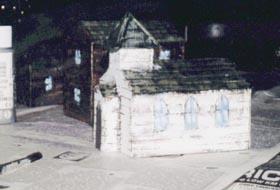 |
Here you can see the church. It's based on those simple county churches that may be seen pretty much everywhere in North America. The church was the centre of rural communities in the 19th century, so it usually has to pop out. Since most of the wooden churches are painted white, this seemed like the obvious choice. |
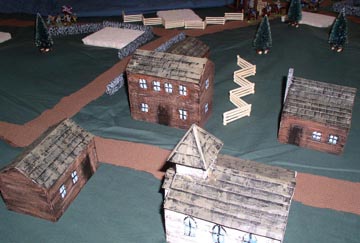  |
European or American Village
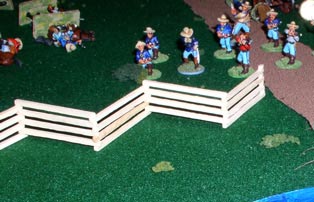
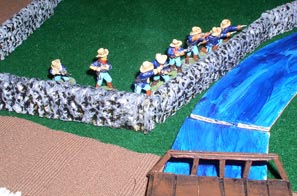
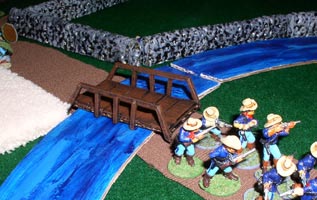
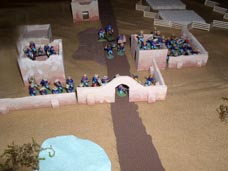
These are typical of the rural villages of North America during the 19th century. The fences are made from balsa matchsticks. The stone walls are "rocky foam" sheets placed over strips of cardboard, with a simple coat of black and a drybrush of grey.
|
  |
Adobe Villages
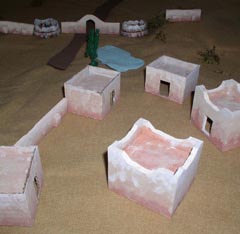
Medium and small sized adobe huts can be arranged to form many village layouts. The walls are pieces of foamcore reinforced by smaller tabs of foamcore on each side.
The towers ruins are made from polystyrene cups. |
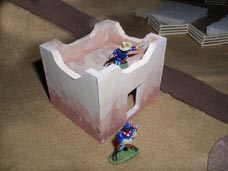 |
Medium sized Adobe hut. The roof can be used to put both troops or artillery pieces. Miniatures by Old Glory and Pinacle. |
| Introduction - The Pawnee
Journal - Update - The
hobby - Miniatures - Terrain
- Buildings - Board - Flora -
Rules - The Battles -
Links
|
| This page created and maintained by John Bell. |