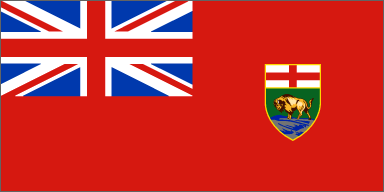
| Manitoba
was created largely by Scotsmen, Englishmen and Frenchmen, however, from
the beginning it was the Scots who had the largest impact. The
first real settlement was entirely Scottish.
Thomas Douglas (Lord Selkirk) is regarded as the founder of both
Winnipeg and Manitoba. He
was on the verge of becoming an important figure in the British
Government, but his concern for the plight of the Highlanders
“prevented him from pursuing his goal”. In 1810 he acquired control of the Hudsons Bay Company, which
granted him a vast tract of land in the Red River Valley and the first
Highland settlers came over in 1811.
By the time he died, having lost both his fortune and his health,
in 1820, he had in effect established Manitoba. The
first school in Winnipeg was begun by Scot Archibald McDonald The
first farmer at Portage la Prairie in 1862 was Scot John McLean In
1868, Simon Dawson, a civil engineer from Scotland, opened
communications between Canada and Red River by what became known as the
Dawson route. In
1872 Winnipeg General Hospital was founded as a gift to the city, by two
Scottish traders – Andrew McDermot and A.G.B. Bannatyne. Of
the 58 years between 1812 and 1870, Scots held the position of governor
of the district for 42 years. In
1869 the first quasi-governor of the new western province of Manitoba
was William McDougall, a Scot, as were the first two official governors,
Adams G Archibald in 1870 and later Alexander Morris, who was also the
province’s first chief justice and the founder of the University of
Manitoba. John
Norquay, born in the Orkney Islands, became Manitoba’s first Premier
in 1870. |
This page created on 4th June, 2001