Bruce moved the Scots army out of the Torwood where
they had been preparing for the coming encounter since May. He had raised about 500 light
cavalry and 6,000 foot soldiers armed with long spears, axes, swords and bows. It was a
small and ragged army, but experienced from seven years of hard fighting. They moved north
to guard the ancient road to Stirling where, on high groud above the eastern marsh, it
passed through woodland at the edge of the New Park.
King Edward of England brought his army from Edinburgh to Falkirk on the way to Stirling.
He had ordered his followers to meet at Berwick on 10th June. Seven days later he crossed
into Scotland with two to three thousand heavy cavalry in 10 divisions and at least 15,000
foot soldiers including his famous Welsh archers. The Scots were outnumbered by
3 to 1. By nightfall on 22nd June 1314, only 12 miles separated the two
armies. 
JUNE 23RD - THE BATTLE COMMENCES
During June 23rd while the English advanced from
Falkirk, the Scots waited beside the road, ready to fight or retreat to the west. They
were drawn up in 4 divisions. Bruce held the southern edge of the wood nearest the
approaching enemy, Edward Bruce was beside him, James Douglas and Walter Stewart next; and
at the north of the line near St Ninians church was Sir Thomas Randolph - Earl of Moray.
The horsemen under Sir Robert Keith were ready in reserve.
| It was afternoon before the first blow was struck. The English
cavalry pressed forward through the Torwood. The leading divisions under the Earls of
Gloucester and Hereford crossed the Bannock Burn and made a frontal attack on the Scots at
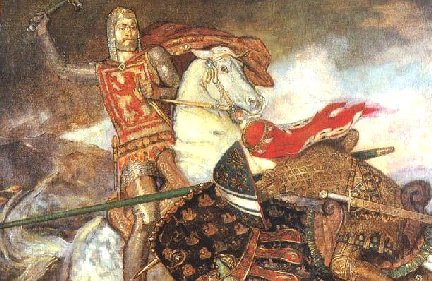
the entry to the New Park. Here an English Knight Sir Henry de Bohun rode directly at
Bruce who raised his battle axe and drove it through his assailant's helmet and skull. The
incident increased the confidence of the Scots and Bruce and his brother stood firm. The
English, confused by the ditches and spikes placed like a minefield alongside the road,
retreated. |
|
 |
Meanwhile another English cavalry
force under Sir Robert Clifford and Sir Henry de Beaumont was advancing towards Stirling
along the lower ground to the east of the Scots. They had drawn level with Moray's
division and formed a schiltron or sheild ring with spears pointing outwards. After fierce
fighting, Moary's men overcame the English. These two victories of infantry over armoured
Knights had their effect on the morale of both armies at the close of the day's fighting.
MORNING - JUNE 24TH
Morning, June 24th found the two armies in contrasting mood.
The English had spent the few hours of dusk among the marshy pools of the carse, which
they called a deep wet evil marsh. Their leaders were discouraged and divided. Above them
in the New Park the Scots waited in greater comfort and confidence. Their Council of War
was still considering whether to fight or retreat when a Scots Knight desserting from the
English army brought word that the English were losing heart. When Bruce asked his leaders
if they should fight , they all pressed him to attack.
At first light the Scots army heard Mass and a speech from their
King. Then in their four divisions they advanced to the edge of the woodland. Before
daybreak the English cavalry had reached the 'hard field' where the battle was to be
fought, well ahead of the main body of infantry.
 |
|
Early accounts of the battle do not fix the position exactly,
but it was probably on the higher ground, known later as 'dryfield', to the north of the
steep gorge of the Bannock Burn and between the edge of the carse and the New Park.
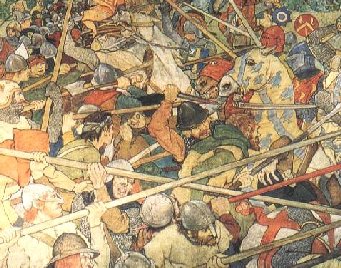
The Scottish foot advanced in echelon with Edward Bruce's division leading on the rfight,
Moray's in the centre and the newly Knighted Sir James Douglas and Sir Walter Stewart on
the left. Bruce's division stayed in reserve. The first main attack was launched against
Edward Bruce by cavalry under the Earl of Gloucester. The Scots formed schiltrom and the
charge made little impression on the dense edge of spears. English casualties were heavy,
and Gloucester was among the first of the many who died that day. |
CRISIS - JUNE 24TH
While Edward Bruce was holding Gloucester's Knights, Moray and Douglas moved their
divisions into line on his left so that the Scots presented a solid mass of spearmen. In
this formation they advanced until they engaged the whole 9 divisions of the English
cavalry already much confused by the stempede of wounded and riderless horses from the
first charge. With great effect the Scots attacked horses rather than riders, and their
own line managed to stand firm.
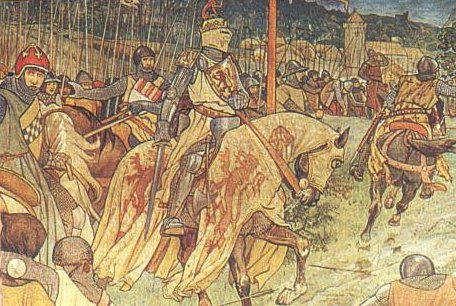
Now came the moment of crisis. The English archers, feared by the Scots for the havoc they
had caused at Falkirk in 1298, were called forward to break up the schiltrons as they had
done before. But most of them had been stationed at the rear, and in the narrow space
could not move quickly into position. Bruce had time to bring up Sir Robert Keith and his
small body of light cavalry.
They charged so fiercely that the archers broke and fled. The
English had failed to exploit the skill of their famus bowmen.
Meanwhile Bruce and his division were watching the course of the battle. When he saw the
archers in flight he brought his men rushing against the enemy, adding weight to the right
of the Scots line. Gradually the Scots began to push them backwards. At this moment to the
surprise of the enemy, a great mob of untrained 'small folk' - yeomen, servants and
labourers, who had been guarding baggage and supplies, burst out from Coxet Hill and
dashed towards the battle. |
|
 |
VICTORY - JUNE 24TH
The hard pressed English thought that they were seeing furth
Scottish reserves and their leaders knew that the day was lost. King Edward must not risk
death or capture and he was persuaded to withdraw with 500 Knights. He rode along the edge
of the carse towards Stirling. The Governor of the castle advised the party that to enter
the castle would be to invite capture. Edward turned back through the King's Park and,
crossing to the west of the Scottish army, reached the Torwood and the ultimate safety of
a boat at Dunbar.
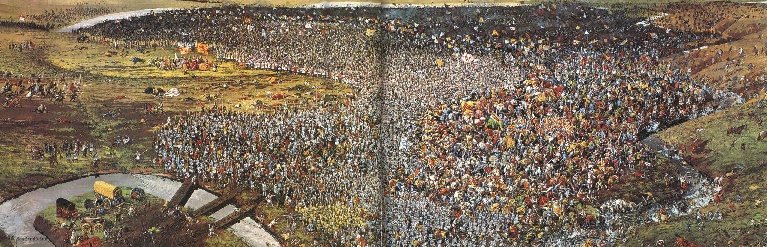
When the royal standard was seen leaving the field it proved the signal to the English for
disintegration and general retreat quickly turned into rout. The army fled towards the
Forth and the steep gorge of the Bannock burn where countless men and horse were trampled
and drowned. The day was won. A number escaped along King Edward's route to Stirling,
where they surrendered. The Earl of Hereford fled with a party to Bothwell castle but the
governor, until then an English supporter, handed them over to King Robert.
Although it would be many years before Bruce's victory bore its full fruit, the name of
Bannockburn stands high in the battle role of freedom and was a turning point in
Scotland's fight to retain her independence.
PEACE WITH ENGLAND
Peace with England was not concluded until 14 years after
Bannockburn. By 1318, when his men recaptured Berwick, Bruce had regained his whole
Kingdom; but Edward refused to recognise his position as King of Scots or to renounce the
claim to the feudal overlordship of Scotland made by his father in 1290. Without agreement
on these fundamental points the Scots would not consider a peace treaty. Bruce and his
leaders, Douglas and Moray, carried raids deep into the enemy's northern counties, but
ineffectively, as the real wealth of England lay beyond their reach. Edward unsuccessfully
beseiged Berwick, and in 1322 he marched through Lothian to the Forth. This was his last
expedition into Scotland, for troubles in his own Kingdom thereafter kept him occupied ast
home. A truce failed to produce the recognition demanded by Bruce.
In 1327 Edward II was deposed, and, on the day of his young son's coronation, the Scots
made a raid across the border. After one brief campaign, Edward III and his advisors sent
envoys north to discuss peace terms. In parliament at York in 1328 Edward conceded
Scotland's freedom from "subjection, servitude, claim or demand" and declared
Robert Bruce "by God's grace illustrious King of Scots". A peace treaty was
signed at Edinburgh and ratified at Northampton.
Back To
History Index
HOME
This page updated on 18th
January, 2001.
|
