John and Martha Ostie
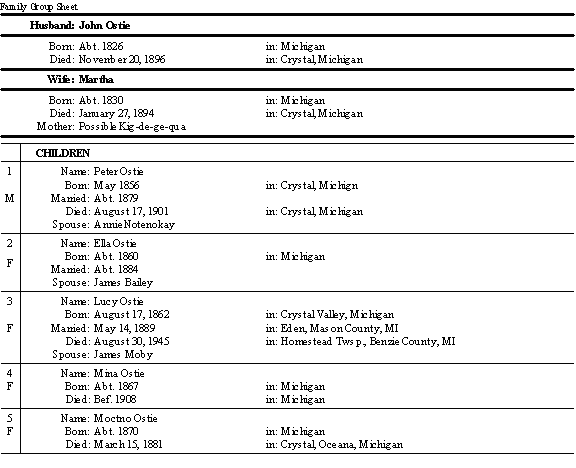
John Ostie was born about 1826 in Michigan. He was married to Martha. She was born about 1830 in Michigan.
John and Martha were listed together on the 1860 United States Census for the Indian Reservation, Oceana County, Michigan. John is listed as Ah-ta-ah-some, age 35, Martha is listed as Wa-we-que-cou-yo-quay, age 30. They have one sone, Mich-sah-ba, age 2. All members of the family were born in Michigan.
John and Martha were listed together on the 1870 United States Census for Crystal Township, Oceana County, Michigan. John, listed as Aish-to-ash-say, is 45, Martha is listed as 40 years old. They are listed with son, Paul, age 12, and daughters Phebe, age 9, Lucy, age 6, Mary, age 3. Also living with them was Kigdegequay, age 70. All members of the family are listed as being born in Michigan.
John and Martha are listed together on the 1880 United States Census for Crystal Township, Oceana County, Michigan. John, listed as Ush-tay-aw-lunk, is 54, Martha is listed as 50 years old. They had son, Peter, age 23, daughter-in-law, Anna, age 20, daughter Pheba, age 20, daughter Lucy, age 17, daughter Mina, age 13, and daughter Moctino, age 10 living with them. Pheba, Lucy, and Mina were listed as being in school. John and Peter are employed in farming.
The book, Oceana County Pioneers and Business Men of Today, recounts the investigation of the murder and disappearance of Alonzo Irons. John Austey is listed on page 112 as one of the men that aided in the investigation. It states:
C. went to
Bean’s mill early this morning and VanBrocklin told
him that Austa-
hasong, an
old Indian and a reliable one, had found a trail near
he wished C. to look at. VanBrocklin is an old trailer and he said that the Indian’s
word is reliable, and C. asked him if he would go and show him (C.) the trail. He
said he would. During the talk the villainous faces of Joe and Louis Baptiste were
watching C., but he paid no attention to them. VanBrocklin borrowed Shonagee-
sick’s river boots for C. and they started on what proved to be a sixteen mile tramp.
VanBrocklin and C. with Austahasong and his son and two other Indians left camp
and after walking about
seven miles came to the marsh near
wild, desolate place and they saw several bear tracks. After they waded through the
swamp a long distance they came to the trail. Austah gave a grunt and pointed to it.
They then went to the place in the woods where it starts and followed it down to the
creek where it crossed, and then through the swamp grass to within three or four
rods of
ground. C. saw that a soft, heavy body had been dragged over the place. It certainly
was no canoe. C. suggested a bear or deer, but could see at once that if it were either
hair would have been left on the trail. Austah said “If bear or deer trail go from
lake.” One of the Indians suggested that a bundle of light wood for burning in a
jack-light was dragged there, and Austah laughed at dragging light wood a
long way through water when there was plenty of it on the banks of the lake; besides
where the trail started there was no light wood. The trail led to within a few rods of
a canoe that Austah made over a year ago, and it has been on the lake ever since. C.
got into the canoe and paddled around the lake, which is small but deep and shut in
by thick woods all around; he could see the bottom in some places covered with moss
and weeds, but that was only
on the edge. After making the circuit of
the
rected the party to go back and see if they could find anything in the shape of a trail
leading from the place where the body was dragged. There were three little smokes
or small fires where the trail began, and after some searching about for some time Austah
and VanBrocklin found the tracks of persons leading away from the trail and also the
same tracks deeply indented pointing towards the trail. C. was a little skeptical
about the identity of these tracks, but he could see that they were old and deep,
as if a heavy body had been carried. After about two hours’ work the Indians followed
the track to the old wagon road cut down to the swamp from the main road and about
half a mile from where Irons was last seen. There was just one faint wagon track on
this road, and all said that the road had not been used for months. It certainly looks as
if a body had been carried in a wagon as far as the road goes and then slung from
a pole or carried on a litter to a lonely place near the swamp and then dragged to the
lake, taken in the canoe and thrown into the water. C. did not rely on his own opin-
ion entirely, but on that of experienced woodsmen like Austah, VanBrocklin and oth-
ers, all of whom said that nothing could be dragged by a hunting and fishing party
that would make a similar trail. One Indian, Bailey, differed, but he is a Catholic
and Austah is a Methodist. The other is a Pagan and agreed with Austah.
Martha died on
John died on November 20, 1896 in Crystal Township, Oceana County, Michigan. His death is recorded in the Oceana County Deaths on page 12, record number 9. His name is listed as John Austyosunk. He was 79 years old when he died from consumption. The death record indicates that he was a widower.
Durant’s Field Notes which were recorded around 1908 lists John as Aish-taw-aw-sung. It indicates that both he and Martha were dead. It also states that Peter, Mina, and Moctno were dead. Durant also records that Peter had married Annie Notenokay, Ella had married James Bailey, and Lucy had married James Moby.
RETURN HOME – James and Lucy’s Page
If you have more information on this family please let us know: [email protected]