Battles are the main part in Risk, all of the battle's outcome is determined by the dice, not skills, Dice. The way it works is naturally rolling the dice, highest number wind, tie goes to the defender. However a few rules are in play which will be described in this section. For information on Global domination risk, click here. For information on 2-player risk, click here.
Table of fighting (B01)
This table will describe how attacking/defending works.
| X | 1 Unit | 2 Units | 3 Units | More than 3 units |
| 1 unit | Can't Attack | 1,1 | 2,1 | 3,1 |
| 2 units | Can't Attack | 1,2 | 2,2 | 3,2 |
Rolling the dice is simple, everyone knows how to do that but its more than rolling the dice its figuring out what beats what and how. For this example the defender will be rolling 1 die as well as the attacker, ok Dice roll defender gets a 2 and attacker gets a 5, naturally attacker wins, defender loses an army simple right? Well lets say defender also rolls a 5, defender wins tie goes to the defender always!
Well thats the basics lets get more advanced attacker rolls 2 dice, defender 1. Dice roll defender gets a 5 attacker gets a 5 and a 2, defender wins but why? First you match up the highest roll of the attacker and defender so the defending 5 is matched up with the attacking 5 thus defender wins, the second dice is only useful if the defender rolled a second, it was only rolled for a better chance of getting a higher number.
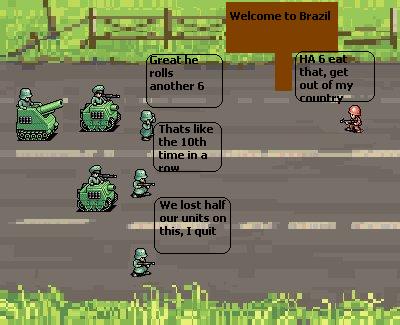 Alright now attacker has 3 and defender has 2 dice, Dice rollattacker has 3,4,2 and defender gets 4,2,1 each side looses 1, the highest of both sides are matched up 4 and 4, defender wins, than the second highest of both sides are matched up 3 and 2, attacker wins, thus both sides loses 1. Lets say attacker had 5, 4, 2 and defender still had 4, 2, 1 than defender will lose 2, the 5 and the 4 are matched, attacker wins, than the 4 and the 2 are matched, attacker wins again, defender looses 2 units. That is how dice rolling works.
Attacking (B03)
Alright now attacker has 3 and defender has 2 dice, Dice rollattacker has 3,4,2 and defender gets 4,2,1 each side looses 1, the highest of both sides are matched up 4 and 4, defender wins, than the second highest of both sides are matched up 3 and 2, attacker wins, thus both sides loses 1. Lets say attacker had 5, 4, 2 and defender still had 4, 2, 1 than defender will lose 2, the 5 and the 4 are matched, attacker wins, than the 4 and the 2 are matched, attacker wins again, defender looses 2 units. That is how dice rolling works.
Attacking (B03)
A few notes for when you are attacking.
A few notes for when you are defending
Official site www.hasbro.com
Thanks to the people at Advancewarsnet for the advance wars sprites and backgrounds.
Thanks to Grim from Http://sdb.neuropod.net for the cavalier sprites.