| Chemists, Big people in a Big world |
| Click here to see a diagram of how nuclear fission works. Again, scroll down. |
| What�s a Nuclear Reactor? A nuclear reactor is a self-sustaining series of nuclear fission, and can be used for many things. The three largest nuclear uses of nuclear reactors are; power, research, and propulsion. Power reactors are, of course used to create power which is converted to electricity which we use all the time. Research reactors are used for research around nuclear fission. And propulsion reactors are used to power nuclear submarines and ships. The most common out of these three is the nuclear power reactor. Nuclear reactors provide 17% of the worlds power, including 15% in the US. So far there are 400 around the world and 100 in the US. Nuclear reactors work when bunches of unstable isotopes, such as Uranium-235 (and 238) and Plutonium-239 are submerged in water. The unstable isotopes fissions, and causes heat energy. This heat causes the water to boil and gives off steam which is converted into to power. The reactors talked about on this web sight will mostly be thermal, light powered reactors as opposed to intermediate, or fast reactors. The big difference in theses three is the amount of volts that are produced in an amount of time. |
| How does Nuclear fission work? The energy in nuclear power reactors is caused by nuclear fission. Nuclear fission happens when the nucleus of an atom of an unstable isotope is hit by another slow moving neutron which is shoot at the atom using energy. This causes the atom to split which gives off 200 million electron volts of energy, 85% of which is from the atom splitting and the rest is from the products decaying. This also troughs off other neutrons which causes a chain reaction where other unstable atoms are hit and give off energy and neutrons. This chain reaction can be subcritical, critical, or supercritical state. A subcritical state is when the rate of the chain reaction is slows down and eventually stops. This happens when there is less then one neutron released for each fission. A critical state is when the rate of the chain reaction is the same. Or when one neutron is released from each fission. A supercritical state is when the rate of the chain reaction is quick. Or when more than one neutron is released from each fission. Most nuclear reactors are at a supercritical state so that the reactions continue to happen. |
 |
| Click here to see a diagram of a nuclear power plant, you may need to scrool down. |
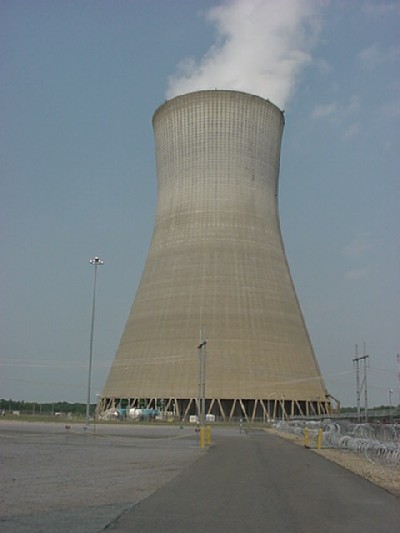
| This is a cooling tower at a nuclear reactor |
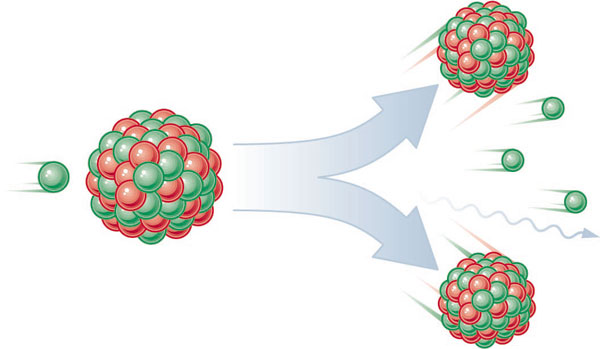 |
| This is a picture of nuclear fission. Note the two smaller parts that the atom breaks into as well as the neutrons that are released. |
| How is it controlled? Why isn�t it one large bomb? Since the state is supercritical the reactions must be controlled so that the reactor is not one large bomb. This is controlled in part through removing fuel, and changing the rate of the fission. Removing the fuel slows down the reaction because there isn�t as much fuel to react, and changing the rate of the reaction changes the state from supercritical to critical or subcritical. This happens when the control rods are lowered further into the bundle of fuel. These control rods act as buffer against the neutrons that are flying around causing fission. They are usually made of hydrogen (which is another reason why the water is there), deuterium, beryllium, and carbon. These can be found in the forms of water, heavy water, beryllium metal and oxide, and graphite. Water and heavy water are most likely to be used since in thermal reactors, as well as rods made out of graphite. Even with the control rods, there is still place for human error. One of the causes for the Chernobyl incident was that not enough control rods were in the reactor, which meant the fuel became really supercritical and caused a fire. |
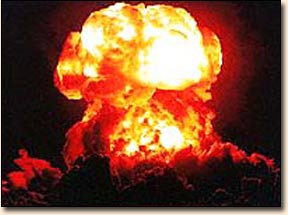 |
| This is an atom bomb, it's best when reactors do not look like this. |