
Food for Thought
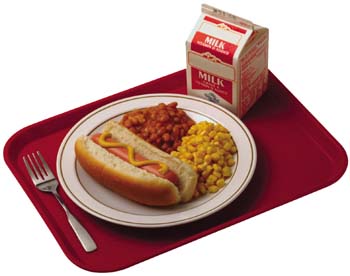
Today, under the Farm Security and Rural Investment Act of 2002, the USDA must allow government-approved food safety technology, such as irradiation, to be used in commodities procured by the federal school lunch program, while continuing salmonella testing. Local school district across the country will ultimately decide whether or not irradiated food will be served to schoolchildren in their district.
To garner support for irradiated meat the USDA awarded $151.000 to the Minnesota Department of Education to test the effectiveness of sending irradiation information kits to parents in Spring Lake Park, Willmar & Sauk Rapids school districts. The original grant proposal stated that a �successful outcome of the pilot project would be the acceptance and introduction of irradiated foods into select districts.�
On July 28, 2003, Allie Shah, Staff Writer at the Star Tribune published the following headline: Meat Plan Blasted as Marketing Tool. Consumer advocacy group Public Citizen argued that the pilot program�s purpose was not to present objective information, but rather to promote irradiation. Moreover, the fliers represented only the health benefits of irradiation and not the risks. Among other thing the article reported that Sauk Rapids school district leaders pulled out of the project in April after receiving the education materials about food irradiation. Superintendent Greg Vandal said district leaders �felt they were being asked to take a stand on irradiation�we realized we were stepping further into this than what we agreed to.�
Questions Regarding Safety
�It would appear that the FDA gave its approval on the basis of five or six studies on rats and dogs. These were selected as methodologically sound from a pool of over two thousand studies, over four hundred of which appeared potentially good enough for preliminary review. Clearly, there are many potential biases in selecting such a small number of studies on which to base major decisions.�
Donald R Louria, Ph.D., Chairman, Department of Preventive Medicine and Community Health, University of Medicine and Dentistry of New Jersey
Verbatim Excerpts from Expert Testimony
U.S. CONGRESSIONAL HEARING INTO FOOD IRRADIATION
House Committee on Energy and Commerce
Subcommittee on Health and the Environment
JUNE 19 1987
�In 1975 were reported the results of feeding five malnourished Indian children wheat irradiated with 75,000 rads. This wheat produced weight gain, serum albumin, and hemoglobin levels indistinguishable from what was found with unirradiated wheat. However, four of the five children showed gross chromosomal polyploidy four weeks after initiation of the feeding program. Chromosome number returned to normal twenty six weeks after the feeding was stopped. This is unequivocal evidence of a potent mutagen in irradiated wheat. I would remind you that the high lung cancer incidence in the United States in 1982-83 was 80 per 100,000, which is equivalent to 0.08 percent. In these children, incidence of polyploidy was 80 percent [1000 times larger].
Proponents of food irradiation have attempted to dismiss this study since only five individuals were involved, but mercifully no one has repeated this with greater numbers of children, especially since equivalent results were found when irradiated wheat was fed to monkeys and rats. In both these studies polyploidy was seen after several weeks of feeding and returned to normal about two months after feeding irradiated wheat was stopped. In summary, I would be hard put to find a group of better studies to demonstrate the mutagenic properties of irradiated wheat.�
These children were given a very cruel choice, I think, of either facing imminent starvation or the possibility of leukemia or lymphoma one, two, or three decades down the road. This is a very cruel choice indeed.�
�It will take four to six decades to demonstrate a statistically significant increase in cancer due to mutagins introduced into the food supply by irradiation�When food irradiation is finally prohibited several decades worth of people with increased cancer incidence will be in the pipeline.�
George L Tritsch, Ph D
Cancer Research Scientist, Roswell Park Memorial Institute, New York State Department of Health
Verbatim Excerpts from Expert Testimony
U.S. CONGRESSIONAL HEARING INTO FOOD IRRADIATION
House Committee on Energy and Commerce
Subcommittee on Health and the Environment
JUNE 19 1987
Reason to Oppose Irradiated Foods
� Research reveals a wide range of health problems in laboratory animals that ate irradiated food including premature death, fatal internal bleeding, a rare form of cancer, stillbirths and other reproductive problems, genetic damage, organ malfunctions and nutritional deficiencies.
� Dr. William Au, a toxicologist at the Department of Preventive Medicine and Community Health, University of Texas Medical Branch in Galveston, has argued that the lack of understanding regarding the ill effects suffered by children who consume toxic chemicals in foods extends to �the toxicological risk with respect to eating irradiated food.�
� Undernourished schoolchildren are the most likely to consume a high percentage of their daily food intake from the school meal programs (breakfast, lunch, and snack.) These children are a more susceptible population and most in need of a healthy meal.
� At the March 2002 Intertech Annual Conference on Food Irradiation, Dr. Sean Fox, Agricultural Economics Professor at Kansas State University, reported that based on his research, women who have children living at home were the most opposed to food irradiation. Furthermore, this particular demographic group is the most likely to support labeling for foods treated with radiation. In a national poll conducted for Public Citizen in January 2002, over four-fifths (83%) of women who had children living at home favored labeling for foods that had been irradiated. This supported findings from a 1999 national poll conducted for the Center for Science in the Public Interest and the American Association of Retired Persons in which 92.9% of female respondents favored labeling for irradiated foods.