


|
|
|
IWO JIMA uncommon valor was a common virtue." Admiral Chester W. Nimitz
February 15, 1945, was the start of a living hell, the invasion of Iwo Jima. It all started with a naval bombardment of the island by the Navy, then came the bombers. The pre-invasion bombing was intended to soften up the enemy. However, the Japanese had prepared for years. Underground tunnels and defensive positions honeycombed the island, the bombardment did little to destroy these defenses. John Adie, Gilbert Carbajal, and Frank Nichols landed on the shores of Iwo Jima with the 5th Marine Division on Green Beach. Their mission, to act as forward observers for their Howitzer Battery; John's radio name for the Iwo campaign was "Oil Tank1". The first objective of the 5th Division was to capture Mount Suribachi. They were with the the A Battery, 2nd 155mm Howitzer Battalion, nicknamed "The Forgotten Battalion". For the invasion the "Forgotten Battalion" was attached to the 5th Division. The three marines were on LST 760. An LST is a ship that isn't large enough to have a name. LST's, Landing Ship Tank, were built to carry troops and supplies to the beaches during an invasion. After several days at sea the men were finally told of their destination; the Island of Iwo Jima. Their day would have begun with a specially prepared breakfast of steak and eggs at 0415 after which they would have stowed their gear. At 0730 the LST's would begin launching small boats and LVT's. The men of the 2nd 155mm Howitzer Battalion were part of the largest body of Marines committed in combat in one operation during World War II. When the naval and air bombardment stopped the Japanese emerged from their fortified tunnels and caves to begin a heavy barrage of fire against the landing force. Their strategy was to wait for the Marines to hit the beach, then annihilate them. On the second day of the invasion the 28th Marines, 5th Division had swept across the southern end of the island and moved to take Mount Suribachi, which the Marines called "Mount Sonofabitchy". By the end of the second day Motoyama Airfield No. 1 was controlled by the Marines. On the 23rd of February, the famous flag raising took place on Mount Suribachi. John has said that he was already across the island on the other side of Suribachi, at the airfield and heard someone yell, "there go the colors". One evening, at sunset, John and his buddies noticed a rifle barrel protruding from a rock formation very close to them. The Japs had elaborate tunnels from which they would emerge, fire on the marines, then disappear. A point of frustration for the Marines was that the Japanese could not be seen. The Japs even dragged their dead back under the surface of the island. The three men decided to wait until daylight to take the position of the gun barrel. During the night they were too apprehensive to sleep. Rats ran over there feet as they waited for the morning sky to brighten. As the dawn light came they readied themselves for the fight. Moving on the position they were relieved to find that the gun barrel that they had watched in anticipation all night was nothing more than one of the metal pipes used to reel out the radio wire. When they finished the story, they looked at one another and laughed. On February 27th , Frank Nichols, "Big Nick" was wounded. Both John and Gil said the wound didn't seem serious, nor did they elaborate on the cause of the wound. John administered first aid, cleaning and covering the wound. Big Nick was evacuated out to a hospital ship. "We got word later, that he died on the hospital ship. It didn't seem life threatening." John stated, then changed the subject, Gil remained quiet. In 1994 Joan sent for the casualty report for Frank Nichols. We realized that both John and Gil had to have an answer to the nagging question, "what happened to Big Nick"? About four weeks after she sent for the report, it arrived. She opened the envelope and read the report. She called her father with the news. "Dad, Frank Nichols was a corporal", she queried. "Yes, he was, how did you know that", he asked. "Well, I sent for the casualty report", she said. He was quiet. "Dad, Big Nick didn't die on the hospital ship. He died in a hospital back in the States not far from his home in Kentucky and is buried in his home town", she gave him the news, he remained quiet. "He didn't die from his wounds, he was sick; he had leukemia. They must have discovered it when he was on the hospital ship and evacuated him back to the States", she finished. She could hear the relief when he replied. "Yes, he was sick all the time, he had a sore throat. Did you tell Gil, you have to call Gil and tell him", he wanted Gil to hear the news ASAP. Joan said she would call him and give him the information, she did, and Gil was relieved to hear that their friend had made it home. During their reunion in Phoenix they talked about family and about their lives after the war. Eventually John asked for everyone's attention, he had to tell his family something. Gil, instinctively knew what his friend was about to say. "John, no, don't, I know what you are going to say, don't", Gil said almost embarrassed. "No, I have to tell my family what you did", John wouldn't stop. "You know it was bad on Iwo Jima. We were under fire and I went to take cover in a hole, Gil came out of nowhere and tackled me before I could jump in this hole. He had seen a booby trap, a grenade rigged to blow up if someone landed on it. Gil reached into the hole and disarmed it." John finished. "John I told you then it was nothing", Gil insisted. "No, you saved my life and now I have told my family". "I told you then if I didn't stop you the both of us would have been hit", Gil didn't want the honor John had just given him, but he got it anyway. They changed the subject. We don't know if John and Gil knew that the flag raised above Mount Suribachi came from LST 779, another LST in the landing that was used by the Battalion. If they did they never mentioned it. At the time they heard someone shout, "there go the colors", the flag was flying over Suribachi. They were too busy to dwell on it at the time. There was a battle being fought, and they had a job to do. The Jersey City Journal February 18, 1965 John Adie who operates Feeney and Adie's tavern in Bayonne was with the Fifth Marine Division and was fighting at the foot of Mount Suribachi when five Marines hoisted the makeshift flag on top of the extinct volcano and became famous. "Someone said, there go the colors," Adie recalls. "We knew this wasn't the end of anything and thought about what was ahead." Adie, a radio operator for a forward artillery team, relayed enemy positions back to the artillery. He was sent back to his battery for a rest after the Suribachi campaign and met a friend from Bayonne, Joseph Tverdak. The two old friends had something to eat together, and Tverdak returned to his group, the 13th Marines. Tverdak, now an insurance salesman, was also a spotter for artillery. It was hard to move equipment, he said, because of the soft, sandy terrain and dead bodies all over the beach. The wind blew sooty ash in your face. Tverdak and Adie did not see each other again until the war ended and they were back in Bayonne. If you are not familiar with the famous photo of the flag raising on mount Suribachi here is a brief explanation. A patrol of about forty marines climbed to the summit of Suribachi. One of the men had a flag with him; finding a piece of pipe they fixed the flag to it and raised it for the island to see. Photos were taken of this flag raising. A high ranking officer decided that the flag was not large enough and ordered another flag to the summit. A runner was sent to the beach and a much larger flag was given to him from LST 779. Meanwhile Joe Rosenthal was climbing to the summit. When the second flag arrived at the top of Suribachi, the first flag was taken down, the larger one was fixed to the pipe and raised, that is when the famous photograph was taken. There was a great controversy over the photo, many claiming that the photo was staged, it wasn't. You can find many sites on the internet that contain details of this historic event. The following is an account of the second flag that was raised and photographed on Mount Suribachi. Private first-class Fred R. Huffman was in the bow of LST
779 waiting to hit the beach, it was February 20th. He was standing next to a
friend, Sergeant Russ Mitchell who was holding a folded American flag. Mitchell
told him that it was the ship's flag and it was going to be raised on Suribachi.
He was to give it to the beach master after landing. Mitchell realized that he
had forgotten his canteen and asked Huffman to hold the flag while he went to
get the canteen.
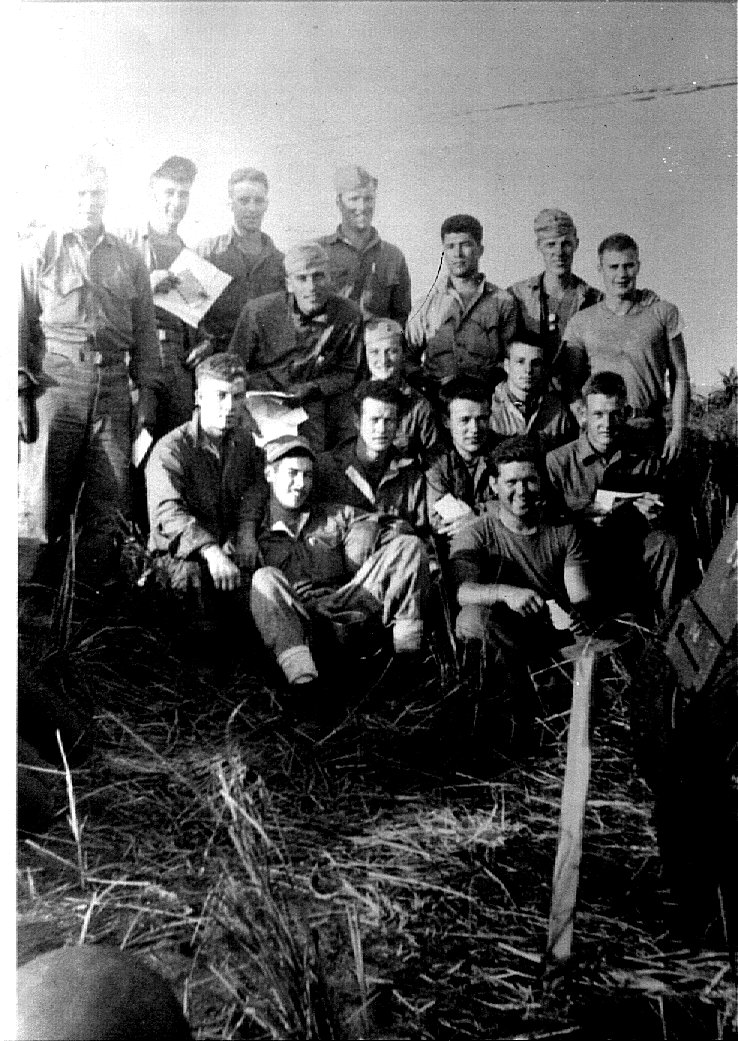
Our Gang Top Left to right Robert Glick, Reginald St. Pierre, Robert Mitchell, John Adie, Gilbert Carbajal, Carr, ? Polie Ames, ?, Jerome Lafferty, ?, Donald Hogue ?, Roscoe Amick, ?, William Coffin War is said to "be the worst of times and it is the best of times". When you witness a reunion of two buddies who have been to hell and back, you realize that they share a bond that cannot be imagined. This friendship is the best of times. |