In the decoration
of the high crosses ornament plays a major role. These patterns may
occur on the metalwork and in the manuscript illuminations; their similarity
being so striking that it gives some clues to the dating of the monument.
This is also true of spirals and animal interlacing while the interlacing
and step-patterns vary only a little, and thus they can be of very little
help in this regard.
The spirals are connected by curved triangles, reduced to outlines and
animated by little leaf patterns. The granite crosses display a great
variety of curvilinear design; the spirals are made of thick lines without
any embellishments of the linking lines. On the left side the cross looks
as if the pattern were a simplified version of a scroll of foliage with
practically only the stems left.
Foliage is not a very common kind of ornament in Irish art. In pre-Romanesque
carvings, there are several examples of it. These crosses are characterized
by beautifully curving scrolls, little bunches of leaves and grapes and
animals climbing on the branches and picking at the fruit. In all these
cases the panels are rectangular and have a double row of scrolls.
On the figured crosses, animal-interlacings are much in favour , becoming
an essential pattern and covering most of the background to the high relief
figures. Human figures are barely present as elements of decorative motifs,
as occurs in several of the manuscripts.
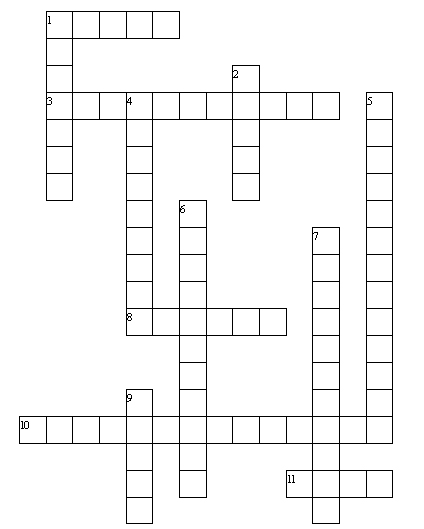
Task
Directions
: Complete the following puzzle. Then send to your instructor an
e-mail message with the correct words only. Include in the subject area of
the e-mail the words "Documentary, task1."
Horizontal:
1. A very simplified version of foliage ornament with practically
only the thick parts of the plant left.
3. To get this shape you need four points.
8. You can find it at a snail, a violin or as an ornamental
shape in churches.
10. Sometimes a shape is made of linking lines without any
extras.
11. Empty spaces to be filled in.
Vertical:
1. Especially winded lines on which you turn continuously
left to get right on a higher level for example on a staircase.
2. What kind of figures are barely present as elements of
decorative motifs.
4. It either has a metallic sound in an orchestra or it's
a geometrical pattern or it's a very complicated kind of relationship.
5. You have them on a ladder, on a scale or even in architecture.
6. Baskets are made with that technique, pigtails as well.
7. It's not linear, but it's not a curve, it's both in some
way.
9. If you have no hints or proofs, maybe you have lots of
these.