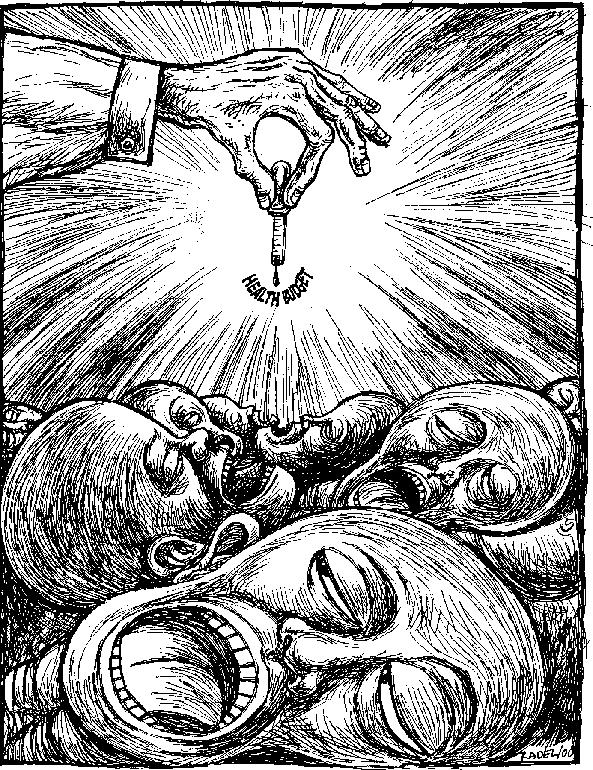
The shrinking health budget reflects on how social services have to compete for budgetary priorities in the light of a growing government deficit. A whopping budget deficit of over P50 billion in 1999 is affecting the National Government’s allocation this year for services, among them health.
Department of Health (DOH) budget officer Larry Cruz said that based on the year 2000 budget proposed by President Estrada, and which Congress is deliberating at present, they expect a reduction in the appropriation for the health sector by about P200 million.
This year’s proposed national budget of P650 billion is 9.6 percent higher than the 1999 adjusted budget of P593 billion.
Cruz said the health sector’s 1999 budget amounted to P11,265,838,000. In the proposed year 2000 budget, DOH will get only P11,097,625,000. He added that their budget might also have to be further deducted for the P30 million share of local governments in the internal revenue allotment (IRA). The allocation was scrapped in the proposed budget but was returned after local government officials threatened to go on a four-day strike.
During committee deliberations on health sector allocations, Cruz said they were informed that no government agency was exempted from budget cuts.
In 1999, P5.07 billion of the DOH budget went to manpower support for activities relating, among others, to primary health care, disease control and elimination and the maintenance of health facilities while P5.3 billion was allocated for the maintenance and other operating expenses (MOOEs) of these programs. The remaining P922.99 million was for capital outlays.
Cruz clarified though that the decrease of around P200 million in the DOH budget would not necessarily mean the scrapping of a particular project.
Instead it might, at most, result in the reduction of target beneficiaries.
“For example, we targeted one million children for a particular activity. The cut in our budget might mean that we have to reduce our beneficiaries to 600,000 kids,” he pointed out.
In other words, fewer people still will have access to basic health services. Vulnerable groups of women and children, as a consequence, are most likely to be affected by the continuous underfunding for health.
Records at the National Statistics Office (NSO), as of February 1999, showed that there has been minimal change in the number of infant deaths in the country from 1998 to 1999. Diarrhea and acute respiratory infections account for about 38 percent of Filipino children deaths.
While maternal deaths have decreased on the average from 1995 to 1999, the incidents of these in the country’s poorest regions such as the Autonomous Region of Muslim Mindanao, Caraga, Central Mindanao and Eastern Visayas are twice the national rate.
Also, only 65 percent of children aged 12 to 23 have been fully immunized.
Aside from the elimination and control of diseases like tuberculosis, dengue, leprosy and malaria, DOH also funds immunization programs, dental health, family planning and a host of other activities.
At present, the health department also provides assistance to 23 priority provinces and takes care of 13 special hospitals, 15 medical centers, 21 regional hospitals, 15 regional health training centers and eight sanitariums nationwide.
Since the budget has not been approved yet, Cruz said they have been released 1/12th of the equivalent of the 1999 budget as their allocation for this month.
Wise public spending on health can boost economic growth while promoting equity and reducing poverty due to its positive effects on the formation of human capital. Its benefits, however, largely depends on how the funds are allocated within the sector.
An assessment conducted by the International Monetary Fund (IMF) of developing and transition countries show that since the mid-1980’s, real per capital spending on health has increased, on average, in developing countries, but decreased in the transition economies.
However, a relatively high percentage of public spending is still allocated to curative rather than preventive health care.
In 18 Asian countries including the Philippines, public expenditures on health averaged only about 1.6 percent of the Gross Domestic Product (GDP) and 6.5 percent of total government spending. Using data gathered over a 10-year period or from 1986 to 1996, IMF observed that health spending as a share of GDP rose everywhere except Asia and the transition countries. The decline in Asia was attributed more to rapid economic growth in the region than to a reduction in real spending.
Not surprisingly, real per capita outlays on health during the period showed especially sharp increases in Asia.
In the Philippines, it seemed the trend is about to continue. Public health spending in 1998 averaged only 1.9 percent of its Gross National Product (GNP), far below the World Health Organization (WHO) standard of five percent.
The insistence
of lawmakers to retain their pork barrel funds in the proposed 2000 budget
contributes to this bleak scenario on health. The Congress bicameral committee
putting the final touches on the proposed budget had approved the retention
of the P7.1-billion Priority Development Assistance Fund (PDAF) for legislators.*
| Budget
2000 1999 |
| National
P650 B
P593 B
Health P 11 B P 11.2 B |
