|
11.28.01
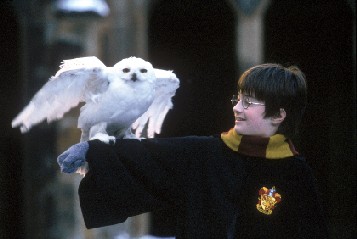
We saw Harry Potter last night. The movie, I mean, not the actual Harry. It was very enjoyable, although I suppose one is compelled to say the usual thing about it not being quite as good as the book -- but what that really means is, the Director did not delve into the depths of and perfectly recreate my own imagination before making his movie. So I won't say that.
And I'm not sure that even if he had consulted me, I could quite explain or he could recreate what is in my mind when I read Harry, or any other book. And I wouldn't want him to.
My favourite [story a child has told me about reading the Harry Potters books] was the girl who came to the Edinburgh Book Festival to see me. When she reached the signing table she said "I didn't want so many people to be here � this is MY book." That really resonated with me, because that's how I feel about my own favourite books.
--J.K. Rowling
Me, too. The amazing thing about books is that if the author is skilled, he or she can plop what's there straight into your brain, and you come up with the visuals on your own, without ever having seen a picture at all. And then you walk around with this entire world of someone else's making inside your head.
Where the idea for Harry Potter actually came from I really couldn't tell you. I was travelling on a train between Manchester and London and it just popped into my head. I spent four hours thinking about what Hogwarts would be like - the most interesting train journey I've ever taken. By the time I got off at King's Cross many of the characters in the books had already been invented.
So J.K. Rowling is some unknown person in the U.K., and then out of the depths of her magnificent brain -- swish, gurgle, boom -- an entire alternate world full of practically real people is hatched. (Like Hagrid's dragon egg.) How would you feel if that were you?
Writing became such a process of discovery that I couldn't wait to get to work in the morning: I wanted to know what I was going to say.
--Sharon O'Brien
I used to go wild with frustration in grad school whenever we'd discuss Stanley Fish's Reader-Response theory. It was, of course, influenced by postmodern notions of truth (truth is entirely subjective), and what the privitization of meaning. Reader-Response Theory is a form of literary criticism that rejects the author's intentions when writing something, and places meaning solely with those receiving the text. The interpretive community creates its own reality. In other words, forget what Rowling (or any other author) intended, because all that matters is what I, the reader, perceive. The bottom line is that the text itself is without inherent meaning, and meaning resides only in the reader.
Fish firmly believes that knowledge is not objective but always socially conditioned. All that one thinks and "knows" is an interpretation that is only made possible by the social context in which one lives.
I don't have much more, today, to say to the whole postmodern "there is no meaning in the text, there is no God, there is no gender, there is no meaning anywhere, and life is wholly subjective" bolognie except "Bolognie," and they may interpret "Bolognie" as they will.
In one sense, the boy wizard has slipped beyond her control; he is out there, everywhere, and legions of people feel a sense of ownership. But in the most important way, Harry still belongs to her. His future is in her head, as is that of the entire fictional universe she has set in motion.
--Time magazine article
|